Join The Collection to save, track, and explore works like this.

Fausto Melotti — Piccolo monumento al nulla
Fausto Melotti

Piccolo monumento al nulla

1972

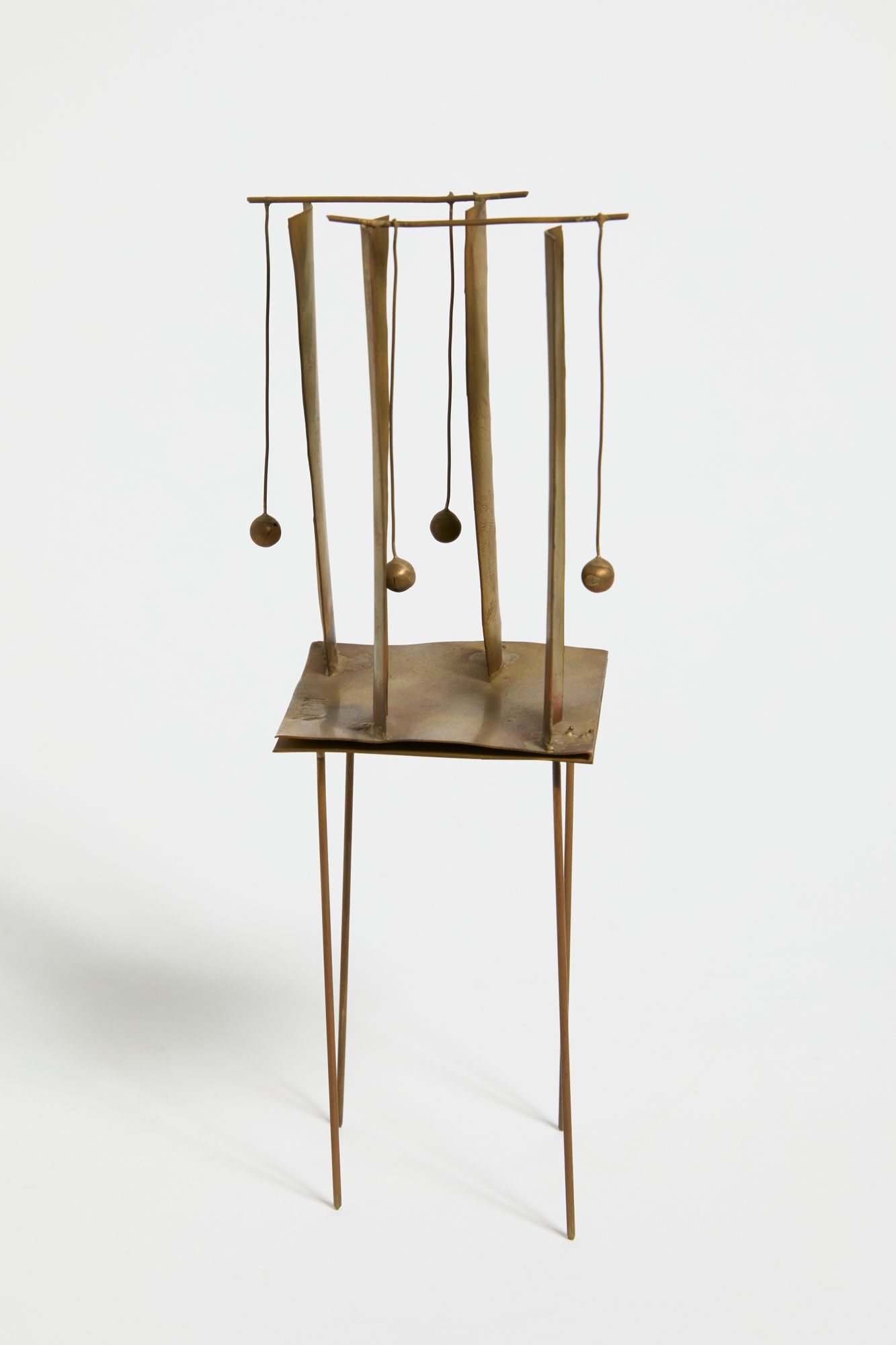
This delicate brass sculpture presents itself as a kind of diminutive ceremonial structure, a miniature monument assembled from slender vertical rods rising from a gently warped square platform elevated on four needle-thin legs. From a horizontal armature at the top, small spheres hang suspended on fine wire or cord, swaying with the suggestion of pendulums frozen mid-motion. The verticality of the piece creates an almost architectural impression, evoking the interior of a temple, a music stand, or perhaps a primitive instrument, yet the whole construction resists any single utilitarian reading. Melotti's characteristic lightness of touch is everywhere apparent, in the slight irregularity of the rods, in the soft buckle of the base plate, in the way the cast brass carries a warm, aged patina that speaks equally of craft and of time. Fausto Melotti occupies a singular position in twentieth-century Italian art, trained as both an engineer and a sculptor, and deeply shaped by his friendship with Lucio Fontana and his early engagement with abstraction in the 1930s. By the early 1970s, when this work was made, Melotti had developed a highly personal idiom built around theatrical fragility, poetic assemblage, and the suspension of weight. His sculptures from this period frequently invoke music, mathematics, and metaphysics simultaneously, translating abstract systems into three-dimensional form with an almost fairy-tale economy of means. The title, which translates roughly as "Small Monument to Nothingness," is quintessentially Melottian in its wry philosophical register, proposing a monument to absence, to the void, to that which cannot be commemorated or contained. For collectors, a work of this scale and character occupies a rare category. Small enough to hold in two hands yet entirely complete as a statement, it demonstrates Melotti at the height of his conceptual and technical maturity. The brass construction has developed the kind of nuanced surface oxidation that only decades of careful existence can produce, and the hanging spheres retain their original movement, a sign of exceptional preservation. Works by Melotti from this period have been the subject of sustained critical reassessment, with major retrospectives and significant acquisitions by European and American institutions confirming his place among the most intellectually rigorous sculptors of the postwar era. This piece is an opportunity to acquire a work that is intimate in scale and inexhaustible in meaning.

Medium
Brass sculpture

🔨 Auction Lot

Martini Studio d'Arte: Modern And Contemporary Art

June 10, 2026

Estimate: €10,000 to €15,000

Lot 83

Start the Discussion

Request access to join the discussion

About this work

Fausto Melotti, Piccolo monumento al nulla, 1972

This delicate brass sculpture presents itself as a kind of diminutive ceremonial structure, a miniature monument assembled from slender vertical rods rising from a gently warped square platform elevated on four needle-thin legs. From a horizontal armature at the top, small spheres hang suspended on fine wire or cord, swaying with the suggestion of pendulums frozen mid-motion. The verticality of the piece creates an almost architectural impression, evoking the interior of a temple, a music stand, or perhaps a primitive instrument, yet the whole construction resists any single utilitarian reading. Melotti's characteristic lightness of touch is everywhere apparent, in the slight irregularity of the rods, in the soft buckle of the base plate, in the way the cast brass carries a warm, aged patina that speaks equally of craft and of time. Fausto Melotti occupies a singular position in twentieth-century Italian art, trained as both an engineer and a sculptor, and deeply shaped by his friendship with Lucio Fontana and his early engagement with abstraction in the 1930s. By the early 1970s, when this work was made, Melotti had developed a highly personal idiom built around theatrical fragility, poetic assemblage, and the suspension of weight. His sculptures from this period frequently invoke music, mathematics, and metaphysics simultaneously, translating abstract systems into three-dimensional form with an almost fairy-tale economy of means. The title, which translates roughly as "Small Monument to Nothingness," is quintessentially Melottian in its wry philosophical register, proposing a monument to absence, to the void, to that which cannot be commemorated or contained. For collectors, a work of this scale and character occupies a rare category. Small enough to hold in two hands yet entirely complete as a statement, it demonstrates Melotti at the height of his conceptual and technical maturity. The brass construction has developed the kind of nuanced surface oxidation that only decades of careful existence can produce, and the hanging spheres retain their original movement, a sign of exceptional preservation. Works by Melotti from this period have been the subject of sustained critical reassessment, with major retrospectives and significant acquisitions by European and American institutions confirming his place among the most intellectually rigorous sculptors of the postwar era. This piece is an opportunity to acquire a work that is intimate in scale and inexhaustible in meaning.

Medium
Brass sculpture
Year
1972
Seen at
Martini Studio d'Arte

Related themes

Figurative Structure, Assemblage, Small Scale, Twentieth Century, Conceptual, Suspended Elements, Architectural Form, Minimalist, Male Artist, Modernist, Sculpture, European Art, Italian Artist, Geometric Abstraction, Patinated Metal, Abstract Sculpture, Kinetic Suggestion, Warm Tones, Poetic Abstraction, Brass

More works by Fausto Melotti