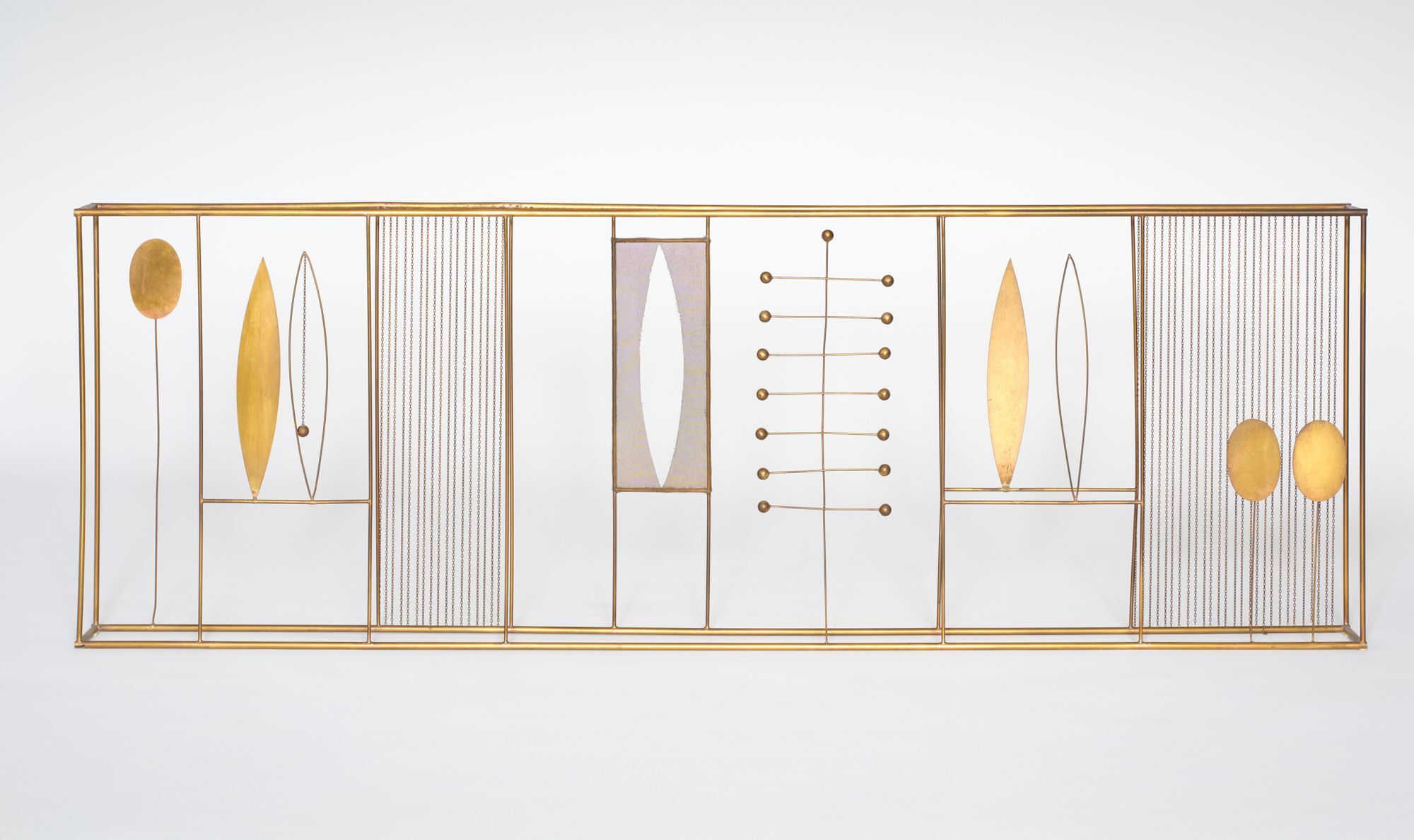
Contrappunto Piano
1973
Contrappunto Piano presents itself as a shallow brass vitrine, its gilded framework enclosing a world of suspended forms that seem to hover between sculpture and musical notation. Across its horizontal expanse, Melotti arranges a vocabulary of recurring motifs, polished ovoid discs, elongated leaf shapes, delicate chain curtains, and branching armatures tipped with small spheres, distributing them across sectioned compartments with the precision and rhythm of a composed score. The surface reads simultaneously as landscape, diagram, and melody, each element given its own interval of negative space so that the eye moves across the work the way attention moves through a passage of music, pausing, accelerating, resolving. The pale lavender panel at the center anchors the composition, offering a moment of chromatic softness against the warm gold that dominates the surrounding registers. Melotti, trained as both an engineer and a musician before dedicating himself to the visual arts, brought an unusually rigorous understanding of counterpoint to his practice. The title is literal in its ambitions: contrappunto, counterpoint, the technique of setting independent melodic lines in productive tension with one another. In Contrappunto Piano the brass elements function as voices, related but distinct, never competing for the same register. The chain curtains introduce a quality of transparency and vibration reminiscent of tremolo, while the branching sphere forms suggest notation systems or the structural diagrams of a score laid open on a stand. The result is a work that rewards sustained looking precisely because it refuses a single focal resolution, always offering another relationship to discover. Works from Melotti's mature period of the 1970s represent the fullest expression of his long investigation into lightness and immateriality in sculptural form, and pieces of this scale and complexity appear with relative rarity on the international market. Contrappunto Piano is an exceptional example of his capacity to make brass, an inherently weighty and reflective material, behave with the airy intelligence of a chamber composition. Its condition is commensurate with its importance, and its dimensions make it adaptable to a range of architectural contexts, functioning equally well as a freestanding object or as a work mounted for contemplation against a wall. For collectors with an interest in post-war Italian art or the intersection of music and visual form, this work represents a significant opportunity.
- Medium
- Brass sculpture
🔨 Auction Lot
Martini Studio d'Arte: Modern And Contemporary Art
June 10, 2026
Estimate: €40,000 to €50,000
Lot 82
More by Fausto Melotti
Start the Discussion
Request access to join the discussion