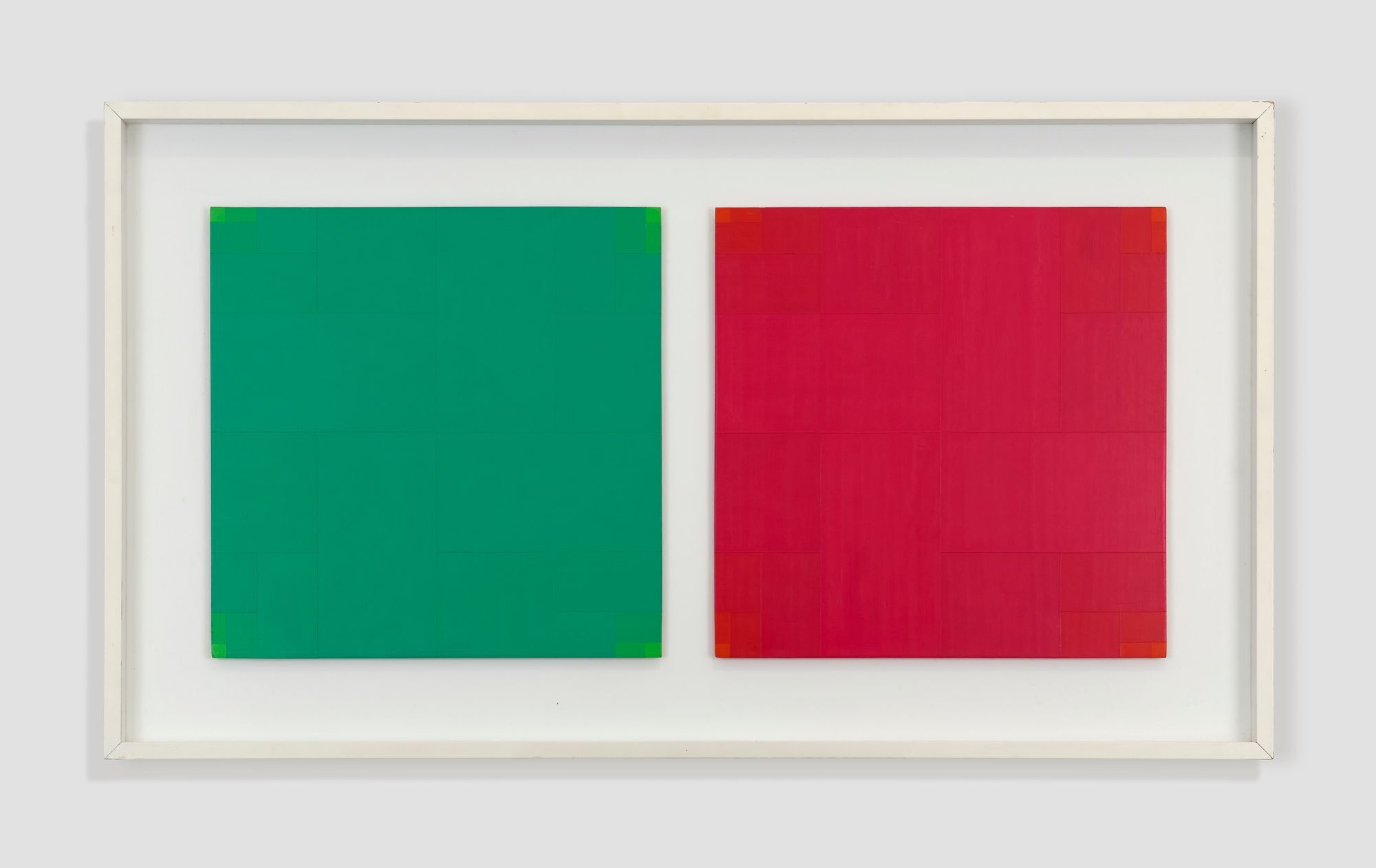
Op. 392 + 393 B/H
1971
Comprising two equal squares presented side by side within a single white frame, this 1971 diptych exemplifies Tornquist's sustained investigation into chromatic interaction and perceptual phenomena. The left panel presents a field of saturated emerald green, its surface appearing remarkably unified at first glance, while closer inspection reveals a subtle grid structure formed by the overlapping of translucent acrylic layers. The right panel offers its complement in a deep, luminous red, where the underlying grid becomes far more legible, the intersecting bands producing visible shifts in tone and saturation that animate the surface without resorting to illusionistic depth. Each corner of both panels betrays a concentrated flash of pure pigment, a structural disclosure that reveals the logic of the layering system beneath the seemingly monolithic color fields. Tornquist, born in Graz in 1938 and deeply influenced by his studies under Josef Albers at Yale, devoted his practice to the systematic exploration of how colors modify one another through proximity, layering, and optical mixture. Op. 392 + 393 B/H belongs to a body of work produced in the early 1970s that reflects his engagement with the theories of Goethe and Itten alongside the rigorous formal methodology of the Bauhaus tradition. The pairing of green and red, colors that sit in direct complementary opposition on the color wheel, is not merely a decorative choice but a deliberate provocation of the viewer's perceptual apparatus. The eye, moving between the two panels, experiences an afterimage effect that intensifies the apparent vibrancy of each color, a phenomenon that Tornquist understood as a kind of visual dialogue rather than a static condition. Works from this period represent some of the most focused and intellectually coherent output of Tornquist's long career, predating his later theoretical publications on color and light that would cement his international reputation. The diptych format itself carries conceptual weight, insisting on relationship and comparison as the primary mode of engagement. Presented in its original white frame, Op. 392 + 393 B/H retains the crisp, laboratory-like quality that distinguished Tornquist's approach from the more gestural tendencies of his contemporaries, offering collectors a work that rewards sustained looking and holds equal appeal for those drawn to Op Art, color theory, and the Italian Arte Programmata milieu in which he worked during this period.
- Medium
- Diptych, acrylic liquitex on board
🔨 Auction Lot
Martini Studio d'Arte: Modern And Contemporary Art
June 10, 2026
Estimate: €3,000 to €4,000
Lot 185
More by Jorrit Tornquist
Start the Discussion
Request access to join the discussion