Join The Collection to save, track, and explore works like this.

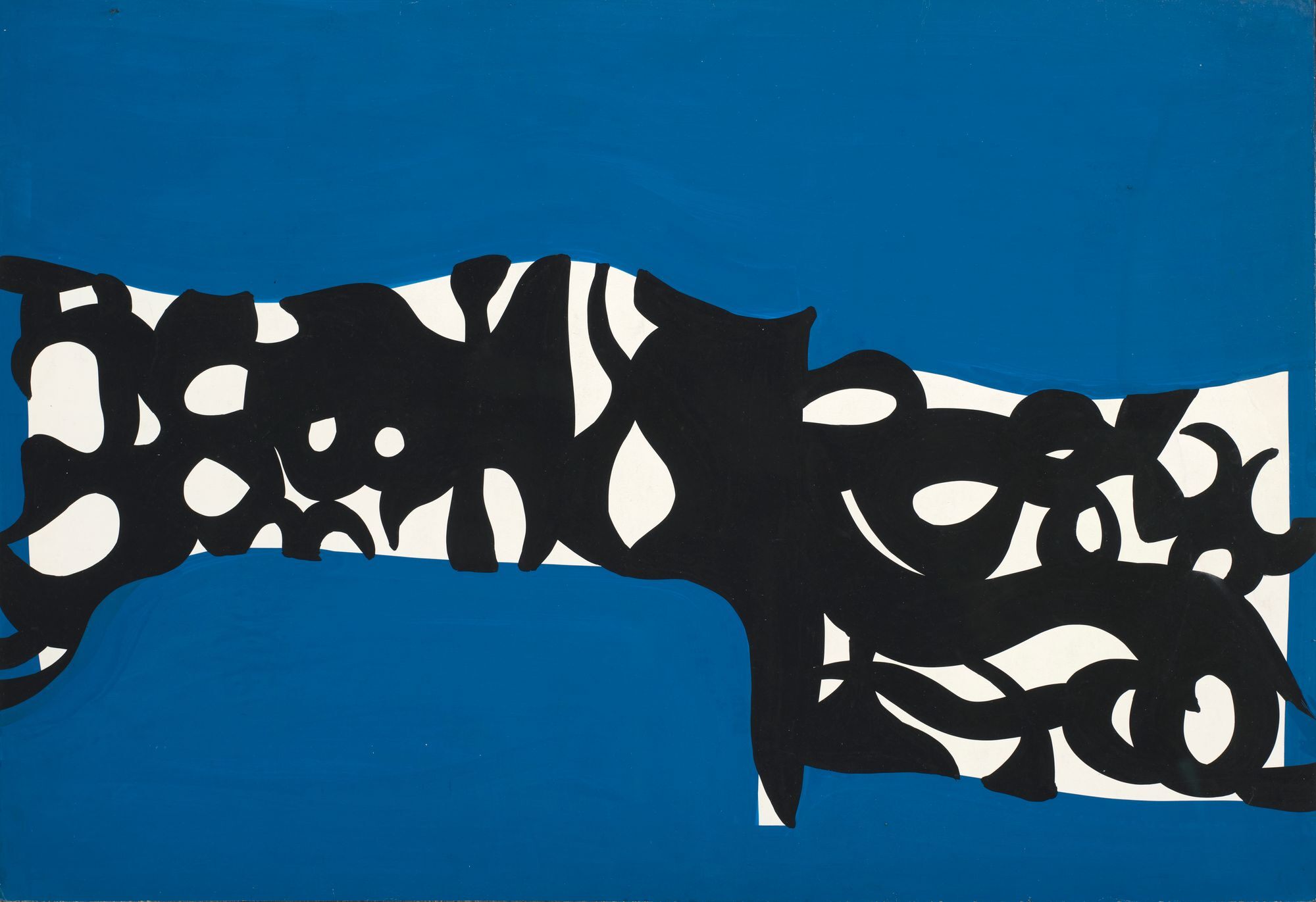
Carla Accardi — Bianconero su turchese
Carla Accardi

Bianconero su turchese

1960

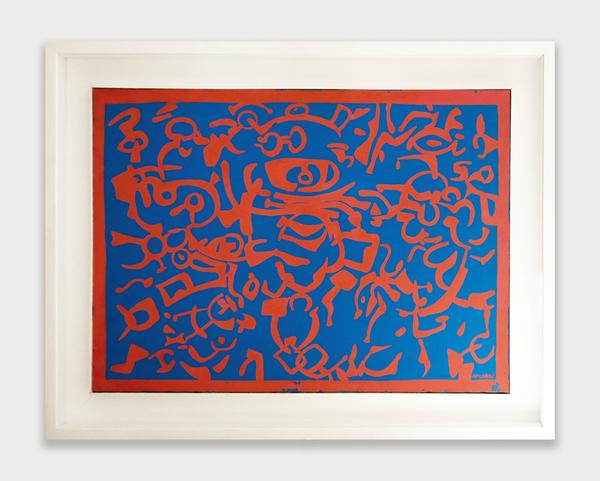
Bianconero su turchese presents a horizontal band of interlocking black and white forms that cuts across a field of saturated turquoise, appearing simultaneously as a creature in motion and a sequence of interwoven signs. The black forms coil and branch against a white ground that has been subsumed within them, creating a visual tension between figure and field that refuses easy resolution. Accardi's marks carry the energy of gestural abstraction while maintaining a precision that aligns them with the sign-based thinking she had been developing since the early 1950s. The composition neither begins nor fully ends at the canvas edge, suggesting a continuity beyond the picture plane, as though the viewer has encountered a fragment of an endlessly unfolding visual language. This work belongs to a pivotal period in Accardi's career, when she was moving away from the raw, informal mark-making of her earliest abstractions toward a more deliberate investigation of sign, repetition, and visual rhythm. Having co-founded the Italian avant-garde group Forma 1 in 1947, she spent the subsequent decade testing the boundaries between painting and writing, between image and script. By 1960, her marks had grown more architecturally complex, bundling together into dense passages that reward sustained looking. The choice of casein tempera on light cardboard applied to canvas reflects her ongoing interest in surface materiality, the matte opacity of the medium giving the blacks a velvety depth that contrasts with the luminous turquoise ground. For collectors, the work represents an important example of Italian postwar abstraction at a moment of genuine formal ambition. Accardi's international reputation has grown substantially in recent decades, with major retrospectives and prominent institutional holdings affirming her significance within the broader narrative of European modernism. Bianconero su turchese is a compact and concentrated statement of her visual intelligence, modest in scale yet commanding in presence. The three-color economy, turquoise, black, and white, achieves a graphic clarity that anticipates later developments in both Conceptual art and pattern-based abstraction, positioning this work as both historically rooted and persistently contemporary in its appeal.

Medium
Casein tempera on light cardboard applied on canvas

🔨 Auction Lot

Martini Studio d'Arte: Modern And Contemporary Art

June 10, 2026

Estimate: €40,000 to €50,000

Lot 71
Start the Discussion

Request access to join the discussion

Spotted works by Carla Accardi

About this work

Carla Accardi, Bianconero su turchese, 1960

Bianconero su turchese presents a horizontal band of interlocking black and white forms that cuts across a field of saturated turquoise, appearing simultaneously as a creature in motion and a sequence of interwoven signs. The black forms coil and branch against a white ground that has been subsumed within them, creating a visual tension between figure and field that refuses easy resolution. Accardi's marks carry the energy of gestural abstraction while maintaining a precision that aligns them with the sign-based thinking she had been developing since the early 1950s. The composition neither begins nor fully ends at the canvas edge, suggesting a continuity beyond the picture plane, as though the viewer has encountered a fragment of an endlessly unfolding visual language. This work belongs to a pivotal period in Accardi's career, when she was moving away from the raw, informal mark-making of her earliest abstractions toward a more deliberate investigation of sign, repetition, and visual rhythm. Having co-founded the Italian avant-garde group Forma 1 in 1947, she spent the subsequent decade testing the boundaries between painting and writing, between image and script. By 1960, her marks had grown more architecturally complex, bundling together into dense passages that reward sustained looking. The choice of casein tempera on light cardboard applied to canvas reflects her ongoing interest in surface materiality, the matte opacity of the medium giving the blacks a velvety depth that contrasts with the luminous turquoise ground. For collectors, the work represents an important example of Italian postwar abstraction at a moment of genuine formal ambition. Accardi's international reputation has grown substantially in recent decades, with major retrospectives and prominent institutional holdings affirming her significance within the broader narrative of European modernism. Bianconero su turchese is a compact and concentrated statement of her visual intelligence, modest in scale yet commanding in presence. The three-color economy, turquoise, black, and white, achieves a graphic clarity that anticipates later developments in both Conceptual art and pattern-based abstraction, positioning this work as both historically rooted and persistently contemporary in its appeal.

Medium
Casein tempera on light cardboard applied on canvas
Year
1960
Seen at
Martini Studio d'Arte

Related themes

Abstract Art, Bold Color, Modernist, Mid Century, Writing And Image, Casein Tempera, Mixed Media, Avant-Garde, Pattern And Repetition, Black And White, Gestural Abstraction, Geometric Abstraction, Italian, European, Turquoise, Sign Based, Figure Ground, Female Artist, Postwar, Works on Canvas, Horizontal Format, Visual Rhythm

More works by Carla Accardi

Collected by

Joshua Cohen