Join The Collection to save, track, and explore works like this.

Gregorio Vardánega — Couleurs en diffusion
Gregorio Vardánega

Couleurs en diffusion

1969

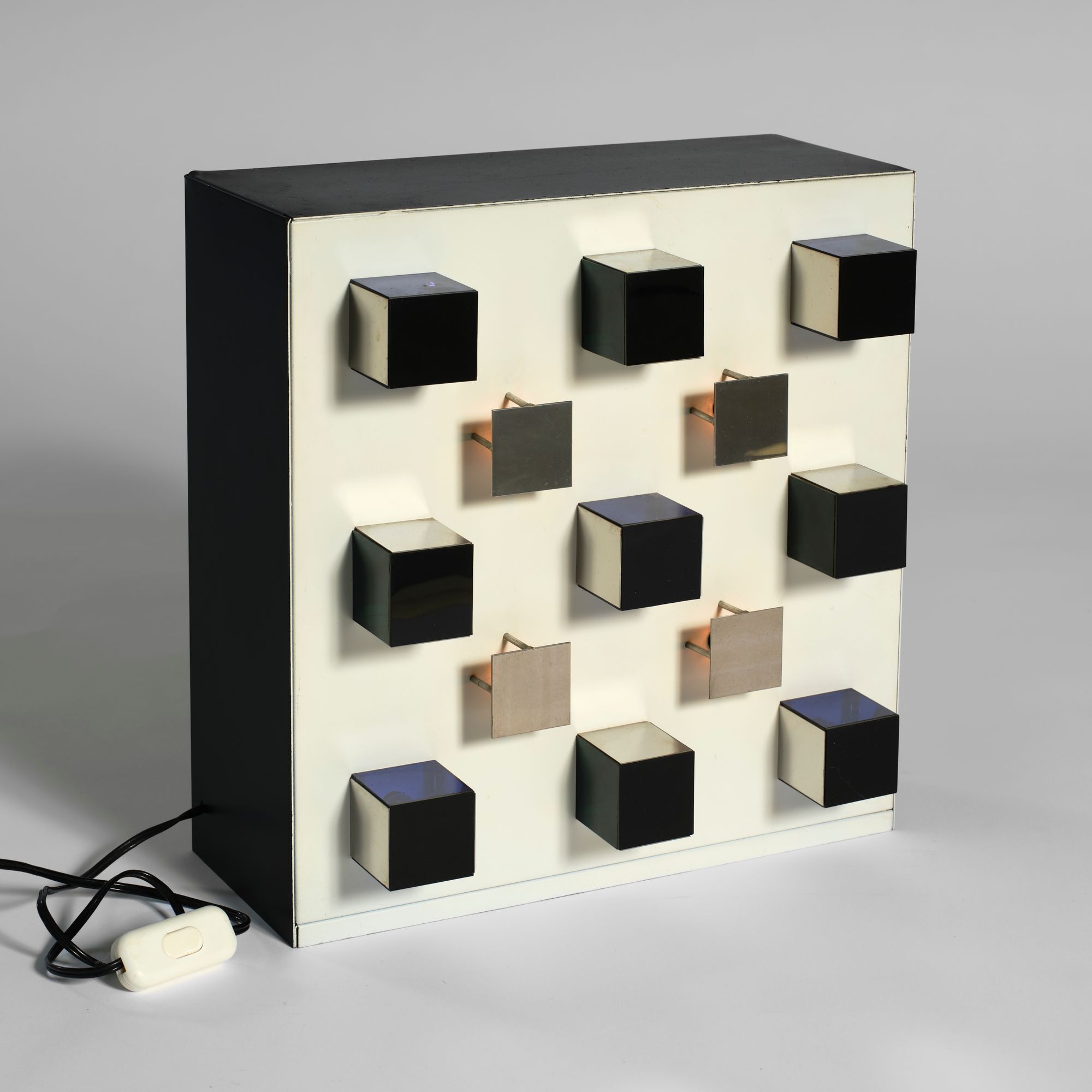
Couleurs en diffusion presents a white lacquered metal box from which sixteen smaller cubes protrude in an irregular grid, their black-painted faces oriented at varying angles to catch and deflect the warm light emanating from within the structure. Vardánega engineered the piece so that the cubes rotate slightly on their mounts, meaning no two viewings are precisely alike, and the interplay between shadow, reflection, and colored light shifts continuously as the observer moves around the sculpture. The electrical system, visible through the gaps between protruding elements, bathes certain cubes in amber and blue tones, creating the sensation that the work breathes and pulses rather than remaining static. At just 34 by 33 by 17.5 centimeters, the sculpture is intimate in scale yet generates a visual complexity far exceeding its modest dimensions. Vardánega, born in Argentina in 1923 and deeply embedded in the kinetic and optical art movements that flourished in Paris during the 1960s, was preoccupied throughout his career with the dematerialization of form through light and movement. He was closely associated with the Groupe de Recherche d'Art Visuel, sharing with Victor Vasarely, Julio Le Parc, and François Morellet a conviction that art should engage the perceptual system rather than simply represent the world. Couleurs en diffusion, completed in 1969, sits at the height of this movement, when artists across Europe and Latin America were interrogating the boundaries between sculpture, environment, and sensory experience. The use of PVC alongside metal gives the work a deliberately industrial quality, aligning it with the broader interest in manufactured materials that defined the period. For collectors, this work represents a rare convergence of historical significance and aesthetic immediacy. Kinetic and lumino-kinetic works from this period have been subject to sustained institutional and market attention, with major retrospectives and acquisitions at the Centre Pompidou, the Museum of Kinetic Art in Geneva, and leading private collections worldwide. Vardánega's works in particular are held in relatively limited numbers in private hands, making available examples genuinely consequential. The piece retains its original electrical cord and in-line switch, a period-specific detail that contributes to its authenticity and documentary value. Couleurs en diffusion functions equally as a historical artifact of postwar experimental practice and as a compelling, lively object for the contemporary interior.

Medium
Metal sculpture and PVC, luminous electrical system

🔨 Auction Lot

Martini Studio d'Arte: Modern And Contemporary Art

June 10, 2026

Estimate: €3,000 to €4,000

Lot 16

Start the Discussion

Request access to join the discussion

About this work

Gregorio Vardánega, Couleurs en diffusion, 1969

Couleurs en diffusion presents a white lacquered metal box from which sixteen smaller cubes protrude in an irregular grid, their black-painted faces oriented at varying angles to catch and deflect the warm light emanating from within the structure. Vardánega engineered the piece so that the cubes rotate slightly on their mounts, meaning no two viewings are precisely alike, and the interplay between shadow, reflection, and colored light shifts continuously as the observer moves around the sculpture. The electrical system, visible through the gaps between protruding elements, bathes certain cubes in amber and blue tones, creating the sensation that the work breathes and pulses rather than remaining static. At just 34 by 33 by 17.5 centimeters, the sculpture is intimate in scale yet generates a visual complexity far exceeding its modest dimensions. Vardánega, born in Argentina in 1923 and deeply embedded in the kinetic and optical art movements that flourished in Paris during the 1960s, was preoccupied throughout his career with the dematerialization of form through light and movement. He was closely associated with the Groupe de Recherche d'Art Visuel, sharing with Victor Vasarely, Julio Le Parc, and François Morellet a conviction that art should engage the perceptual system rather than simply represent the world. Couleurs en diffusion, completed in 1969, sits at the height of this movement, when artists across Europe and Latin America were interrogating the boundaries between sculpture, environment, and sensory experience. The use of PVC alongside metal gives the work a deliberately industrial quality, aligning it with the broader interest in manufactured materials that defined the period. For collectors, this work represents a rare convergence of historical significance and aesthetic immediacy. Kinetic and lumino-kinetic works from this period have been subject to sustained institutional and market attention, with major retrospectives and acquisitions at the Centre Pompidou, the Museum of Kinetic Art in Geneva, and leading private collections worldwide. Vardánega's works in particular are held in relatively limited numbers in private hands, making available examples genuinely consequential. The piece retains its original electrical cord and in-line switch, a period-specific detail that contributes to its authenticity and documentary value. Couleurs en diffusion functions equally as a historical artifact of postwar experimental practice and as a compelling, lively object for the contemporary interior.

Medium
Metal sculpture and PVC, luminous electrical system
Year
1969
Seen at
Martini Studio d'Arte

Related themes

Abstract Art, Argentine Artist, Avant Garde, Small Scale, Amber Tones, Latin American, Kinetic Art, Male Artist, Modernist, Sculpture, Mixed Media, Light and Space, Industrial Materials, Op Art, Black And White, Geometric Abstraction, Perceptual Art, Moving Parts, Paris School, Illuminated Sculpture