Join The Collection to save, track, and explore works like this.

Achille Perilli — Untitled
Achille Perilli

Untitled

1953

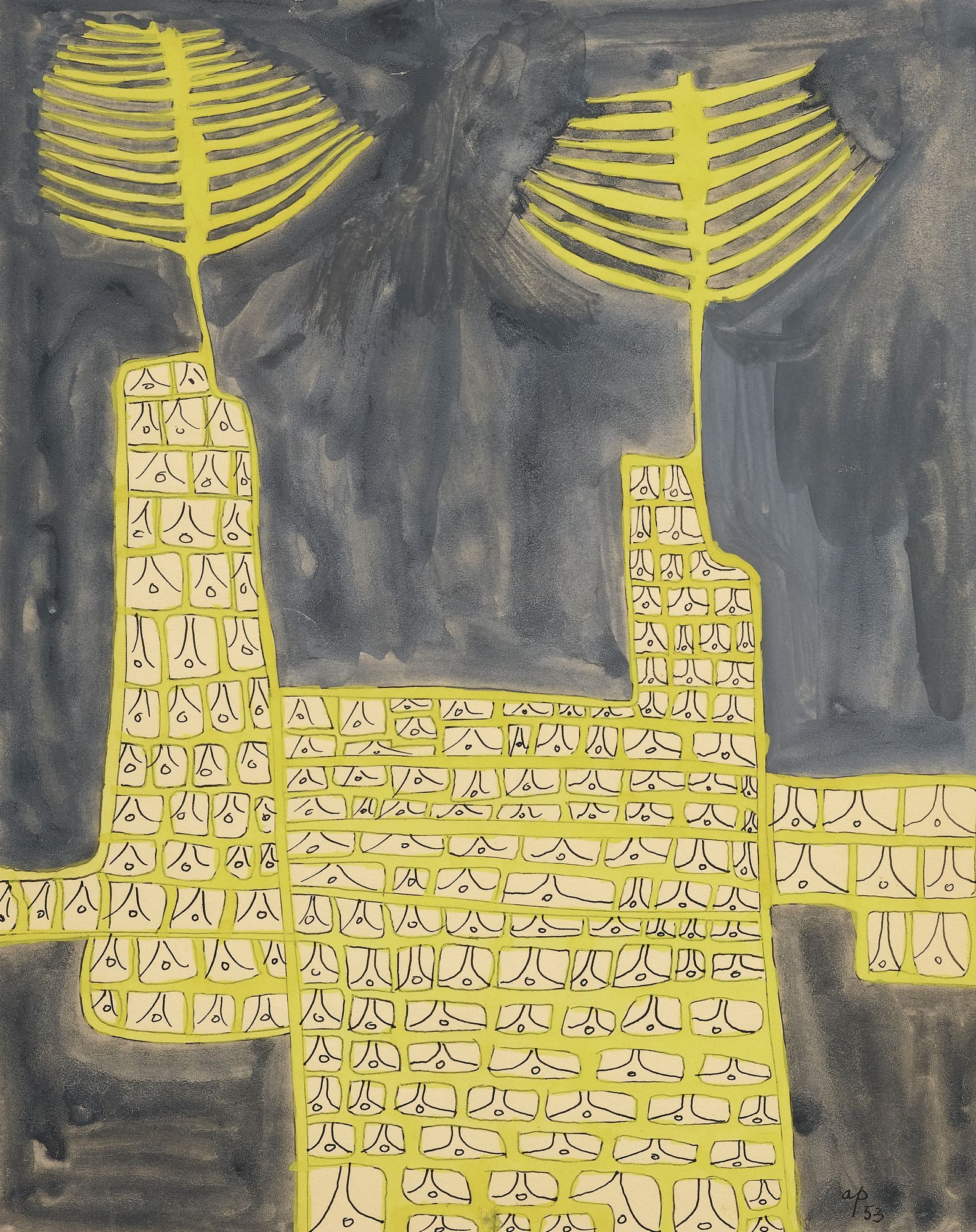
This intimate work on paper from 1953 presents a boldly graphic composition in which two tree-like or skeletal forms rise against a brooding gray ground, their yellow-green outlines describing a rhythmic, architectural structure that dominates the picture plane. The lower portion of the composition unfolds as an irregular cross or stepped field, its interior subdivided into a honeycomb of cells, each containing a small biomorphic mark that reads simultaneously as a seed, a glyph, or a cellular organism. The repeated unit, drawn in fluid black ink, gives the surface a quietly insistent pulse, somewhere between a written language and a natural system, suggesting that Perilli was already pursuing the synthesis between sign, structure, and biological form that would define his mature practice. Achille Perilli was a founding member of the Roman avant-garde group Forma 1, established in 1947, and this work sits at a compelling transitional moment in his development, after the group's early commitment to geometric abstraction and before his later experiments with what he called "irrational geometry." The tension in this piece between organic improvisation and structural repetition reflects that productive uncertainty. The yellow-green contour lines, applied in tempera with deliberate directness, impose an almost architectural order, while the hand-drawn marks within each cell retain an entirely human spontaneity. The gray ground, worked with broad, atmospheric brushstrokes, holds the composition in a nocturnal or stormy light that adds emotional weight to what might otherwise read as a purely formal exercise. Works on paper from this early period of Perilli's career are relatively scarce in the market, and this signed and dated example offers an unusually clear window into the artist's thinking at a formative moment in Italian postwar abstraction. The modest dimensions intensify rather than diminish the work's presence, concentrating its formal invention into a format that rewards sustained close looking. The piece relates meaningfully to contemporaneous developments in Art Informel and the broader European postwar tendency to seek new pictorial languages beyond both figuration and rigid geometry, while remaining distinctly personal in its imagery. For collectors with an interest in Italian modernism, works on paper, or the genealogy of European abstraction, this is a work of genuine historical and aesthetic significance.

Medium
Ink and tempera on paper

🔨 Auction Lot

Martini Studio d'Arte: Modern And Contemporary Art

June 10, 2026

Estimate: €1,000 to €2,000

Lot 175

Start the Discussion

Request access to join the discussion

More by Achille Perilli

About this work

Achille Perilli, Untitled, 1953

This intimate work on paper from 1953 presents a boldly graphic composition in which two tree-like or skeletal forms rise against a brooding gray ground, their yellow-green outlines describing a rhythmic, architectural structure that dominates the picture plane. The lower portion of the composition unfolds as an irregular cross or stepped field, its interior subdivided into a honeycomb of cells, each containing a small biomorphic mark that reads simultaneously as a seed, a glyph, or a cellular organism. The repeated unit, drawn in fluid black ink, gives the surface a quietly insistent pulse, somewhere between a written language and a natural system, suggesting that Perilli was already pursuing the synthesis between sign, structure, and biological form that would define his mature practice. Achille Perilli was a founding member of the Roman avant-garde group Forma 1, established in 1947, and this work sits at a compelling transitional moment in his development, after the group's early commitment to geometric abstraction and before his later experiments with what he called "irrational geometry." The tension in this piece between organic improvisation and structural repetition reflects that productive uncertainty. The yellow-green contour lines, applied in tempera with deliberate directness, impose an almost architectural order, while the hand-drawn marks within each cell retain an entirely human spontaneity. The gray ground, worked with broad, atmospheric brushstrokes, holds the composition in a nocturnal or stormy light that adds emotional weight to what might otherwise read as a purely formal exercise. Works on paper from this early period of Perilli's career are relatively scarce in the market, and this signed and dated example offers an unusually clear window into the artist's thinking at a formative moment in Italian postwar abstraction. The modest dimensions intensify rather than diminish the work's presence, concentrating its formal invention into a format that rewards sustained close looking. The piece relates meaningfully to contemporaneous developments in Art Informel and the broader European postwar tendency to seek new pictorial languages beyond both figuration and rigid geometry, while remaining distinctly personal in its imagery. For collectors with an interest in Italian modernism, works on paper, or the genealogy of European abstraction, this is a work of genuine historical and aesthetic significance.

Medium
Ink and tempera on paper
Year
1953
Seen at
Martini Studio d'Arte

Related themes

Abstract Art, Avant Garde, Small Scale, Organic Abstraction, Mid Century Modern, Figurative Abstraction, Tempera, Structural Composition, Male Artist, Modernist, Yellow Green, Pattern And Repetition, Gray Tones, Italian Artist, Sign And Symbol, Black And White, Geometric Abstraction, Works On Paper, Biomorphic Forms, Ink Drawing, Postwar European

More works by Achille Perilli