Join The Collection to save, track, and explore works like this.

Lucio Fontana — Nudo femminile
Lucio Fontana

Nudo femminile

1962

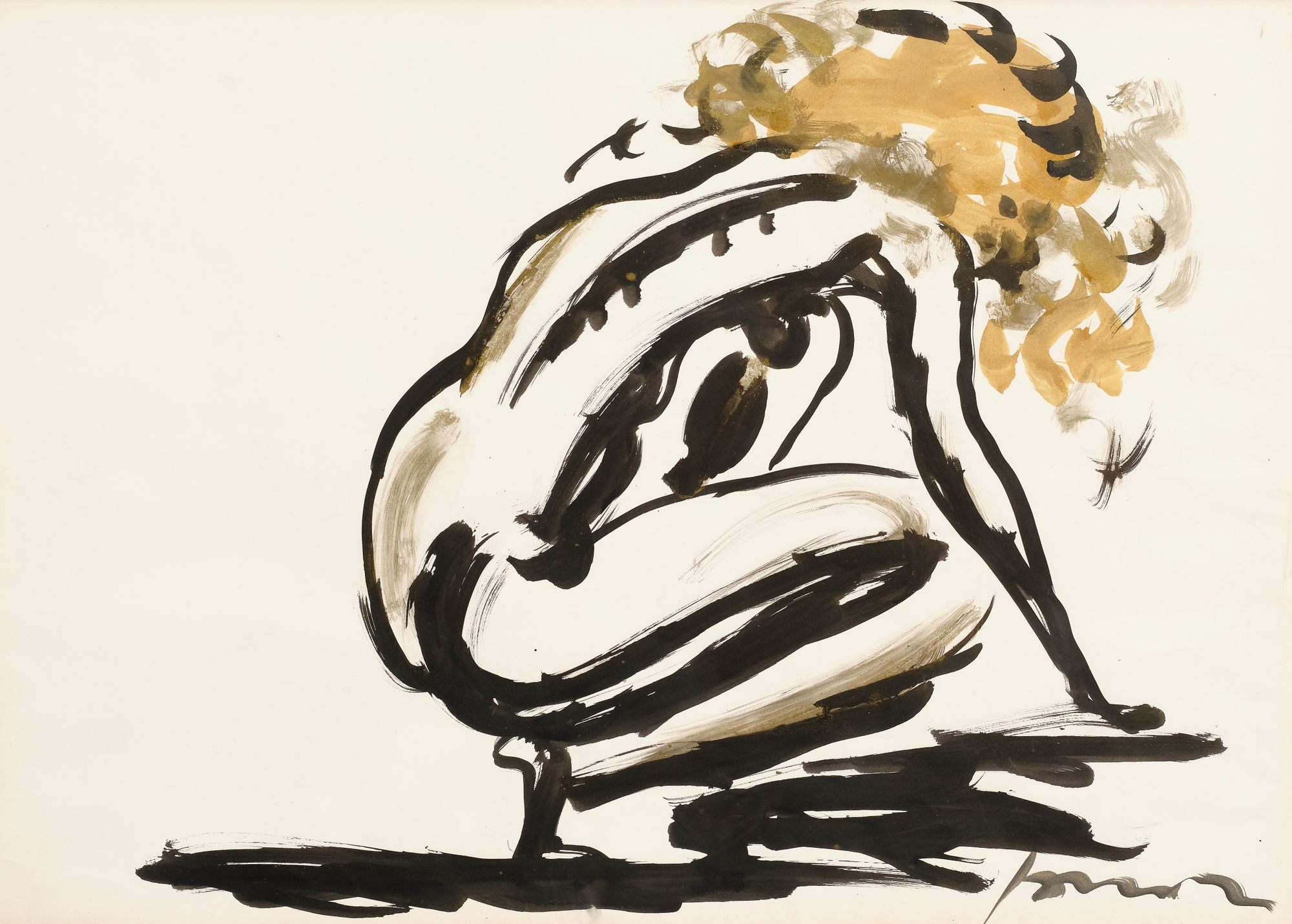
Executed in sweeping strokes of China ink against an unprimed white ground, this dynamic work on paper from 1962 captures the human figure in a state of contemplative repose. Fontana deploys a vocabulary of bold, gestural lines that coil and arc across the sheet, suggesting the rounded volumes of a reclining female form with remarkable economy of means. The composition is anchored by dense black passages that dissolve into shadow at the lower register, while loose washes of golden and ochre yellow animate the figure's crown of hair, introducing warmth and chromatic contrast against the stark monochrome of the ink lines. The result is a work that hovers productively between representation and abstraction, inviting the viewer to complete what the artist has so deliberately left open. The work belongs to a sustained body of figurative drawings that occupied Fontana throughout his career, running parallel to and in dialogue with his more celebrated Concetti Spaziali, the cut and punctured canvases for which he is internationally renowned. In these works on paper, Fontana allowed himself a freedom of improvisation fully consistent with his Spatialist philosophy, in which the act of making, rather than the finished object, carries primary significance. The figure is not described so much as evoked, conjured through a sequence of marks that betray both confidence and spontaneity. The brushwork carries visible momentum, each stroke arriving with the directness of a calligraphic gesture, referencing simultaneously the traditions of European figuration and the influence of East Asian ink painting that circulated widely in postwar Italian artistic culture. At seventy by one hundred centimeters, the sheet commands a physical presence that amplifies the energy contained within it. Dated to 1962, a period of remarkable productivity for the artist, the work reflects Fontana at the height of his powers, moving fluidly between mediums and scales with characteristic assurance. Works of this nature represent an important dimension of the artist's practice that has attracted increasing critical and market attention, as scholars and collectors seek a more complete understanding of an oeuvre that cannot be reduced to any single series or signature gesture. The sheet bears what appears to be a partially legible signature in the lower right corner, consistent with the artist's customary practice of signing works on paper informally during this period.

Medium
China ink, black, yellow and golden on paper

🔨 Auction Lot

Martini Studio d'Arte: Modern And Contemporary Art

June 10, 2026

Estimate: €15,000 to €25,000

Lot 96
Start the Discussion

Request access to join the discussion

About this work

Lucio Fontana, Nudo femminile, 1962

Executed in sweeping strokes of China ink against an unprimed white ground, this dynamic work on paper from 1962 captures the human figure in a state of contemplative repose. Fontana deploys a vocabulary of bold, gestural lines that coil and arc across the sheet, suggesting the rounded volumes of a reclining female form with remarkable economy of means. The composition is anchored by dense black passages that dissolve into shadow at the lower register, while loose washes of golden and ochre yellow animate the figure's crown of hair, introducing warmth and chromatic contrast against the stark monochrome of the ink lines. The result is a work that hovers productively between representation and abstraction, inviting the viewer to complete what the artist has so deliberately left open. The work belongs to a sustained body of figurative drawings that occupied Fontana throughout his career, running parallel to and in dialogue with his more celebrated Concetti Spaziali, the cut and punctured canvases for which he is internationally renowned. In these works on paper, Fontana allowed himself a freedom of improvisation fully consistent with his Spatialist philosophy, in which the act of making, rather than the finished object, carries primary significance. The figure is not described so much as evoked, conjured through a sequence of marks that betray both confidence and spontaneity. The brushwork carries visible momentum, each stroke arriving with the directness of a calligraphic gesture, referencing simultaneously the traditions of European figuration and the influence of East Asian ink painting that circulated widely in postwar Italian artistic culture. At seventy by one hundred centimeters, the sheet commands a physical presence that amplifies the energy contained within it. Dated to 1962, a period of remarkable productivity for the artist, the work reflects Fontana at the height of his powers, moving fluidly between mediums and scales with characteristic assurance. Works of this nature represent an important dimension of the artist's practice that has attracted increasing critical and market attention, as scholars and collectors seek a more complete understanding of an oeuvre that cannot be reduced to any single series or signature gesture. The sheet bears what appears to be a partially legible signature in the lower right corner, consistent with the artist's customary practice of signing works on paper informally during this period.

Medium
China ink, black, yellow and golden on paper
Year
1962
Seen at
Martini Studio d'Arte

Related themes

Ochre And Gold, Argentine Italian, Figure Study, Mid Century Modern, Figurative Abstract, Contemplative, Reclining Figure, Modernist, Expressive Line, Black And White, Calligraphic Mark, Nude Figure, Abstract Figurative, Human Form, Works On Paper, Female Artist, Spatialist, Drawing, Warm Tones, Ink Drawing, Gestural Drawing

More works by Lucio Fontana

Collected by

Sebastián In Situ, Sebastián Naranjo, Alex Capecelatro