Join The Collection to save, track, and explore works like this.

Gabriele De Vecchi — URMNT
Gabriele De Vecchi

URMNT

1962

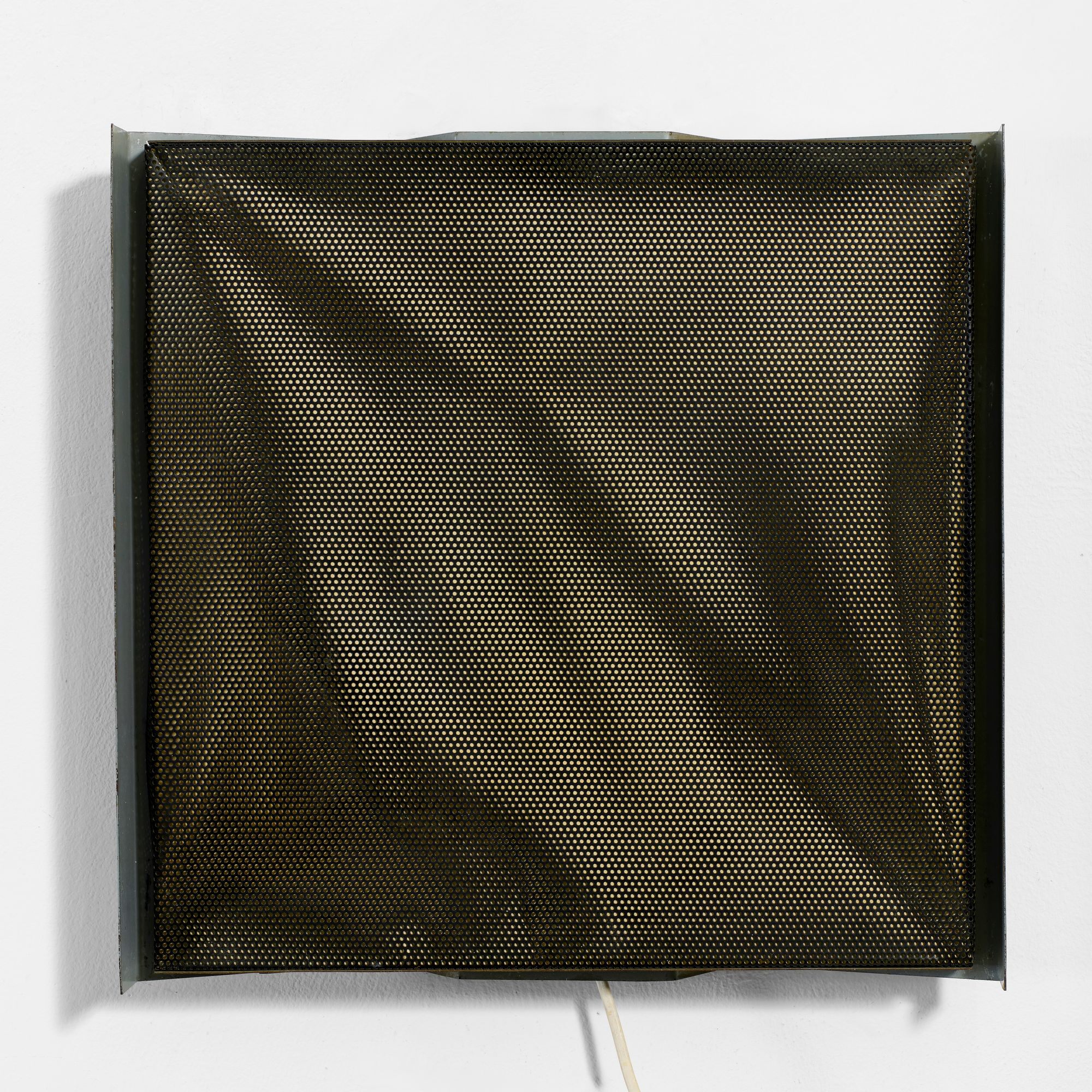
This wall-mounted kinetic relief by Gabriele De Vecchi presents a square field of perforated metal sheet contained within a shallow painted steel housing, from which a single cord descends to signal the presence of a concealed motor within. When activated, the engine sets the perforated surface into subtle motion, producing shifting moiré patterns as the regular grid of punctures moves against the fixed geometry of its frame. The interplay between light passing through the holes and the slight undulation of the metal creates an optical experience that is never twice the same, transforming an industrially produced material into an instrument of perceptual uncertainty. The darkened, oxidized tone of the metal surface absorbs and redistributes ambient light, lending the work a restrained visual weight that belies its quiet animation. De Vecchi was a founding member of the Gruppo T collective, established in Milan in 1959 alongside Giovanni Anceschi, Davide Boriani, Gianni Colombo, and later Grazia Varisco. The group advanced a rigorous investigation of time, movement, and viewer perception as constitutive elements of the artwork, situating their practice within the broader international discourse of kinetic and programmatic art that included contemporaries such as Gruppo N in Padua and the artists associated with the Centre de Recherche d'Art Visuel in Paris. URMNT, completed in 1962, belongs to a critical early phase of this research, when De Vecchi was most intensely focused on mechanical motion as a means of destabilizing the static, object-bound conventions of painting and sculpture. For collectors, the work occupies an important position within the history of Italian kinetic art and the postwar legacy of Neo-Constructivism. Its compact dimensions and self-contained wall-mounted format make it highly suitable for domestic or institutional display, and the mechanized component reflects a period commitment to integrating industrial production into fine art practice without sacrificing formal precision or material sophistication. Works from this early period of Gruppo T activity are increasingly recognized by major museums and auction institutions as foundational to any serious account of kinetic and op art in the 1960s, and examples in strong condition with functioning motors represent a comparatively rare opportunity to acquire a work that performs as fully as it reads historically.

Medium
Metal, perforated sheet, engine

🔨 Auction Lot

Martini Studio d'Arte: Modern And Contemporary Art

June 10, 2026

Estimate: €4,000 to €5,000

Lot 10

Start the Discussion

Request access to join the discussion

About this work

Gabriele De Vecchi, URMNT, 1962

This wall-mounted kinetic relief by Gabriele De Vecchi presents a square field of perforated metal sheet contained within a shallow painted steel housing, from which a single cord descends to signal the presence of a concealed motor within. When activated, the engine sets the perforated surface into subtle motion, producing shifting moiré patterns as the regular grid of punctures moves against the fixed geometry of its frame. The interplay between light passing through the holes and the slight undulation of the metal creates an optical experience that is never twice the same, transforming an industrially produced material into an instrument of perceptual uncertainty. The darkened, oxidized tone of the metal surface absorbs and redistributes ambient light, lending the work a restrained visual weight that belies its quiet animation. De Vecchi was a founding member of the Gruppo T collective, established in Milan in 1959 alongside Giovanni Anceschi, Davide Boriani, Gianni Colombo, and later Grazia Varisco. The group advanced a rigorous investigation of time, movement, and viewer perception as constitutive elements of the artwork, situating their practice within the broader international discourse of kinetic and programmatic art that included contemporaries such as Gruppo N in Padua and the artists associated with the Centre de Recherche d'Art Visuel in Paris. URMNT, completed in 1962, belongs to a critical early phase of this research, when De Vecchi was most intensely focused on mechanical motion as a means of destabilizing the static, object-bound conventions of painting and sculpture. For collectors, the work occupies an important position within the history of Italian kinetic art and the postwar legacy of Neo-Constructivism. Its compact dimensions and self-contained wall-mounted format make it highly suitable for domestic or institutional display, and the mechanized component reflects a period commitment to integrating industrial production into fine art practice without sacrificing formal precision or material sophistication. Works from this early period of Gruppo T activity are increasingly recognized by major museums and auction institutions as foundational to any serious account of kinetic and op art in the 1960s, and examples in strong condition with functioning motors represent a comparatively rare opportunity to acquire a work that performs as fully as it reads historically.

Medium
Metal, perforated sheet, engine
Year
1962
Seen at
Martini Studio d'Arte

Related themes

Geometric, Relief, Kinetic Art, Male Artist, Modernist, Mid Century, Motorized Sculpture, European Art, Industrial Materials, Op Art, Italian Artist, Perceptual Art, Programmatic Art, Optical Illusion, Wall Mounted, Monochromatic, Light and Shadow, Metal Sculpture, Abstract, Collectible Sculpture