Join The Collection to save, track, and explore works like this.

Luigi Veronesi — Triangolo giallo
Luigi Veronesi

Triangolo giallo

1951

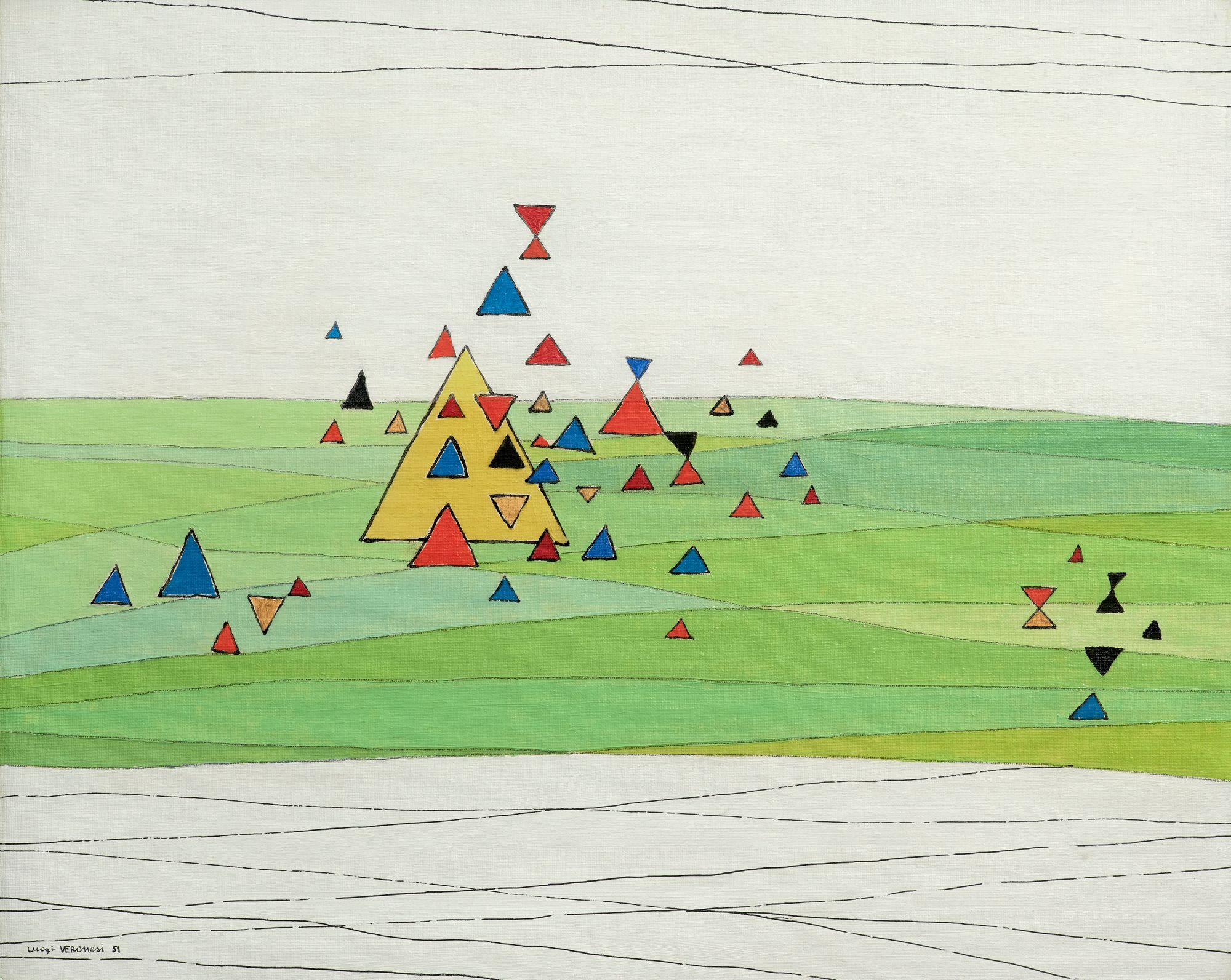
Triangolo giallo presents a gently undulating green landscape populated by a constellation of small triangles in red, blue, black, and ochre, all orbiting a commanding central form rendered in luminous yellow. The triangles point upward and downward, suggesting both rootedness and flight, stability and dispersal. Some cluster near the dominant yellow triangle, as if drawn by gravitational pull, while others drift freely into the pale sky above, untethered from the terrain below. Fine wavy lines articulate the foreground and upper register, evoking water, horizon, or the invisible frequencies that Luigi Veronesi spent much of his career visualizing through abstraction. Veronesi occupied a singular position in twentieth-century Italian modernism, moving fluidly between painting, photography, graphic design, and experimental film while maintaining rigorous fidelity to geometric principles. Trained in Milan and deeply influenced by his contacts with the Bauhaus circle and Abstraction-Création in Paris during the 1930s, he developed a visual language grounded in the rational study of color, rhythm, and spatial interval. By 1951, the year this work was completed, he had refined that language into something altogether more lyrical. Triangolo giallo retains the structural clarity of his earlier abstract sequences yet allows for a poetic looseness, a sense that the geometric elements are participants in a living system rather than components of a diagram. The painting rewards close attention as both a formal and chromatic object. The yellow triangle functions as a tonic chord in a visual composition that is explicitly musical in its thinking, Veronesi having collaborated extensively with composers including Luigi Dallapiccola and Bruno Maderna on works that sought equivalencies between sound and image. The greens shift in value across the undulating bands of landscape, creating a sense of depth and atmosphere that softens the geometry without compromising it. At 40 by 50 centimeters, the work is intimate in scale, inviting prolonged looking and rewarding the collector who values intelligence married to sensory pleasure. It represents Veronesi at the height of his powers, confident in his syntax and generous in his expression, offering a rare synthesis of rigorous modernist thought and genuine painterly warmth.

Medium
Oil on canvas board

🔨 Auction Lot

Martini Studio d'Arte: Modern And Contemporary Art

June 10, 2026

Estimate: €2,000 to €3,000

Lot 186

Start the Discussion

Request access to join the discussion

More by Luigi Veronesi

About this work

Luigi Veronesi, Triangolo giallo, 1951

Triangolo giallo presents a gently undulating green landscape populated by a constellation of small triangles in red, blue, black, and ochre, all orbiting a commanding central form rendered in luminous yellow. The triangles point upward and downward, suggesting both rootedness and flight, stability and dispersal. Some cluster near the dominant yellow triangle, as if drawn by gravitational pull, while others drift freely into the pale sky above, untethered from the terrain below. Fine wavy lines articulate the foreground and upper register, evoking water, horizon, or the invisible frequencies that Luigi Veronesi spent much of his career visualizing through abstraction. Veronesi occupied a singular position in twentieth-century Italian modernism, moving fluidly between painting, photography, graphic design, and experimental film while maintaining rigorous fidelity to geometric principles. Trained in Milan and deeply influenced by his contacts with the Bauhaus circle and Abstraction-Création in Paris during the 1930s, he developed a visual language grounded in the rational study of color, rhythm, and spatial interval. By 1951, the year this work was completed, he had refined that language into something altogether more lyrical. Triangolo giallo retains the structural clarity of his earlier abstract sequences yet allows for a poetic looseness, a sense that the geometric elements are participants in a living system rather than components of a diagram. The painting rewards close attention as both a formal and chromatic object. The yellow triangle functions as a tonic chord in a visual composition that is explicitly musical in its thinking, Veronesi having collaborated extensively with composers including Luigi Dallapiccola and Bruno Maderna on works that sought equivalencies between sound and image. The greens shift in value across the undulating bands of landscape, creating a sense of depth and atmosphere that softens the geometry without compromising it. At 40 by 50 centimeters, the work is intimate in scale, inviting prolonged looking and rewarding the collector who values intelligence married to sensory pleasure. It represents Veronesi at the height of his powers, confident in his syntax and generous in his expression, offering a rare synthesis of rigorous modernist thought and genuine painterly warmth.

Medium
Oil on canvas board
Year
1951
Seen at
Martini Studio d'Arte

Related themes

Constructivist, European Artist, Mid Century Modern, Lyrical Abstraction, Male Artist, Modernist, Spatial Harmony, Bauhaus Influence, Italian Artist, Oil On Canvas, Color Theory, Geometric Abstraction, Postwar Art, Small Format, Rhythmic Composition, Nature Abstracted, Yellow Dominant, Earth Tones, Abstract, Painting, Abstract Landscape

More works by Luigi Veronesi