Join The Collection to save, track, and explore works like this.

Franco Angeli — Frammento di simbolo americano
Franco Angeli

Frammento di simbolo americano

1964

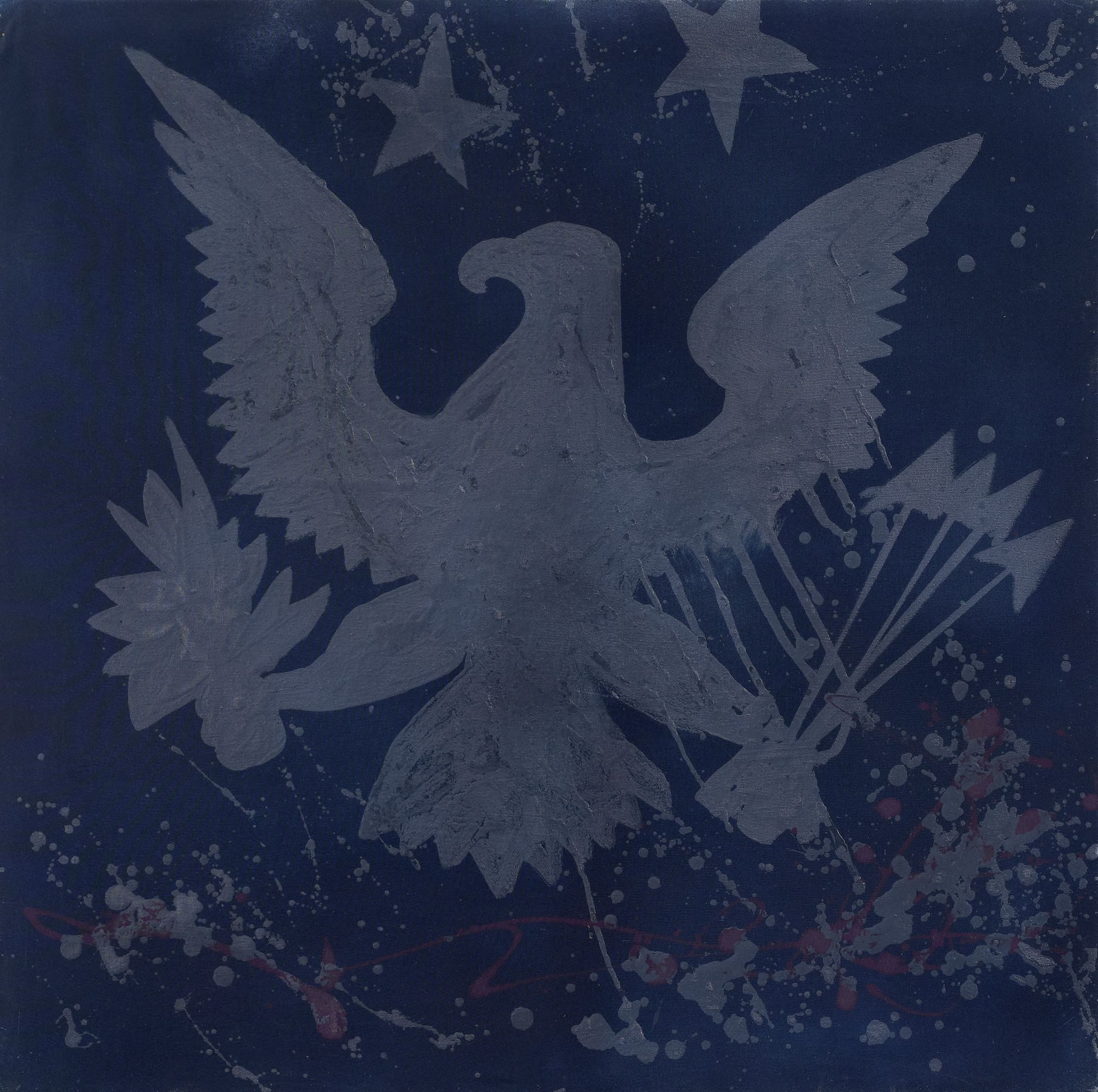
Franco Angeli's "Frammento di simbolo americano" presents the American bald eagle rendered in a muted silver-gray against a deep cobalt ground, its wings fully extended and talons gripping both an olive branch and a bundle of arrows. Stars float at the upper register of the composition, partially obscured by loose, atmospheric paint splatters that disrupt any sense of ceremonial authority. At the lower edge, streaks and drips of red punctuate the darkness, introducing an unsettling note of urgency or violence into an otherwise monochromatic field. The enamel application is gestural and uneven, allowing the blue ground to breathe through the silhouette and deny the symbol its usual heraldic solidity. Angeli was a central figure in the Roman school of artists known as the Scuola di Piazza del Popolo, working alongside Tano Festa and Mario Schifano during a period of intense dialogue with American Pop Art and the cultural anxieties of the Cold War. Unlike his American contemporaries, Angeli approached mass-media imagery with a markedly European skepticism, veiling and eroding his appropriated symbols rather than celebrating or ironizing them in the manner of Warhol or Lichtenstein. The fragmentary quality announced in the title is not merely compositional but conceptual, suggesting that the symbol arrives already damaged, already incomplete, its authority hollowed out by repetition and geopolitical tension. The incorporation of blue glass into the medium further complicates the surface, lending it a material density that resists easy legibility. Dated to 1964, the work situates itself at a pivotal moment, the year following Kennedy's assassination, when American power and its symbolic vocabulary were being reconsidered across the Western world. At a compact 60 by 60 centimeters, the painting commands attention through restraint rather than scale, its near-monochromatic palette demanding close looking to reveal the layering and incident beneath the surface. For collectors, this is a work of considerable historical and aesthetic significance, exemplifying Angeli's singular method of using the imagery of American dominance to question rather than reproduce it. It belongs to a body of work that continues to gain critical recognition as scholars reassess the richness and complexity of Italian art produced in dialogue with, and in resistance to, postwar American cultural imperialism.

Medium
Enamel on canvas with blue glass

🔨 Auction Lot

Martini Studio d'Arte: Modern And Contemporary Art

June 10, 2026

Estimate: €8,000 to €10,000

Lot 51
Start the Discussion

Request access to join the discussion

About this work

Franco Angeli, Frammento di simbolo americano, 1964

Franco Angeli's "Frammento di simbolo americano" presents the American bald eagle rendered in a muted silver-gray against a deep cobalt ground, its wings fully extended and talons gripping both an olive branch and a bundle of arrows. Stars float at the upper register of the composition, partially obscured by loose, atmospheric paint splatters that disrupt any sense of ceremonial authority. At the lower edge, streaks and drips of red punctuate the darkness, introducing an unsettling note of urgency or violence into an otherwise monochromatic field. The enamel application is gestural and uneven, allowing the blue ground to breathe through the silhouette and deny the symbol its usual heraldic solidity. Angeli was a central figure in the Roman school of artists known as the Scuola di Piazza del Popolo, working alongside Tano Festa and Mario Schifano during a period of intense dialogue with American Pop Art and the cultural anxieties of the Cold War. Unlike his American contemporaries, Angeli approached mass-media imagery with a markedly European skepticism, veiling and eroding his appropriated symbols rather than celebrating or ironizing them in the manner of Warhol or Lichtenstein. The fragmentary quality announced in the title is not merely compositional but conceptual, suggesting that the symbol arrives already damaged, already incomplete, its authority hollowed out by repetition and geopolitical tension. The incorporation of blue glass into the medium further complicates the surface, lending it a material density that resists easy legibility. Dated to 1964, the work situates itself at a pivotal moment, the year following Kennedy's assassination, when American power and its symbolic vocabulary were being reconsidered across the Western world. At a compact 60 by 60 centimeters, the painting commands attention through restraint rather than scale, its near-monochromatic palette demanding close looking to reveal the layering and incident beneath the surface. For collectors, this is a work of considerable historical and aesthetic significance, exemplifying Angeli's singular method of using the imagery of American dominance to question rather than reproduce it. It belongs to a body of work that continues to gain critical recognition as scholars reassess the richness and complexity of Italian art produced in dialogue with, and in resistance to, postwar American cultural imperialism.

Medium
Enamel on canvas with blue glass
Year
1964
Seen at
Martini Studio d'Arte

Related themes

American Iconography, European Artist, Mid Century Modern, Fragmentation, Figurative Abstract, Conceptual, Cold War Theme, Male Artist, Gestural Painting, National Symbols, Mixed Media, Italian Artist, Silver And Gray, Appropriation Art, Pop Art, Postwar Art, Political Art, Blue Palette, Symbolic Imagery, Power And Authority, Enamel On Canvas

More works by Franco Angeli