Join The Collection to save, track, and explore works like this.

Franco Angeli — Serie delle monete
Franco Angeli

Serie delle monete

1964

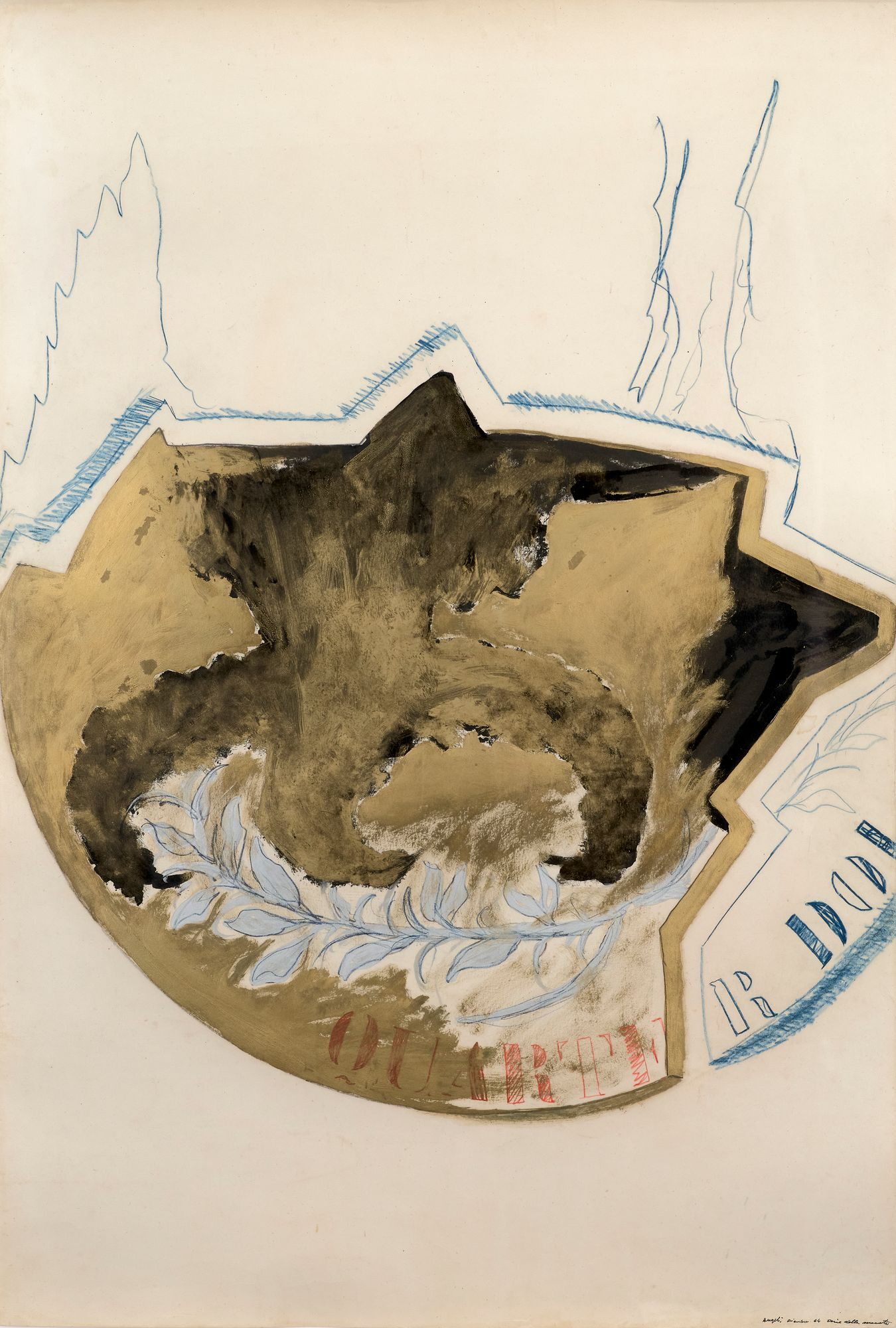
Franco Angeli's Serie delle monete (1964) presents a dramatically fragmented coin face rendered in gouache, ink, and pencil on paper, its golden surface erupting inward as though struck by some unseen force. The work centers on a corroded, crater-like depression that dissolves the coin's relief into swirling passages of raw sienna and deep black, while a delicate laurel wreath, drawn in pale cerulean blue, traces the lower arc of the composition with almost archaeological precision. Partial letterforms in red stamped script emerge from the lower register, legible enough to invoke official currency yet too eroded to be read as anything but ruins. Blue pencil lines extend beyond the coin's broken edge into the surrounding white ground, sketching ghostly flames, architectural fragments, and vertical marks that suggest both destruction and aftermath. Angeli developed his coin and shield imagery in Rome during the early 1960s as a pointed engagement with postwar Italian identity, consumer culture, and the persistence of political iconography. Working within the orbit of Roman Pop and the broader Scuola di Piazza del Popolo, he distinguished himself from his contemporaries through a melancholic ambivalence toward the symbols he appropriated. Where artists like Mario Schifano approached mass imagery with a cooler detachment, Angeli subjected his sources to processes of decomposition, burning, and layering that rendered state symbols simultaneously monumental and catastrophically unstable. The coin, an object of both civic exchange and imperial propaganda, becomes in his hands a site of material and ideological collapse. This work on paper demonstrates the particular intimacy and experimental freedom that Angeli brought to works outside the canvas format. The mixed media approach allows the artist to move between the physicality of paint and the gestural economy of drawing within a single surface, creating an object that reads as both finished artwork and working study. The tension between the coin's surviving gilded authority and its interior void gives the composition an almost archaeological gravitas, as though the viewer has recovered a fragment of some collapsed civilization whose symbols remain recognizable but whose meanings have become irretrievably ambiguous. For collectors of postwar European art, Serie delle monete represents a compact and exceptionally well-preserved example of Angeli's critical engagement with image, power, and material deterioration at the height of his early practice.

Medium
Mixed media on paper

🔨 Auction Lot

Martini Studio d'Arte: Modern And Contemporary Art

June 10, 2026

Estimate: €3,000 to €5,000

Lot 52

Start the Discussion

Request access to join the discussion

About this work

Franco Angeli, Serie delle monete, 1964

Franco Angeli's Serie delle monete (1964) presents a dramatically fragmented coin face rendered in gouache, ink, and pencil on paper, its golden surface erupting inward as though struck by some unseen force. The work centers on a corroded, crater-like depression that dissolves the coin's relief into swirling passages of raw sienna and deep black, while a delicate laurel wreath, drawn in pale cerulean blue, traces the lower arc of the composition with almost archaeological precision. Partial letterforms in red stamped script emerge from the lower register, legible enough to invoke official currency yet too eroded to be read as anything but ruins. Blue pencil lines extend beyond the coin's broken edge into the surrounding white ground, sketching ghostly flames, architectural fragments, and vertical marks that suggest both destruction and aftermath. Angeli developed his coin and shield imagery in Rome during the early 1960s as a pointed engagement with postwar Italian identity, consumer culture, and the persistence of political iconography. Working within the orbit of Roman Pop and the broader Scuola di Piazza del Popolo, he distinguished himself from his contemporaries through a melancholic ambivalence toward the symbols he appropriated. Where artists like Mario Schifano approached mass imagery with a cooler detachment, Angeli subjected his sources to processes of decomposition, burning, and layering that rendered state symbols simultaneously monumental and catastrophically unstable. The coin, an object of both civic exchange and imperial propaganda, becomes in his hands a site of material and ideological collapse. This work on paper demonstrates the particular intimacy and experimental freedom that Angeli brought to works outside the canvas format. The mixed media approach allows the artist to move between the physicality of paint and the gestural economy of drawing within a single surface, creating an object that reads as both finished artwork and working study. The tension between the coin's surviving gilded authority and its interior void gives the composition an almost archaeological gravitas, as though the viewer has recovered a fragment of some collapsed civilization whose symbols remain recognizable but whose meanings have become irretrievably ambiguous. For collectors of postwar European art, Serie delle monete represents a compact and exceptionally well-preserved example of Angeli's critical engagement with image, power, and material deterioration at the height of his early practice.

Medium
Mixed media on paper
Year
1964
Seen at
Martini Studio d'Arte

Related themes

Gouache And Ink, Consumer Culture, European Artist, Ruins And Decay, Fragmentation, Figurative Abstract, Black and Gold, Male Artist, National Identity, Mixed Media, Conceptual Art, Italian Artist, Currency Imagery, Appropriation Art, Political Iconography, Pop Art, Roman School, Postwar Art, Small Format, Works On Paper, Symbolic Imagery

More works by Franco Angeli