Join The Collection to save, track, and explore works like this.

Enrico Baj — Hua-ahu
Enrico Baj

Hua-ahu

1996

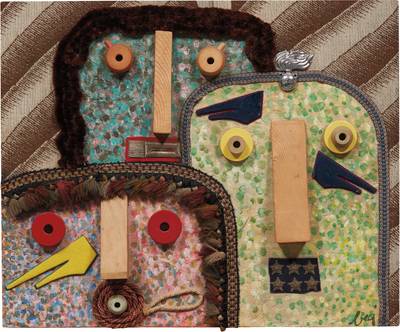
Hua-ahu presents a vivid ceremonial mask rendered in layered paint on felt, its oval form outlined in bold yellow against a textured ground populated with an exuberant accumulation of found objects. The face itself is built from planes of green, pink, and silver, animated by red gestural marks that sweep across the cheeks and forehead in rhythmic strokes. Blue-outlined eyes hold glass button pupils that catch the light with an unsettling directness, while a long geometric nose descends toward a diamond-shaped emblem at the chin, framed in cobalt blue. Surrounding this central image, the surface teems with buttons, polished stones, mosaic tile fragments, metal medallions, and decorative trimmings arranged with both deliberate pattern and a sense of joyful excess. Baj produced this work in 1996, drawing on the lifelong fascination with primitivism, ritual imagery, and the transgressive potential of collage that had defined his practice since his founding of the Mouvement Nucléaire in Milan in the early 1950s. The title, with its suggestion of Polynesian or oceanic ritual objects, reflects his sustained dialogue with non-Western art forms, a conversation informed equally by his admiration for Dubuffet's art brut principles and by a distinctly Italian irreverence toward high modernist hierarchies. Where Baj's better-known assemblages of the 1960s and 1970s incorporated military insignia and upholstery fabric to satirize bourgeois authority, Hua-ahu channels that same material promiscuity toward something more totemic and celebratory, as if the detritus of everyday life has been recruited into a private mythology. At 52 by 28 centimeters, the work is intimate in scale but dense in presence, a quality enhanced by its deep shadow-box frame, which elevates it between painting and three-dimensional object. The mixed media on felt support, a surface Baj returned to throughout his career for its tactile warmth and its resistance to the conventions of canvas, gives the accumulated materials a cohesive ground that unifies their considerable visual variety. For collectors, this piece represents a mature and characteristic expression of Baj's central convictions, that art should be irreverent, sensory, and rooted in the transformative power of humble materials, assembled here into a mask that looks back with genuine authority.

Medium
Assemblage, mixed media, trimmings, buttons, stones, metal on felt applied on board

🔨 Auction Lot

Martini Studio d'Arte: Modern And Contemporary Art

June 10, 2026

Estimate: €3,000 to €4,000

Lot 64
Start the Discussion

Request access to join the discussion

About this work

Enrico Baj, Hua-ahu, 1996

Hua-ahu presents a vivid ceremonial mask rendered in layered paint on felt, its oval form outlined in bold yellow against a textured ground populated with an exuberant accumulation of found objects. The face itself is built from planes of green, pink, and silver, animated by red gestural marks that sweep across the cheeks and forehead in rhythmic strokes. Blue-outlined eyes hold glass button pupils that catch the light with an unsettling directness, while a long geometric nose descends toward a diamond-shaped emblem at the chin, framed in cobalt blue. Surrounding this central image, the surface teems with buttons, polished stones, mosaic tile fragments, metal medallions, and decorative trimmings arranged with both deliberate pattern and a sense of joyful excess. Baj produced this work in 1996, drawing on the lifelong fascination with primitivism, ritual imagery, and the transgressive potential of collage that had defined his practice since his founding of the Mouvement Nucléaire in Milan in the early 1950s. The title, with its suggestion of Polynesian or oceanic ritual objects, reflects his sustained dialogue with non-Western art forms, a conversation informed equally by his admiration for Dubuffet's art brut principles and by a distinctly Italian irreverence toward high modernist hierarchies. Where Baj's better-known assemblages of the 1960s and 1970s incorporated military insignia and upholstery fabric to satirize bourgeois authority, Hua-ahu channels that same material promiscuity toward something more totemic and celebratory, as if the detritus of everyday life has been recruited into a private mythology. At 52 by 28 centimeters, the work is intimate in scale but dense in presence, a quality enhanced by its deep shadow-box frame, which elevates it between painting and three-dimensional object. The mixed media on felt support, a surface Baj returned to throughout his career for its tactile warmth and its resistance to the conventions of canvas, gives the accumulated materials a cohesive ground that unifies their considerable visual variety. For collectors, this piece represents a mature and characteristic expression of Baj's central convictions, that art should be irreverent, sensory, and rooted in the transformative power of humble materials, assembled here into a mask that looks back with genuine authority.

Medium
Assemblage, mixed media, trimmings, buttons, stones, metal on felt applied on board
Year
1996
Seen at
Martini Studio d'Arte

Related themes

Ceremonial, Assemblage, Avant Garde, Tactile Surface, Male Artist, Modernist, Nuclear Art, Mixed Media, Ritual Imagery, Collage, Italian, European, Primitivism, Portrait, Non Western Influence, Mask, Decorative Art, Vibrant Color, Figurative, Found Objects, Art Brut

More works by Enrico Baj