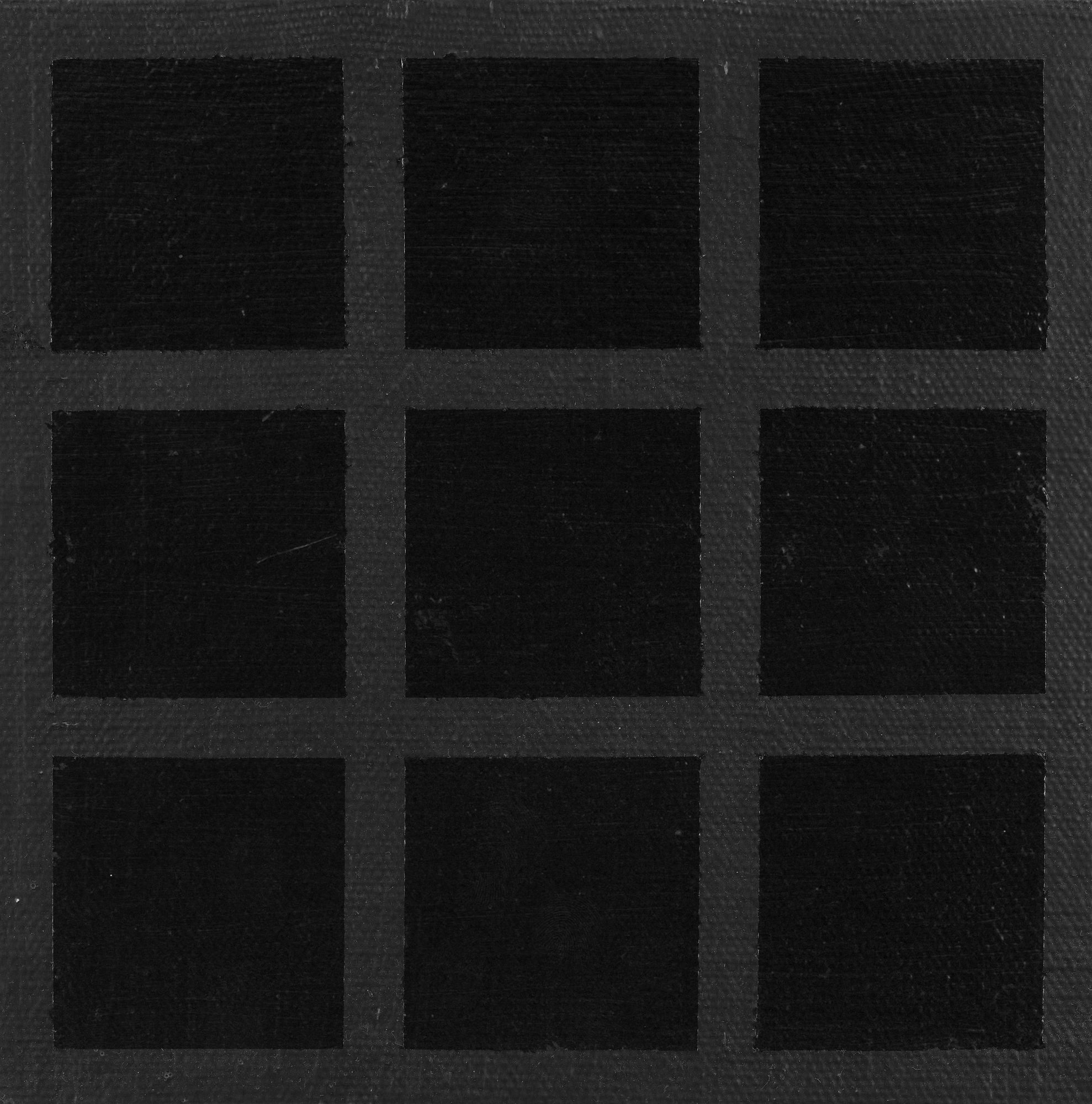
Untitled
1969
This small yet commanding work presents a three-by-three grid of near-black squares set against a slightly lighter dark ground, the whole rendered in acrylic on board at an intimate scale of just twenty-three centimeters square. The squares are painted with a deliberate, matte evenness, and the canvas texture beneath the paint remains subtly visible, softening what might otherwise read as pure geometric severity. The grid lines separating the squares carry a quiet materiality, their slightly warmer tone distinguishing them from the dense darkness of the squares themselves. Within this restrained vocabulary, Rajlich generates a surprising perceptual complexity, as the eye moves across the surface searching for variation, finding instead a meditative steadiness that rewards sustained attention. Tomas Rajlich, born in Czechoslovakia in 1935 and later associated with the Dutch art scene following his emigration in 1969, became one of the most committed practitioners of systematic, reductive painting in postwar European art. This untitled work from 1969 represents an early statement of the concerns that would define his mature practice, namely the exhaustive yet open-ended exploration of a single pictorial unit repeated across a field. Working at a moment when Minimalism and Conceptualism were reshaping artistic discourse across Europe and North America, Rajlich pursued a path that was resolutely painterly rather than industrial, insisting on the hand-made mark even within the strictest structural logic. The grid for him was never a neutral container but an active pictorial decision, a framework through which paint, surface, and perception could be examined with rigorous clarity. For collectors, this work occupies a significant position both within Rajlich's own chronology and within the broader history of European reductive abstraction. Its modest dimensions belie a conceptual ambition that connects it to contemporaneous practices from artists such as Brice Marden, Robert Ryman, and members of the Dutch Nul group, while retaining a distinctly personal sensibility rooted in careful material attention. The acrylic on board support lends the work a physical solidity that complements its visual economy, and its excellent condition ensures that the nuanced tonal relationships Rajlich established in 1969 remain fully legible. Works from this foundational period of his career appear rarely on the market, making this a genuinely uncommon opportunity to acquire an early example of one of the most singular voices in postwar European painting.
- Medium
- Acrylic on board
🔨 Auction Lot
Martini Studio d'Arte: Modern And Contemporary Art
June 10, 2026
Estimate: €4,000 to €5,000
Lot 130
More by Tomas Rajlich
Start the Discussion
Request access to join the discussion