Jules
1971
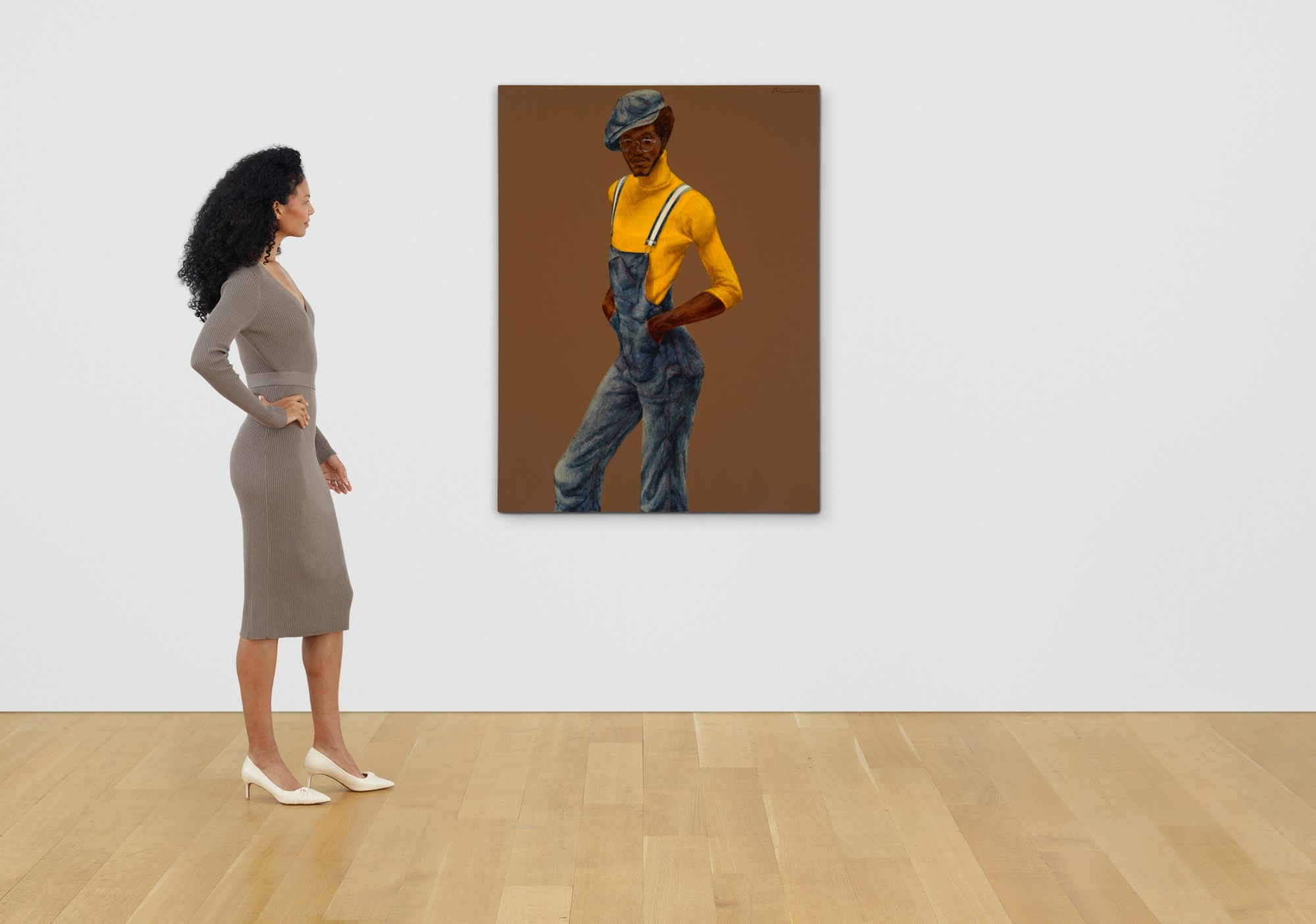
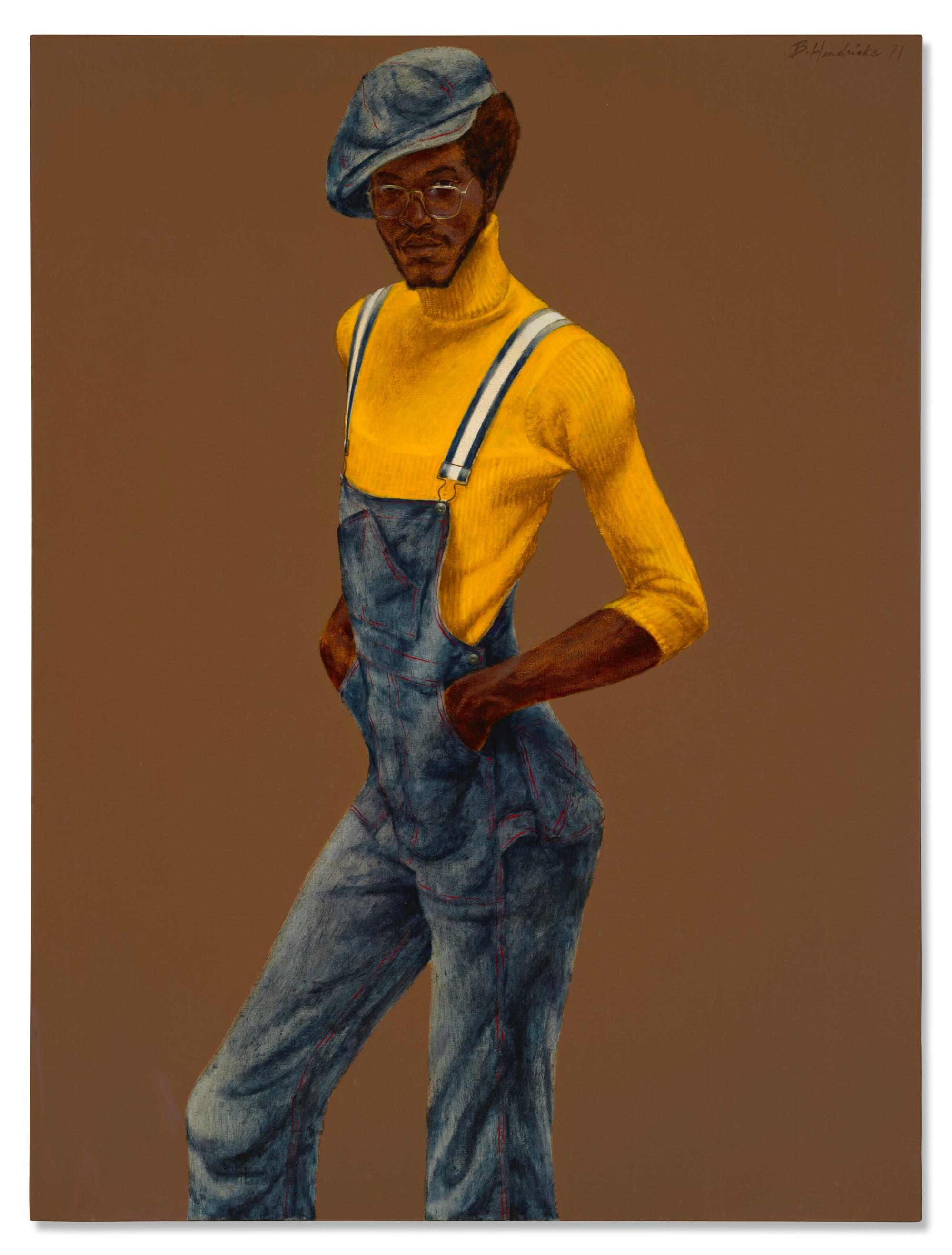
Painted in 1971, this portrait presents George Jules Taylor, a fellow Yale student whom Hendricks would immortalize in four major canvases over the following years. Standing with confident contrapposto, the tall figure of Jules dominates the composition in a bright yellow sweater, bold suspenders, and newsboy cap, his gaze direct and engaging as his hands rest deep in his denim pockets. Rendered in oil and acrylic against a burnished bronze ground, the work exemplifies Hendricks's revolutionary approach to portraiture, one that transcends mere representation to become a collaborative act of identity creation between artist and sitter. By depicting Black subjects with such visual prominence and dignity, Hendricks deliberately countered centuries of exclusion from the Western art historical canon, asserting the fundamental right of his community to occupy spaces of artistic significance. The painting's power lies not in narrative complexity but in the sheer fact of its subject's existence, a statement of visibility and self-determination that continues to resonate.
- Medium
- oil and acrylic on linen
- Dimensions
- Signed
- Yes
- Spotted At
- Auction House · Christie's
Notes
LOT ESSAY Present lot illustrated (detail). Painted in 1971, and held in the same private collection for over 50 years, Barkley L. Hendricks’s Jules is the first of four paintings in which the artist immortalized George Jules Taylor, a fellow student at Yale. In this bold and audacious portrait, Hendricks reverses centuries of art historical omission by giving his sitter—a proud Black man—a place in the art historical canon that had previously not been afforded his antecedents. Yet, Hendricks’s portraits go beyond mere representation, they are a partnership between artist and sitter to reflect, create, and develop an identity built on self-reliance and visibility. One of the artist’s most important series, the three other paintings of George Jules Taylor are all in major international museum collections. Jules was about six-six, six-eight…I mean, he’s a majestic figure as far as that’s concerned, and I wanted that… Barkley L. Hendricks Standing tall, with his hands confidently buried deep in the front pockets of his dungarees, the subject of Hendricks’s masterful portrait looks out directly from the surface of the canvas. Dressed in a bright yellow sweater, his denims held up by a pair of bold black-and-white suspenders, and wearing a large newsboy-style cap, the lithe figure of Jules twists and contorts to fit the confines of the canvas. Standing contrapposto, his confident stance confronts the viewer directly. Painted against a burnished bronze ground, attention is focused purely on the sitter, his engaging appearance and his dynamic personality. This combination of detailed figurative elements set against an unmodulated ground provides for an unmistakable message. As Antwaun Sargent notes. “the entire narrative of the painting is the fact of the subject’s existence, which is to say he painted these people because they existed” (quoted in A. Sargent, “Barkley L. Hendricks: To Be Real,” in A. Ng and A. Sargent, Barkley L. Hendricks: Portraits at the Frick, exh. cat., The Frick Collection, New York, 2023, p. 41). Barkley L. Hendricks, George Jules Taylor, 1972. National Gallery of Art, Washington, D.C. © Barkley L. Hendricks. Courtesy of the Estate of Barkley L. Hendricks and Jack Shainman Gallery, New York. The man Hendricks chose as his subject is George Jules Taylor (born Jules Easton Taylor), a student the artist met while they were both students at Yale. Hendricks was studying for his MFA, and Taylor was a first-year undergraduate, and they both signed up to take a class with the painter Bernard Chaet. Hendricks was immediately struck by his new friend’s height (he was 6’ 6,” compared with Hendricks’s 5’ 9”), his sartorial elegance, and distinctive persona. “[He was a] provocative subject matter for me,” Hendricks’s recalls, remembering how he looked like a “black Dracula who would float around campus barefoot” (quoted in A. Arabindan-Kesson, “The Painting,” Tate Gallery, online [accessed: 4/16/2026). For Hendricks though, portraiture was never a means of merely copying the corporeal world, it was a collaboration between artist and sitter to build up an identity. “Hendricks’s understanding of portraiture was…a process of identity creation, enacted collaboratively through the performance of the sitter and its interpretation by the artist… identity for Hendricks’s is a process of (ongoing) production” (ibid.). Barkley L. Hendricks, New Orleans Niggah, 1973. National Afro-American Museum and Cultural Center, Wilberforce. © Barkley L. Hendricks. Courtesy of the Estate of Barkley L. Hendricks and Jack Shainman Gallery, New York. During the course of the next few years, Hendricks would paint three other canvases featuring Taylor: George Jules Taylor (1972, National Gallery of Art, Washington, D.C.); New Orleans Niggah (1973, National Afro-American Museum and Cultural Center, Wilberforce); and Family Jules: NNN (No Naked Niggahs) (1974, Tate Gallery, London). All four portraits convey the power and presence that is inherent in Taylor’s nonchalant coolness that seems to emanate from deep inside, together with their developing friendship and familiarity over the course of the next few years. Their friendship would last until Taylor’s death in 1984. Barkley L. Hendricks, Family Jules: NNN (No Naked Niggahs), 1974. Tate, London. © Barkley L. Hendricks. Courtesy of the Estate of Barkley L. Hendricks and Jack Shainman Gallery, New York. Hendricks’s very contemporary portraits also take their place in the wider art historical narrative. On touring Europe in 1966 as a 21-year-old artist, Hendricks was struck by “how limited the representation of black figures has been in Western art history, and how few of those depicted have been truly harmonizing or personalized portraits” (quoted by A. Ng, “Barkley L. Hendricks and the Old Masters,” in A. Ng and A. Sargent, op. cit., p. 19). His response was to produce portraits that do not deal merely with color but, more fundamentally, with race. As Aimee Ng, curator of the critically acclaimed Hendricks’s exhibition at New York’s Frick Collection in 2023, noted, “Race is central to Hendricks’s practice…it is precisely who his subjects were, together with how he portrayed them, that electrified his art” (ibid., p. 21). Left: Agnolo Bronzino, Lodovico Capponi, circa 1550-1555. Frick Collection, New York. Right: Edouard Manet, Young Man in the Costume of a Majo, 1863. Metropolitan Museum of Art, New York. But ultimately Hendricks’s paintings are about people, and more specifically people he knew. Fellow painter Stanley Whitney (who was also immortalized on canvas by Hendricks) succinctly summarizes his friend’s legacy, “He wasn’t out to be revolutionary. He just wanted to paint people he loved…He wanted to see Black people exhibited in those museums” (S. Whitney, quoted in K. Crow, “The Friendship Behind a $5 Million Barkley L. Hendricks Painting,” Wall Street Journal, March 16, 2023, online [accessed: 4/16/2026]). So often a painter of the people in his life, Hendricks’s ultimate medium could be described as friendship itself. Present lot illustrated.
🔨 Auction Lot
Marian's Richters & 21st Century Evening Sale
Lot 37

Start the Discussion
Request access to join the discussion