Join The Collection to save, track, and explore works like this.

Ugo Carrega — Five
Ugo Carrega

Five

1962

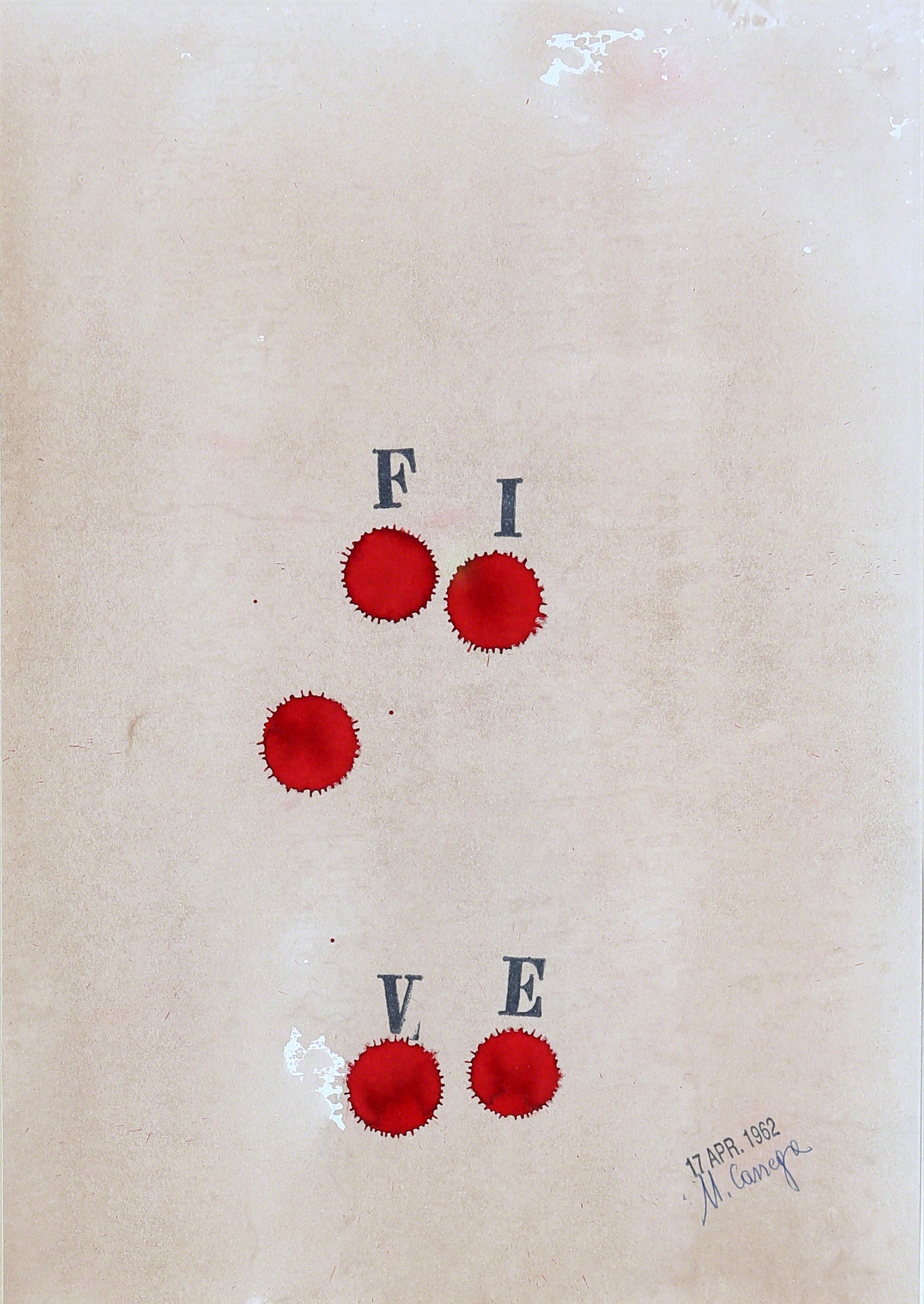
Ugo Carrega's 1962 work, "Five," offers a striking example of his groundbreaking investigations into the realm of visual poetry. Rendered on a subtly textured paper, the composition features the meticulously stamped letters "F" and "I" positioned in the upper portion, while "V" and "E" appear in the lower register. Directly beneath each of these four letters, Carrega applies a vibrant, circular drop of red tempera. These pigmented forms exhibit characteristic organic, spiky edges where the wet medium has bled into the paper, creating a dynamic contrast with the rigid typography. A fifth, solitary red drop is carefully placed to the left of the lower pair of letters, completing the numerical representation explicitly stated in the work's title. This deliberate fragmentation of the word "FIVE" into distinct visual and textual units compels the viewer to engage with language not merely as a conveyor of semantic meaning, but as a malleable, aesthetic element within a precisely orchestrated composition. This piece powerfully articulates Carrega's innovative approach, which was central to the Italian Concrete Poetry movement he helped define. The stark contrast between the mechanical precision of the stamped letters and the fluid, almost visceral quality of the tempera drops highlights the artist's desire to challenge conventional modes of artistic expression and perception. "Five" transcends a simple linguistic exercise, instead inviting contemplation on the very essence of communication itself, dissecting a familiar word into its constituent parts and reassembling it through a novel visual grammar. As an early work from 1962, it serves as a crucial document of Carrega's foundational experimentation, demonstrating his forward-thinking integration of linguistic and visual elements. For collectors, this piece represents a significant moment in the artist's oeuvre, embodying his pivotal role in redefining the relationship between text, image, and meaning in 20th-century art. The inclusion of the handwritten signature and date further underscores its historical and artistic significance.

Medium
Tempera and stamps on paper

🔨 Auction Lot

Martini Studio d'Arte: Modern & Contemporary Art (December 2018)

December 20, 2018

Estimate: €3,000 to €4,000

Lot 94

Start the Discussion

Request access to join the discussion

About this work

Ugo Carrega, Five, 1962

Ugo Carrega's 1962 work, "Five," offers a striking example of his groundbreaking investigations into the realm of visual poetry. Rendered on a subtly textured paper, the composition features the meticulously stamped letters "F" and "I" positioned in the upper portion, while "V" and "E" appear in the lower register. Directly beneath each of these four letters, Carrega applies a vibrant, circular drop of red tempera. These pigmented forms exhibit characteristic organic, spiky edges where the wet medium has bled into the paper, creating a dynamic contrast with the rigid typography. A fifth, solitary red drop is carefully placed to the left of the lower pair of letters, completing the numerical representation explicitly stated in the work's title. This deliberate fragmentation of the word "FIVE" into distinct visual and textual units compels the viewer to engage with language not merely as a conveyor of semantic meaning, but as a malleable, aesthetic element within a precisely orchestrated composition. This piece powerfully articulates Carrega's innovative approach, which was central to the Italian Concrete Poetry movement he helped define. The stark contrast between the mechanical precision of the stamped letters and the fluid, almost visceral quality of the tempera drops highlights the artist's desire to challenge conventional modes of artistic expression and perception. "Five" transcends a simple linguistic exercise, instead inviting contemplation on the very essence of communication itself, dissecting a familiar word into its constituent parts and reassembling it through a novel visual grammar. As an early work from 1962, it serves as a crucial document of Carrega's foundational experimentation, demonstrating his forward-thinking integration of linguistic and visual elements. For collectors, this piece represents a significant moment in the artist's oeuvre, embodying his pivotal role in redefining the relationship between text, image, and meaning in 20th-century art. The inclusion of the handwritten signature and date further underscores its historical and artistic significance.

Medium
Tempera and stamps on paper
Year
1962
Seen at
Martini Studio d'Arte

Related themes

Red and Black, Mark Making, Visual Poetry, European Artist, Tempera, Conceptual, Minimalist, Male Artist, Modernist, Mixed Media, Avant-Garde, Experimental, Language Art, Italian Artist, Small Format, Text Based Art, Concrete Poetry, Found Language, Works On Paper, Abstract, Typography Art

More works by Ugo Carrega