Join The Collection to save, track, and explore works like this.

Roberto Crippa — Spirale
Roberto Crippa

Spirale

1952

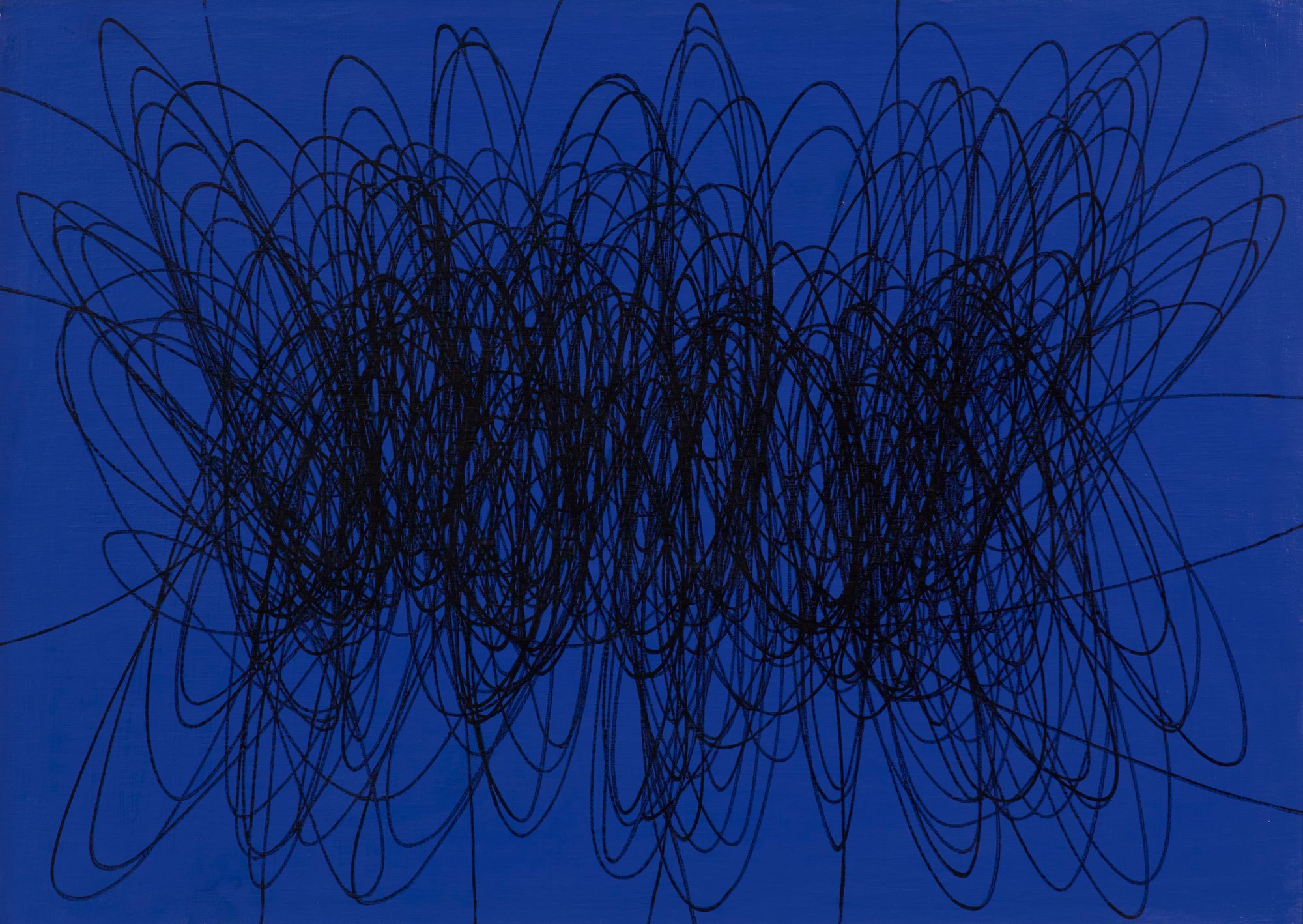
Spirale presents a dense accumulation of looping black lines set against a field of saturated cobalt blue, the marks building upon one another in overlapping elliptical rhythms that compress toward the center of the canvas before releasing outward at the edges. The gestures have a centrifugal energy, as though a single continuous line has been wound and rewound across the surface, gathering momentum and tension in the tightly packed core while individual loops break free along the periphery. The result is simultaneously controlled and unrestrained, a visual record of physical duration and the body's repetitive motion translated directly into paint. Roberto Crippa began his spiral works in the late 1940s and continued refining them through the 1950s, establishing the series as one of the defining contributions of Italian Spatialism, the movement founded by Lucio Fontana that sought to integrate space, movement, time, and matter into a unified artistic experience. Crippa's spirals can be understood within this context as a form of spatial writing, a gesture that refuses the static composition of traditional painting in favor of something kinetic and process-driven. The cobalt ground in this 1952 example is characteristic of the period, a color choice that intensifies the visual vibration between the gestural marks and the background, creating an optical depth that draws the eye inward before the radiating loops push it back outward again. At 50 by 70 centimeters, this canvas occupies an intimate scale that rewards close looking, allowing the individual quality of each line to register fully against the hand-applied ground. Works from this precise moment in Crippa's development, the early 1950s, are considered among the most resolved of the spiral series, exhibiting the confident stroke and compositional maturity that would bring him international recognition at venues including the Venice Biennale. The painting holds strong art-historical relevance as a document of postwar European abstraction's engagement with gesture, energy, and materiality, while remaining visually immediate and emotionally direct to a contemporary eye. It represents an excellent opportunity to acquire a museum-quality example of Spatialism from one of the movement's most significant and underrecognized figures.

Medium
Oil on canvas

🔨 Auction Lot

Martini Studio d'Arte: Modern And Contemporary Art

June 10, 2026

Estimate: €5,000 to €7,000

Lot 179

Start the Discussion

Request access to join the discussion

More by Roberto Crippa

About this work

Roberto Crippa, Spirale, 1952

Spirale presents a dense accumulation of looping black lines set against a field of saturated cobalt blue, the marks building upon one another in overlapping elliptical rhythms that compress toward the center of the canvas before releasing outward at the edges. The gestures have a centrifugal energy, as though a single continuous line has been wound and rewound across the surface, gathering momentum and tension in the tightly packed core while individual loops break free along the periphery. The result is simultaneously controlled and unrestrained, a visual record of physical duration and the body's repetitive motion translated directly into paint. Roberto Crippa began his spiral works in the late 1940s and continued refining them through the 1950s, establishing the series as one of the defining contributions of Italian Spatialism, the movement founded by Lucio Fontana that sought to integrate space, movement, time, and matter into a unified artistic experience. Crippa's spirals can be understood within this context as a form of spatial writing, a gesture that refuses the static composition of traditional painting in favor of something kinetic and process-driven. The cobalt ground in this 1952 example is characteristic of the period, a color choice that intensifies the visual vibration between the gestural marks and the background, creating an optical depth that draws the eye inward before the radiating loops push it back outward again. At 50 by 70 centimeters, this canvas occupies an intimate scale that rewards close looking, allowing the individual quality of each line to register fully against the hand-applied ground. Works from this precise moment in Crippa's development, the early 1950s, are considered among the most resolved of the spiral series, exhibiting the confident stroke and compositional maturity that would bring him international recognition at venues including the Venice Biennale. The painting holds strong art-historical relevance as a document of postwar European abstraction's engagement with gesture, energy, and materiality, while remaining visually immediate and emotionally direct to a contemporary eye. It represents an excellent opportunity to acquire a museum-quality example of Spatialism from one of the movement's most significant and underrecognized figures.

Medium
Oil on canvas
Year
1952
Seen at
Martini Studio d'Arte

Related themes

Spatialism, Mid Century Modern, Repetition Pattern, Male Artist, Modernist, Post War Art, Kinetic energy, Italian Artist, Oil On Canvas, Abstract Expressionism, Gestural Abstraction, Process Art, Small Format, European, Blue Dominant, Line And Form, Optical Depth, Abstract, Spiral Forms, Painting, Cobalt Blue

More works by Roberto Crippa