Join The Collection to save, track, and explore works like this.

Piero Gilardi — Giardino botanico
Piero Gilardi

Giardino botanico

1998

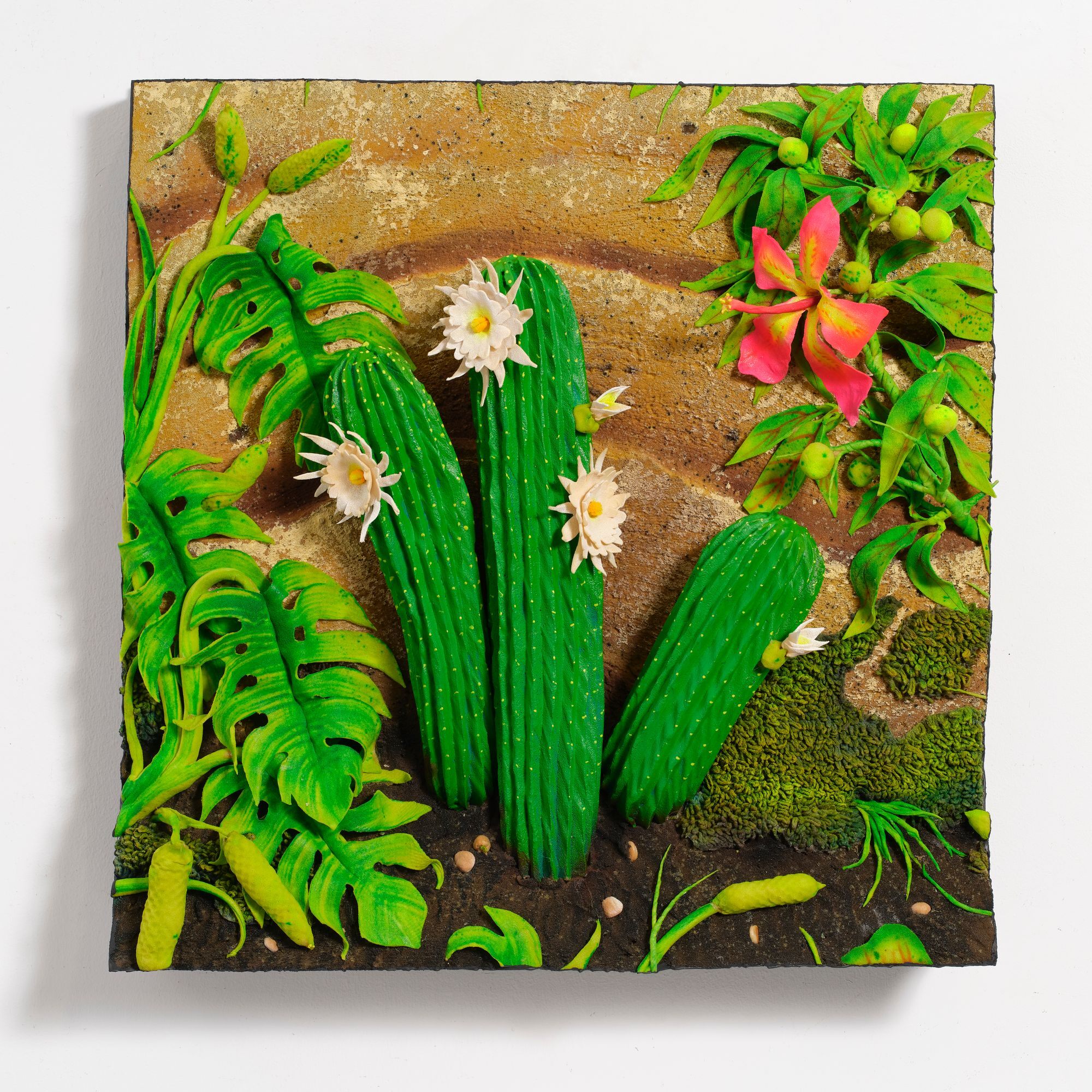
Giardino botanico presents a lush, compressed ecosystem rendered entirely in polyurethane foam, a material Gilardi transformed into his signature vehicle for exploring the boundary between the natural world and its human-made representations. Three columnar cacti rise from a bed of dark soil at the composition's center, each crowned with delicate white blossoms whose petals unfurl with surprising tenderness against the rigid geometry of the stems. Surrounding them, monstera leaves curl and perforate in characteristic fashion while pepper plants, trailing vines, and what appears to be a flowering bromeliad in vivid pink populate every corner of the shallow pictorial space. The warm ochre and sand-toned background, swirling in concentric bands, evokes both geological strata and the kind of idealized garden illustration one might find in a botanical encyclopedia, grounding the work in a tradition of scientific observation even as it playfully subverts it. Gilardi began developing his "Tappeti-Natura," or Nature Carpets, in the mid-1960s, and this 1998 work belongs to a mature phase of that ongoing investigation. The foam medium carries deliberate conceptual weight. Its synthetic origins make no pretense of imitating nature through illusion, and yet the sculptural forms it produces compel a visceral recognition of leaf, spine, and petal. Gilardi was deeply engaged with Arte Povera and later with participatory and political art, and his botanical works reflect a sustained meditation on ecology, alienation from the natural environment, and the ways in which consumer culture simultaneously reproduces and displaces the living world. The work invites tactile engagement while remaining quietly critical of the impulse to domesticate and collect nature itself. At 69 by 69 centimeters, Giardino botanico is scaled for intimate domestic or institutional display, presenting itself as both wall-mounted relief and contained garden. The square format reinforces a sense of the curated, the controlled, the framed specimen, which in turn deepens the irony at the heart of Gilardi's practice. Collectors acquiring this work are receiving not merely an object of considerable visual pleasure but a considered philosophical statement from one of Italy's most consistently rigorous conceptual artists, one whose relevance to contemporary conversations around ecology, simulation, and material culture has only grown in the decades since his initial breakthrough.

Medium
Foam sculpture

🔨 Auction Lot

Martini Studio d'Arte: Modern And Contemporary Art

June 10, 2026

Estimate: €7,000 to €9,000

Lot 127
Start the Discussion

Request access to join the discussion

About this work

Piero Gilardi, Giardino botanico, 1998

Giardino botanico presents a lush, compressed ecosystem rendered entirely in polyurethane foam, a material Gilardi transformed into his signature vehicle for exploring the boundary between the natural world and its human-made representations. Three columnar cacti rise from a bed of dark soil at the composition's center, each crowned with delicate white blossoms whose petals unfurl with surprising tenderness against the rigid geometry of the stems. Surrounding them, monstera leaves curl and perforate in characteristic fashion while pepper plants, trailing vines, and what appears to be a flowering bromeliad in vivid pink populate every corner of the shallow pictorial space. The warm ochre and sand-toned background, swirling in concentric bands, evokes both geological strata and the kind of idealized garden illustration one might find in a botanical encyclopedia, grounding the work in a tradition of scientific observation even as it playfully subverts it. Gilardi began developing his "Tappeti-Natura," or Nature Carpets, in the mid-1960s, and this 1998 work belongs to a mature phase of that ongoing investigation. The foam medium carries deliberate conceptual weight. Its synthetic origins make no pretense of imitating nature through illusion, and yet the sculptural forms it produces compel a visceral recognition of leaf, spine, and petal. Gilardi was deeply engaged with Arte Povera and later with participatory and political art, and his botanical works reflect a sustained meditation on ecology, alienation from the natural environment, and the ways in which consumer culture simultaneously reproduces and displaces the living world. The work invites tactile engagement while remaining quietly critical of the impulse to domesticate and collect nature itself. At 69 by 69 centimeters, Giardino botanico is scaled for intimate domestic or institutional display, presenting itself as both wall-mounted relief and contained garden. The square format reinforces a sense of the curated, the controlled, the framed specimen, which in turn deepens the irony at the heart of Gilardi's practice. Collectors acquiring this work are receiving not merely an object of considerable visual pleasure but a considered philosophical statement from one of Italy's most consistently rigorous conceptual artists, one whose relevance to contemporary conversations around ecology, simulation, and material culture has only grown in the decades since his initial breakthrough.

Medium
Foam sculpture
Year
1998
Seen at
Martini Studio d'Arte

Related themes

Three Dimensional, Green Palette, Synthetic Materials, Male Artist, Relief Work, Sculpture, Botanical, Mixed Media, Conceptual Art, Nature Inspired, Italian Artist, Foam Sculpture, Environmental Art, Wall Mounted, Political Art, Decorative Art, Arte Povera, Floral, Warm Tones, Figurative, Still Life, Contemporary

More works by Piero Gilardi