Join The Collection to save, track, and explore works like this.

Nino Calos — Mobile Lumineux 329
Nino Calos

Mobile Lumineux 329

1971

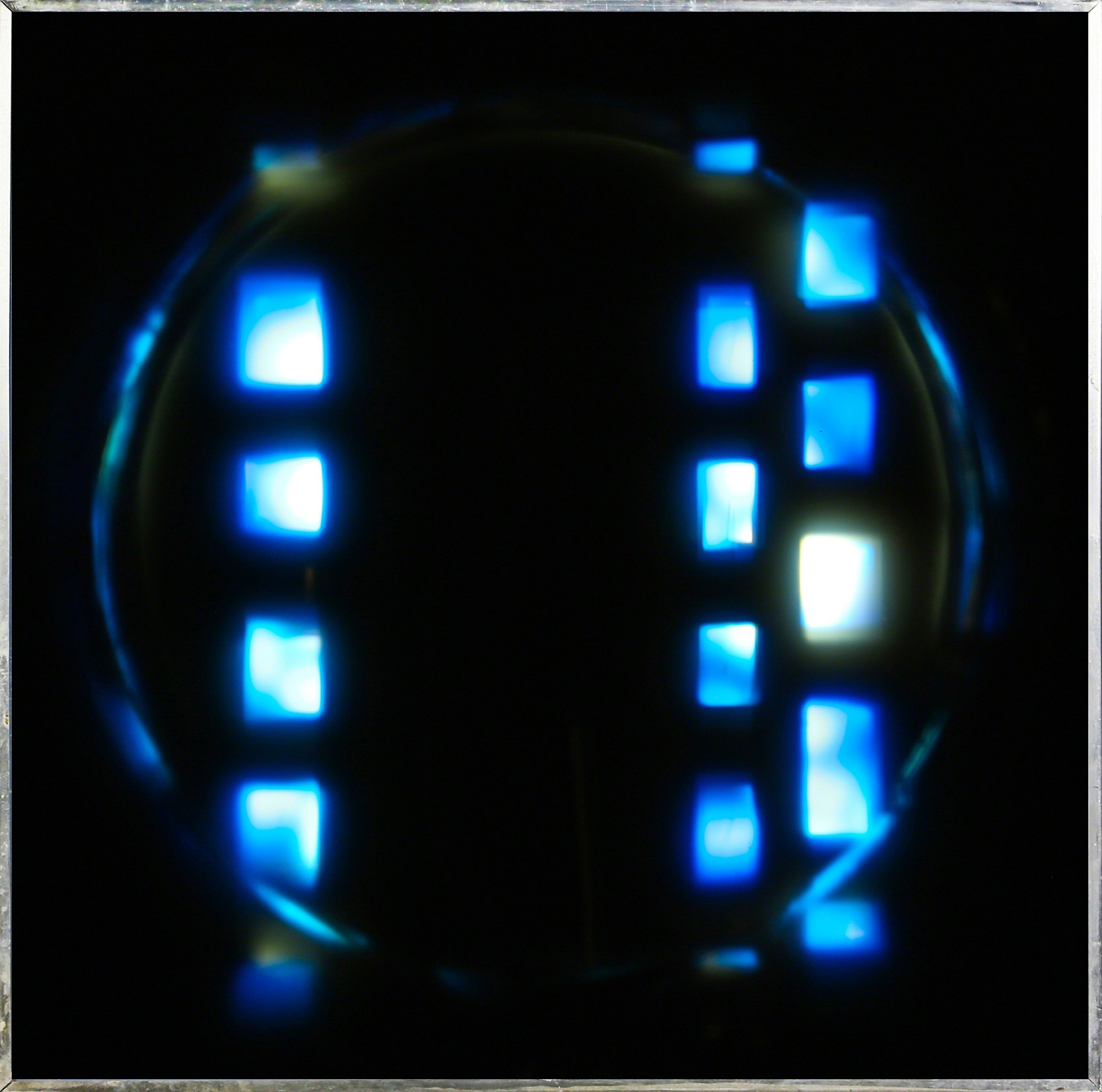
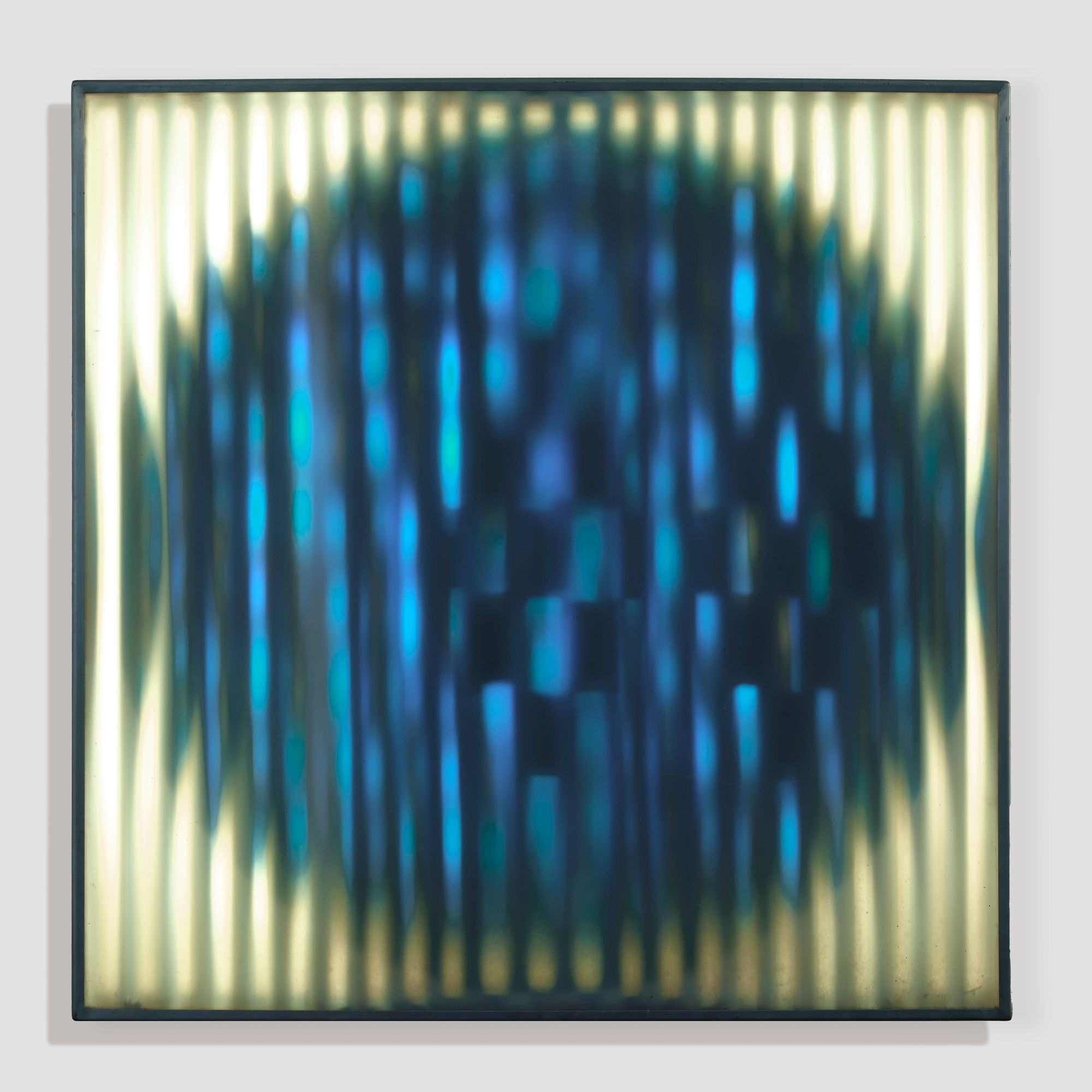
Mobile Lumineux 329 presents a mesmerizing interplay of light and movement contained within a square wooden box fitted with plexiglass and an internal electrical system. Vertical columns of luminous white and pale yellow light pulse along the outer edges of the composition, while the center dissolves into deep pools of cobalt, teal, and indigo. The effect is simultaneously spatial and atmospheric, suggesting depth far beyond the work's fourteen centimeters of physical relief. The internal electrical mechanism animates the piece, producing subtle shifts in illumination that cause the glowing intervals to appear to breathe and undulate, drawing the viewer's eye continuously inward toward the dark, radiant core. Nino Calos created this work in 1971 at a moment when kinetic and lumino-kinetic art had achieved genuine international momentum through venues such as the Galerie Denise René in Paris and major survey exhibitions across Europe and South America. Working within this tradition, Calos developed a rigorous formal language centered on electricity and translucent materials as the primary expressive instruments. Mobile Lumineux 329 is characteristic of his mature practice, in which the physical components, the box, the steel, the plexiglass, function not as ends in themselves but as infrastructure for an experience that is fundamentally temporal. The work changes with viewing angle, ambient light conditions, and the duration of the viewer's attention, meaning no two encounters with it are identical. For the collector, the work occupies a significant position within the broader history of post-war constructivist and kinetic practice, sitting comfortably alongside artists such as Julio Le Parc, François Morellet, and Yvaral, all of whom pursued the dematerialization of the art object through optical and mechanical means. The piece retains its original electrical system, a meaningful preservation consideration given the technical complexity of lumino-kinetic works from this period, and its dimensions make it well suited to a domestic or institutional setting where its emanating light can assert itself against a neutral wall. The deep teal frame, integral to the composition rather than merely decorative, anchors the luminous interior and signals the care with which Calos approached the total object. Mobile Lumineux 329 represents a refined and quietly authoritative contribution to the kinetic tradition of the 1970s.

Medium
Box, wood, plexiglass, steel and electrical system

🔨 Auction Lot

Martini Studio d'Arte: Modern And Contemporary Art

June 10, 2026

Estimate: €2,000 to €3,000

Lot 12

Start the Discussion

Request access to join the discussion

About this work

Nino Calos, Mobile Lumineux 329, 1971

Mobile Lumineux 329 presents a mesmerizing interplay of light and movement contained within a square wooden box fitted with plexiglass and an internal electrical system. Vertical columns of luminous white and pale yellow light pulse along the outer edges of the composition, while the center dissolves into deep pools of cobalt, teal, and indigo. The effect is simultaneously spatial and atmospheric, suggesting depth far beyond the work's fourteen centimeters of physical relief. The internal electrical mechanism animates the piece, producing subtle shifts in illumination that cause the glowing intervals to appear to breathe and undulate, drawing the viewer's eye continuously inward toward the dark, radiant core. Nino Calos created this work in 1971 at a moment when kinetic and lumino-kinetic art had achieved genuine international momentum through venues such as the Galerie Denise René in Paris and major survey exhibitions across Europe and South America. Working within this tradition, Calos developed a rigorous formal language centered on electricity and translucent materials as the primary expressive instruments. Mobile Lumineux 329 is characteristic of his mature practice, in which the physical components, the box, the steel, the plexiglass, function not as ends in themselves but as infrastructure for an experience that is fundamentally temporal. The work changes with viewing angle, ambient light conditions, and the duration of the viewer's attention, meaning no two encounters with it are identical. For the collector, the work occupies a significant position within the broader history of post-war constructivist and kinetic practice, sitting comfortably alongside artists such as Julio Le Parc, François Morellet, and Yvaral, all of whom pursued the dematerialization of the art object through optical and mechanical means. The piece retains its original electrical system, a meaningful preservation consideration given the technical complexity of lumino-kinetic works from this period, and its dimensions make it well suited to a domestic or institutional setting where its emanating light can assert itself against a neutral wall. The deep teal frame, integral to the composition rather than merely decorative, anchors the luminous interior and signals the care with which Calos approached the total object. Mobile Lumineux 329 represents a refined and quietly authoritative contribution to the kinetic tradition of the 1970s.

Medium
Box, wood, plexiglass, steel and electrical system
Year
1971
Seen at
Martini Studio d'Arte

Related themes

Three Dimensional, French, Constructivist, Atmospheric, Relief, Kinetic Art, Geometric Abstract, Male Artist, Modernist, Sculpture, Lumino Kinetic, Mixed Media, Spatial Depth, Op Art, Blue And Indigo, Postwar Art, Light Art, Electric Light, Abstract, Luminous Glow, Plexiglass

More works by Nino Calos