Join The Collection to save, track, and explore works like this.

Giulio Turcato — La pelle
Giulio Turcato

La pelle

1964

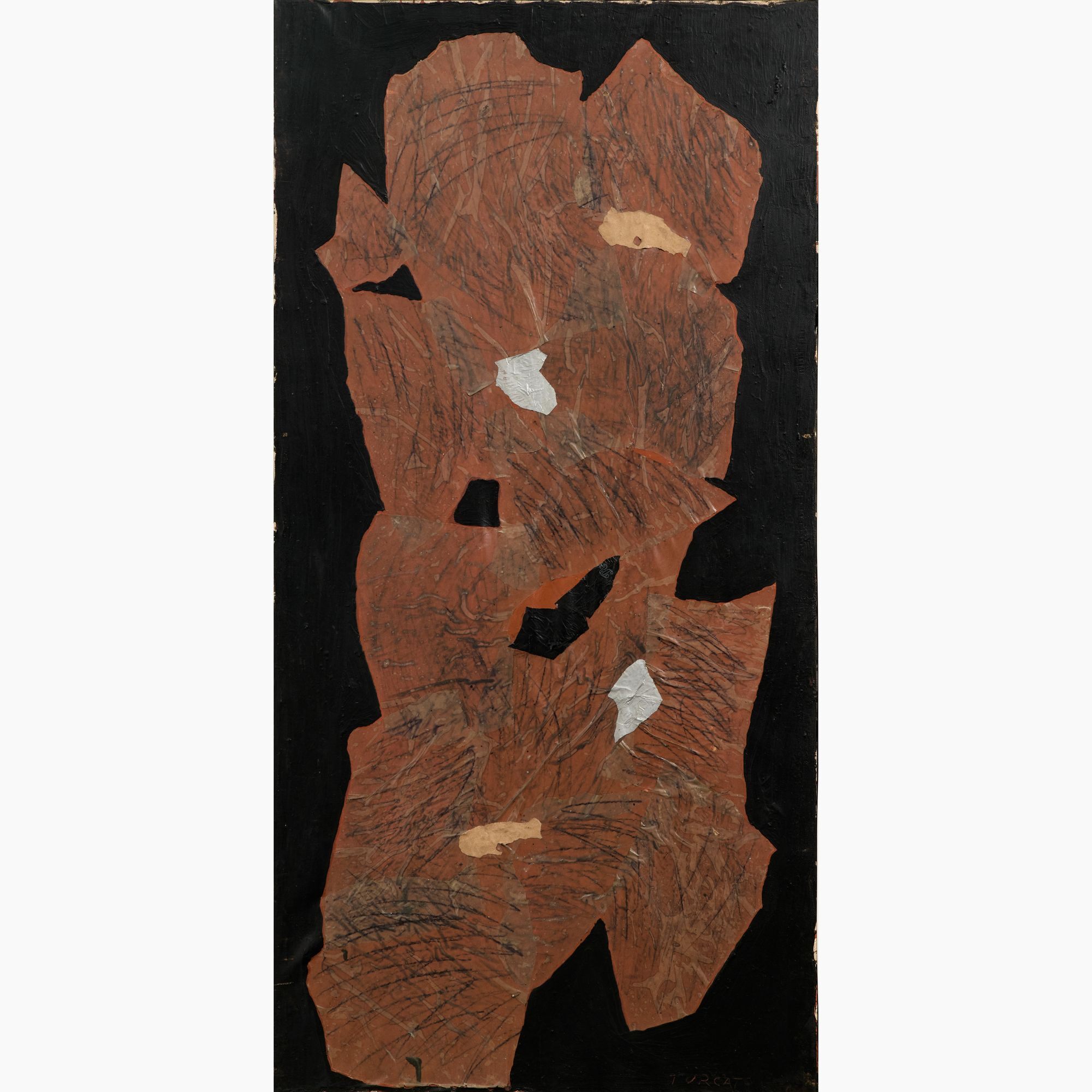
Composed against a deep, uncompromising black ground, this vertical canvas presents a torn and layered central form in warm terracotta and sienna tones, its irregular silhouette suggesting both geological strata and the fragmented surface of weathered skin. The title, which translates from Italian as "The Skin," frames the work's central tension: the boundary between interior and exterior, exposure and concealment. Scattered across the textured surface are small collaged fragments in white, black, and pale ochre, each one embedded into the composition with an almost forensic precision. Networks of graphite-like scratches course through the brown field, giving the impression of nerve endings or the fine grain of organic tissue, reinforcing the visceral anatomical metaphor at the heart of the work. Giulio Turcato produced this work in 1964, a period during which he was increasingly synthesizing the gestural spontaneity of Arte Informale with a more structured, material investigation of surface and substance. Turcato was a founding member of the Forma 1 group in postwar Rome, and by the 1960s his practice had evolved well beyond the group's early engagement with geometric abstraction, moving toward a deeply personal language of texture, matter, and organic reference. The mixed media and collage technique employed here reflects his sustained interest in the expressive potential of layered materials, where paint, paper, and applied fragments coexist as equal participants rather than hierarchical elements. The rough, almost flayed edges of the central form appear to have been torn rather than cut, lending the composition a raw immediacy that recalls Arte Povera's later embrace of humble, corporeal materials. The work carries considerable significance within Turcato's broader output and within the context of Italian postwar art more generally. Its intimate scale, at 120 by 60 centimeters, concentrates the viewer's attention and rewards close looking, as the accumulated marks and collaged inclusions reveal themselves gradually rather than all at once. The earthy palette connects the work to a Mediterranean sensibility rooted in soil, clay, and ancient material culture, while the open wounds of black that punctuate the surface introduce an element of rupture and unease. For collectors of mid-century European abstraction, this is a work of both historical and aesthetic weight, representative of a pivotal moment in Turcato's career and in the broader transformation of Italian modernism.

Medium
Oil, mixed media and collage on canvas

🔨 Auction Lot

Martini Studio d'Arte: Modern And Contemporary Art

June 10, 2026

Estimate: €9,000 to €11,000

Lot 70

Start the Discussion

Request access to join the discussion

More by Giulio Turcato

About this work

Giulio Turcato, La pelle, 1964

Composed against a deep, uncompromising black ground, this vertical canvas presents a torn and layered central form in warm terracotta and sienna tones, its irregular silhouette suggesting both geological strata and the fragmented surface of weathered skin. The title, which translates from Italian as "The Skin," frames the work's central tension: the boundary between interior and exterior, exposure and concealment. Scattered across the textured surface are small collaged fragments in white, black, and pale ochre, each one embedded into the composition with an almost forensic precision. Networks of graphite-like scratches course through the brown field, giving the impression of nerve endings or the fine grain of organic tissue, reinforcing the visceral anatomical metaphor at the heart of the work. Giulio Turcato produced this work in 1964, a period during which he was increasingly synthesizing the gestural spontaneity of Arte Informale with a more structured, material investigation of surface and substance. Turcato was a founding member of the Forma 1 group in postwar Rome, and by the 1960s his practice had evolved well beyond the group's early engagement with geometric abstraction, moving toward a deeply personal language of texture, matter, and organic reference. The mixed media and collage technique employed here reflects his sustained interest in the expressive potential of layered materials, where paint, paper, and applied fragments coexist as equal participants rather than hierarchical elements. The rough, almost flayed edges of the central form appear to have been torn rather than cut, lending the composition a raw immediacy that recalls Arte Povera's later embrace of humble, corporeal materials. The work carries considerable significance within Turcato's broader output and within the context of Italian postwar art more generally. Its intimate scale, at 120 by 60 centimeters, concentrates the viewer's attention and rewards close looking, as the accumulated marks and collaged inclusions reveal themselves gradually rather than all at once. The earthy palette connects the work to a Mediterranean sensibility rooted in soil, clay, and ancient material culture, while the open wounds of black that punctuate the surface introduce an element of rupture and unease. For collectors of mid-century European abstraction, this is a work of both historical and aesthetic weight, representative of a pivotal moment in Turcato's career and in the broader transformation of Italian modernism.

Medium
Oil, mixed media and collage on canvas
Year
1964
Seen at
Martini Studio d'Arte

Related themes

Abstract Art, Layered Composition, Male Artist, Modernist, Black Ground, Mixed Media, European Art, Material Investigation, Collage, Italian Artist, Gestural Abstraction, Postwar Art, Vertical Format, Arte Informale, Matter Painting, Organic Forms, Earth Tones, Textured Surface, Body And Skin, Anatomical Theme

More works by Giulio Turcato