Join The Collection to save, track, and explore works like this.

Giorgio Griffa — Obliquo
Giorgio Griffa

Obliquo

1975

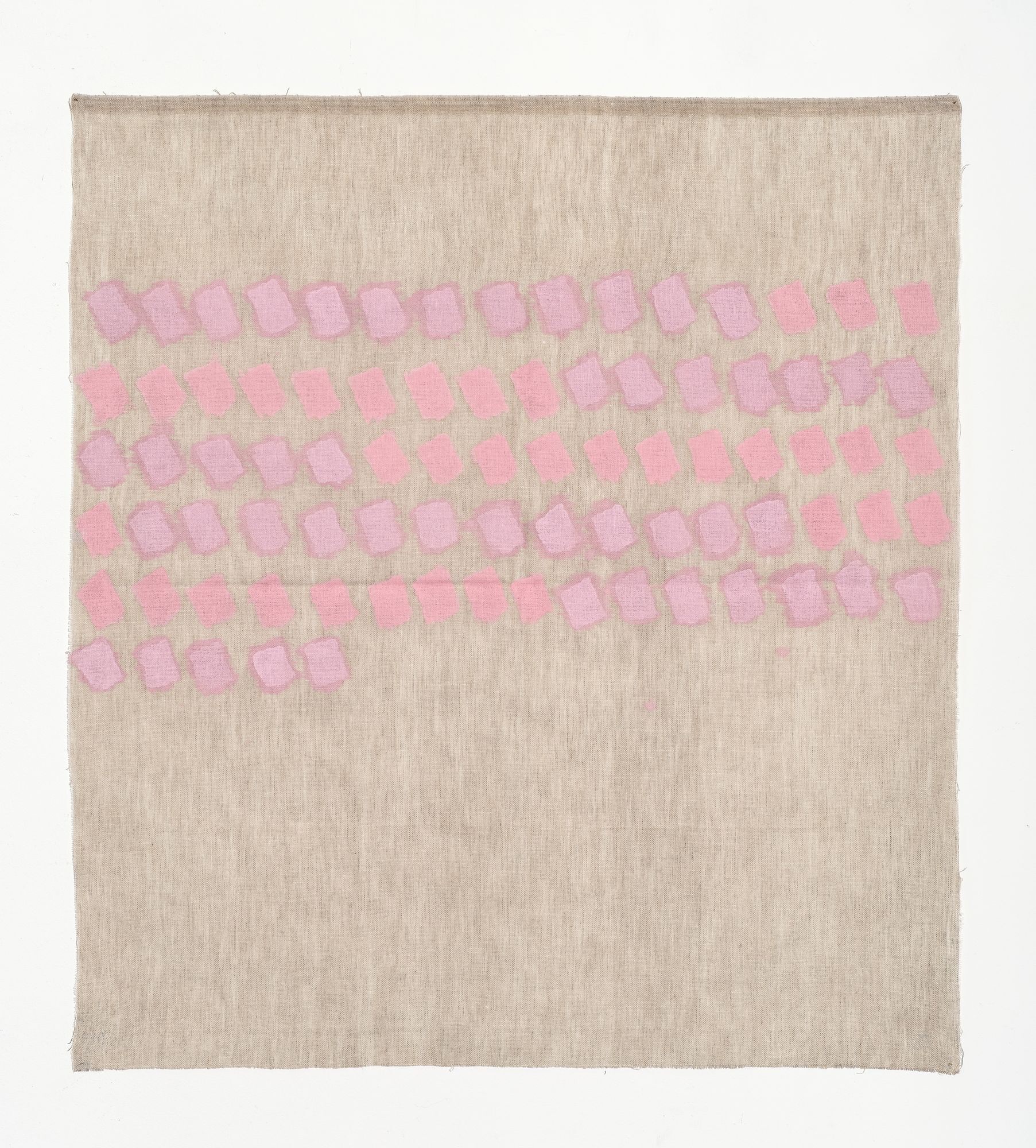
Obliquo presents a field of loosely painted pink and violet rectangles arranged in diagonal rows across an unprimed linen canvas. The shapes, rendered in soft acrylic pigment, drift across the upper two-thirds of the support in undulating bands that move from the lower left toward the upper right. Each mark retains the evidence of the hand that made it, with slightly irregular edges and varied tonal weight that shift between a warm coral pink and a cooler lavender, giving the composition a gentle visual pulse. The unpainted lower portion of the canvas is left intentionally bare, allowing the natural linen ground to function as an active element rather than a neutral backdrop. Griffa developed this approach during the early 1970s as part of his sustained investigation into the elemental conditions of painting, working within the orbit of Arte Povera while maintaining a distinct focus on the painted sign itself. Rather than constructing an illusionistic space or imposing a rigid compositional structure, he treats the canvas as a surface for accumulation and repetition, where marks accrue meaning through their seriality and spacing. The oblique orientation of the rows in this work introduces a quiet dynamism, suggesting movement or procession without arriving at narrative or symbol. The restraint of the palette and the deliberate incompleteness of the composition reflect his longstanding belief that painting should make visible its own process of becoming. Works from this period are among Griffa's most considered and historically significant, bridging the Conceptual impulses of the early 1970s with a meditative sensibility that continues to resonate in contemporary discourse around abstraction and materiality. Obliquo is a strong example of the artist working at the height of his formal investigations, balancing systematic thinking with an openness to chance and variation. The unlined, unstretched canvas, presented without a frame, emphasizes the work's physical nature as a textile object while also reinforcing Griffa's rejection of the hierarchies traditionally associated with easel painting. For collectors interested in Italian postwar and Conceptual art, this work offers both historical depth and an enduring visual presence.

Medium
Acrylic on canvas

🔨 Auction Lot

Martini Studio d'Arte: Modern And Contemporary Art

June 10, 2026

Estimate: €10,000 to €15,000

Lot 142
Start the Discussion

Request access to join the discussion

About this work

Giorgio Griffa, Obliquo, 1975

Obliquo presents a field of loosely painted pink and violet rectangles arranged in diagonal rows across an unprimed linen canvas. The shapes, rendered in soft acrylic pigment, drift across the upper two-thirds of the support in undulating bands that move from the lower left toward the upper right. Each mark retains the evidence of the hand that made it, with slightly irregular edges and varied tonal weight that shift between a warm coral pink and a cooler lavender, giving the composition a gentle visual pulse. The unpainted lower portion of the canvas is left intentionally bare, allowing the natural linen ground to function as an active element rather than a neutral backdrop. Griffa developed this approach during the early 1970s as part of his sustained investigation into the elemental conditions of painting, working within the orbit of Arte Povera while maintaining a distinct focus on the painted sign itself. Rather than constructing an illusionistic space or imposing a rigid compositional structure, he treats the canvas as a surface for accumulation and repetition, where marks accrue meaning through their seriality and spacing. The oblique orientation of the rows in this work introduces a quiet dynamism, suggesting movement or procession without arriving at narrative or symbol. The restraint of the palette and the deliberate incompleteness of the composition reflect his longstanding belief that painting should make visible its own process of becoming. Works from this period are among Griffa's most considered and historically significant, bridging the Conceptual impulses of the early 1970s with a meditative sensibility that continues to resonate in contemporary discourse around abstraction and materiality. Obliquo is a strong example of the artist working at the height of his formal investigations, balancing systematic thinking with an openness to chance and variation. The unlined, unstretched canvas, presented without a frame, emphasizes the work's physical nature as a textile object while also reinforcing Griffa's rejection of the hierarchies traditionally associated with easel painting. For collectors interested in Italian postwar and Conceptual art, this work offers both historical depth and an enduring visual presence.

Medium
Acrylic on canvas
Year
1975
Seen at
Martini Studio d'Arte

Related themes

Incomplete Composition, Unprimed Linen, Pastel Palette, Acrylic On Canvas, Conceptual, Repetition And Pattern, Minimalist, Male Artist, Gestural Mark Making, Modernist, European Art, Diagonal Composition, Serial Art, Geometric Abstraction, Italian, Process Art, Works On Linen, Pink And Violet, Reductive Painting, Arte Povera, Abstract

More works by Giorgio Griffa