Join The Collection to save, track, and explore works like this.

Ezio Gribaudo — Logogrifo EG-TR I
Ezio Gribaudo

Logogrifo EG-TR I

1969

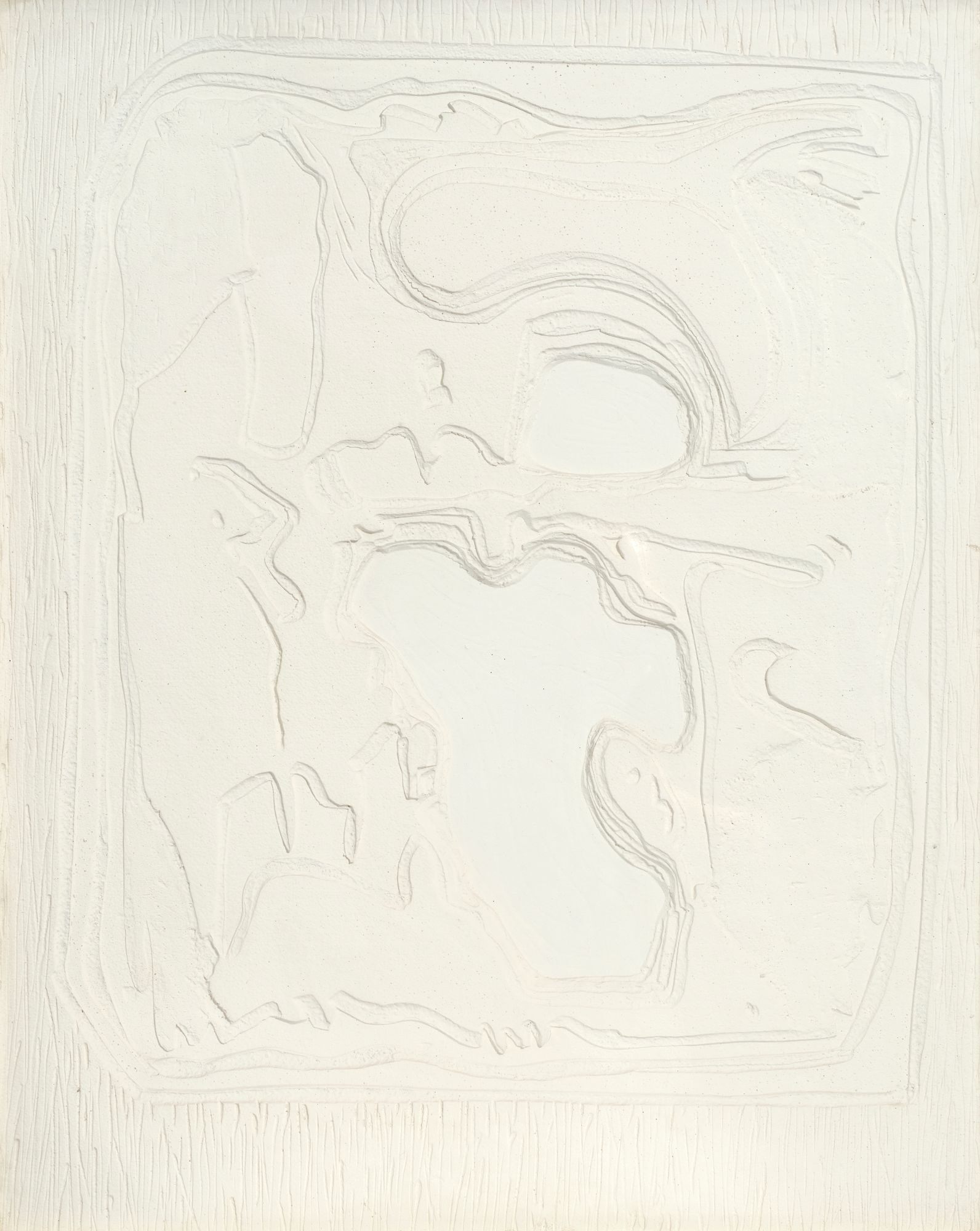
Logogrifo EG-TR I presents itself as a study in near-invisibility, its carved and relief forms emerging from a monochromatic white ground with the subtlety of breath on glass. Executed in polystyrene in 1969, the work belongs to Gribaudo's celebrated Logogrifi series, in which the Turin-born artist, publisher, and designer explored the threshold between language and image, between legibility and abstraction. The surface of this large-scale panel, measuring 100 by 80 centimeters, is animated entirely by depth and light rather than color, with sinuous contour lines, pooling voids, and layered ridges that suggest geological strata, cartographic tracings, or the fossilized impression of some vanished organism. The forms resist easy identification yet carry an unmistakable sense of intention, as though encoding a message that hovers perpetually at the edge of comprehension. Gribaudo arrived at this body of work from a unique position as both a fine artist and the director of the influential Edizioni d'Arte Fratelli Pozzo, where he collaborated closely with figures including Pablo Picasso, Max Ernst, and Jean Dubuffet. That proximity to some of the twentieth century's most inventive minds inflected his own practice with a sophisticated awareness of material, surface, and the act of making marks as a form of communication. In Logogrifo EG-TR I, the carved polystyrene becomes a kind of primary language, one that precedes or perhaps exceeds verbal meaning. The ridged border framing the central composition reinforces this sense of the work as a kind of tablet or inscription, something retrieved rather than invented. For collectors, the work occupies a compelling position within postwar Italian art, connecting to broader movements including Arte Povera and Concrete poetry while remaining thoroughly singular in its execution and sensibility. Polystyrene, chosen here not as a cheap substitute but as a material with its own expressive character, responds to carving with a delicacy that plaster or wood cannot replicate, preserving the finest hesitations and pressures of the artist's hand. The result is a work of quiet authority, one that rewards sustained looking and performs differently across changing light conditions throughout the day. Logogrifo EG-TR I represents Gribaudo at the height of his experimental confidence, producing an object that is simultaneously archaic in feeling and entirely of its radical moment.

Medium
Carving and relief on polystyrene

🔨 Auction Lot

Martini Studio d'Arte: Modern And Contemporary Art

June 10, 2026

Estimate: €2,000 to €3,000

Lot 228

Start the Discussion

Request access to join the discussion

About this work

Ezio Gribaudo, Logogrifo EG-TR I, 1969

Logogrifo EG-TR I presents itself as a study in near-invisibility, its carved and relief forms emerging from a monochromatic white ground with the subtlety of breath on glass. Executed in polystyrene in 1969, the work belongs to Gribaudo's celebrated Logogrifi series, in which the Turin-born artist, publisher, and designer explored the threshold between language and image, between legibility and abstraction. The surface of this large-scale panel, measuring 100 by 80 centimeters, is animated entirely by depth and light rather than color, with sinuous contour lines, pooling voids, and layered ridges that suggest geological strata, cartographic tracings, or the fossilized impression of some vanished organism. The forms resist easy identification yet carry an unmistakable sense of intention, as though encoding a message that hovers perpetually at the edge of comprehension. Gribaudo arrived at this body of work from a unique position as both a fine artist and the director of the influential Edizioni d'Arte Fratelli Pozzo, where he collaborated closely with figures including Pablo Picasso, Max Ernst, and Jean Dubuffet. That proximity to some of the twentieth century's most inventive minds inflected his own practice with a sophisticated awareness of material, surface, and the act of making marks as a form of communication. In Logogrifo EG-TR I, the carved polystyrene becomes a kind of primary language, one that precedes or perhaps exceeds verbal meaning. The ridged border framing the central composition reinforces this sense of the work as a kind of tablet or inscription, something retrieved rather than invented. For collectors, the work occupies a compelling position within postwar Italian art, connecting to broader movements including Arte Povera and Concrete poetry while remaining thoroughly singular in its execution and sensibility. Polystyrene, chosen here not as a cheap substitute but as a material with its own expressive character, responds to carving with a delicacy that plaster or wood cannot replicate, preserving the finest hesitations and pressures of the artist's hand. The result is a work of quiet authority, one that rewards sustained looking and performs differently across changing light conditions throughout the day. Logogrifo EG-TR I represents Gribaudo at the height of his experimental confidence, producing an object that is simultaneously archaic in feeling and entirely of its radical moment.

Medium
Carving and relief on polystyrene
Year
1969
Seen at
Martini Studio d'Arte

Related themes

Abstract Relief, Constructivist, European Artist, Relief, Material Exploration, Conceptual, Tactile Surface, Male Artist, Modernist, Sculpture, Polystyrene, Italian Artist, Sign And Symbol, Three Dimensional Work, Geometric Abstraction, Textural Surface, Large Format, Postwar Art, White Monochromatic, Minimalist Palette, Language and Image, Abstract