Join The Collection to save, track, and explore works like this.

Soshana Afroyim — 9.0
Soshana Afroyim

9.0

1959

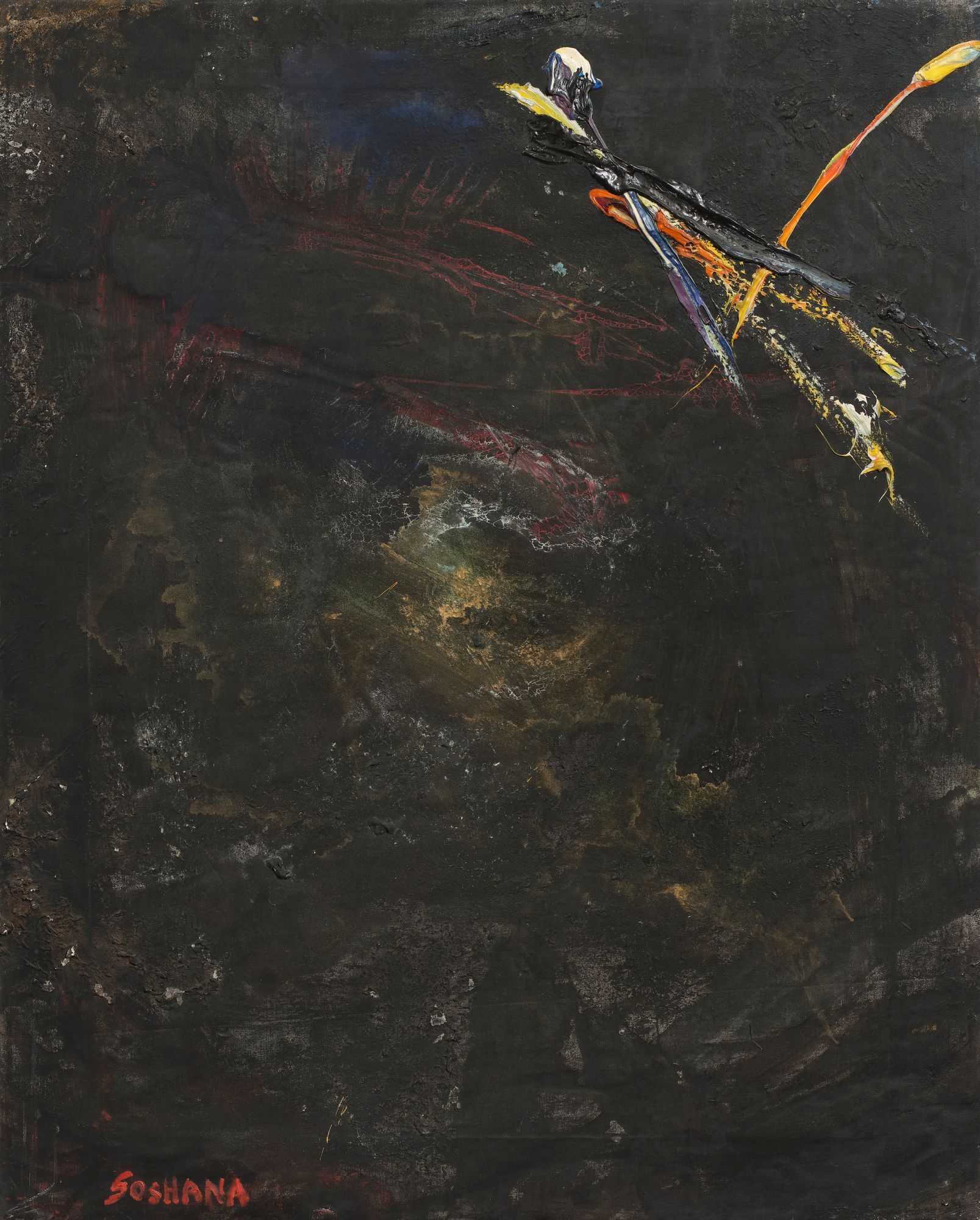
Painted in 1959, this mixed media work on canvas plunges the viewer into a field of dense, textured darkness from which a single explosive motif erupts in the upper right quadrant. Against a ground built up with layered blacks, shadowed umbers, and the faint geological striations of scraped and reworked paint, a burst of vivid color commands immediate attention. Yellow, orange, red, and blue extend outward from a central black spine in gestures that simultaneously suggest a comet trailing light, a bird in violent flight, and the fragmented anatomy of a human figure. The red calligraphic marks scattered across the upper left portion of the canvas read as residual energy, faint transmissions from whatever force has already passed through the composition. Soshana Afroyim was working at the height of the postwar abstract expressionist moment when she produced this painting, though her practice resists easy alignment with any single school. Having traveled extensively and absorbed influences from Paris, New York, Tokyo, and beyond, she brought a cosmopolitan restlessness to her canvases that distinguishes them from the more programmatic gesturalism of her contemporaries. In a work like this one, the dramatic asymmetry and the deliberate emptiness of the lower two thirds of the composition reflect an awareness of Asian spatial philosophies as much as Western action painting. The void is not absence but potential, a charged ground against which the lone energetic form becomes more luminous and more precarious. The title, rendered simply as a numerical designation, encourages the viewer to approach the work without predetermined narrative, allowing the physical materiality of the surface to speak first. The impastoed texture of the central figure, the scratched and faintly iridescent passages in the mid-ground, and the uneven density of the black field all reward close inspection and reward the tactile attention that reproduction cannot fully convey. At 81 by 65 centimeters, the canvas is intimate enough to invite sustained looking while carrying a psychological scale that feels considerably larger. For collectors with an interest in postwar European and international abstraction, this work offers a rare point of entry into the practice of an artist whose reputation has grown steadily as scholars and institutions revisit the broader, more geographically diverse story of mid-century modernism.

Medium
Mixed media on canvas

🔨 Auction Lot

Martini Studio d'Arte: Modern And Contemporary Art

June 10, 2026

Estimate: €1,000 to €2,000

Lot 167

Start the Discussion

Request access to join the discussion

About this work

Soshana Afroyim, 9.0, 1959

Painted in 1959, this mixed media work on canvas plunges the viewer into a field of dense, textured darkness from which a single explosive motif erupts in the upper right quadrant. Against a ground built up with layered blacks, shadowed umbers, and the faint geological striations of scraped and reworked paint, a burst of vivid color commands immediate attention. Yellow, orange, red, and blue extend outward from a central black spine in gestures that simultaneously suggest a comet trailing light, a bird in violent flight, and the fragmented anatomy of a human figure. The red calligraphic marks scattered across the upper left portion of the canvas read as residual energy, faint transmissions from whatever force has already passed through the composition. Soshana Afroyim was working at the height of the postwar abstract expressionist moment when she produced this painting, though her practice resists easy alignment with any single school. Having traveled extensively and absorbed influences from Paris, New York, Tokyo, and beyond, she brought a cosmopolitan restlessness to her canvases that distinguishes them from the more programmatic gesturalism of her contemporaries. In a work like this one, the dramatic asymmetry and the deliberate emptiness of the lower two thirds of the composition reflect an awareness of Asian spatial philosophies as much as Western action painting. The void is not absence but potential, a charged ground against which the lone energetic form becomes more luminous and more precarious. The title, rendered simply as a numerical designation, encourages the viewer to approach the work without predetermined narrative, allowing the physical materiality of the surface to speak first. The impastoed texture of the central figure, the scratched and faintly iridescent passages in the mid-ground, and the uneven density of the black field all reward close inspection and reward the tactile attention that reproduction cannot fully convey. At 81 by 65 centimeters, the canvas is intimate enough to invite sustained looking while carrying a psychological scale that feels considerably larger. For collectors with an interest in postwar European and international abstraction, this work offers a rare point of entry into the practice of an artist whose reputation has grown steadily as scholars and institutions revisit the broader, more geographically diverse story of mid-century modernism.

Medium
Mixed media on canvas
Year
1959
Seen at
Martini Studio d'Arte

Related themes

Asymmetric Composition, Vivid Accent Colors, Dark Palette, Figurative Abstraction, Cosmopolitan Artist, Explosive Energy, Mixed Media Canvas, Mixed Media, Midcentury Modern, Eastern Influence, Action Painting, Gestural Abstraction, Austrian Artist, Cosmic Imagery, Negative Space, Postwar Art, Abstract Expressionist, Calligraphic Mark, Female Artist, Earth Tones, Textured Surface