Join The Collection to save, track, and explore works like this.

Juan Fernando Olaguíbel & Vicente Mendiola — Diana the Huntress Fountain (La Diana Cazadora)

Diana the Huntress Fountain (La Diana Cazadora)

1942

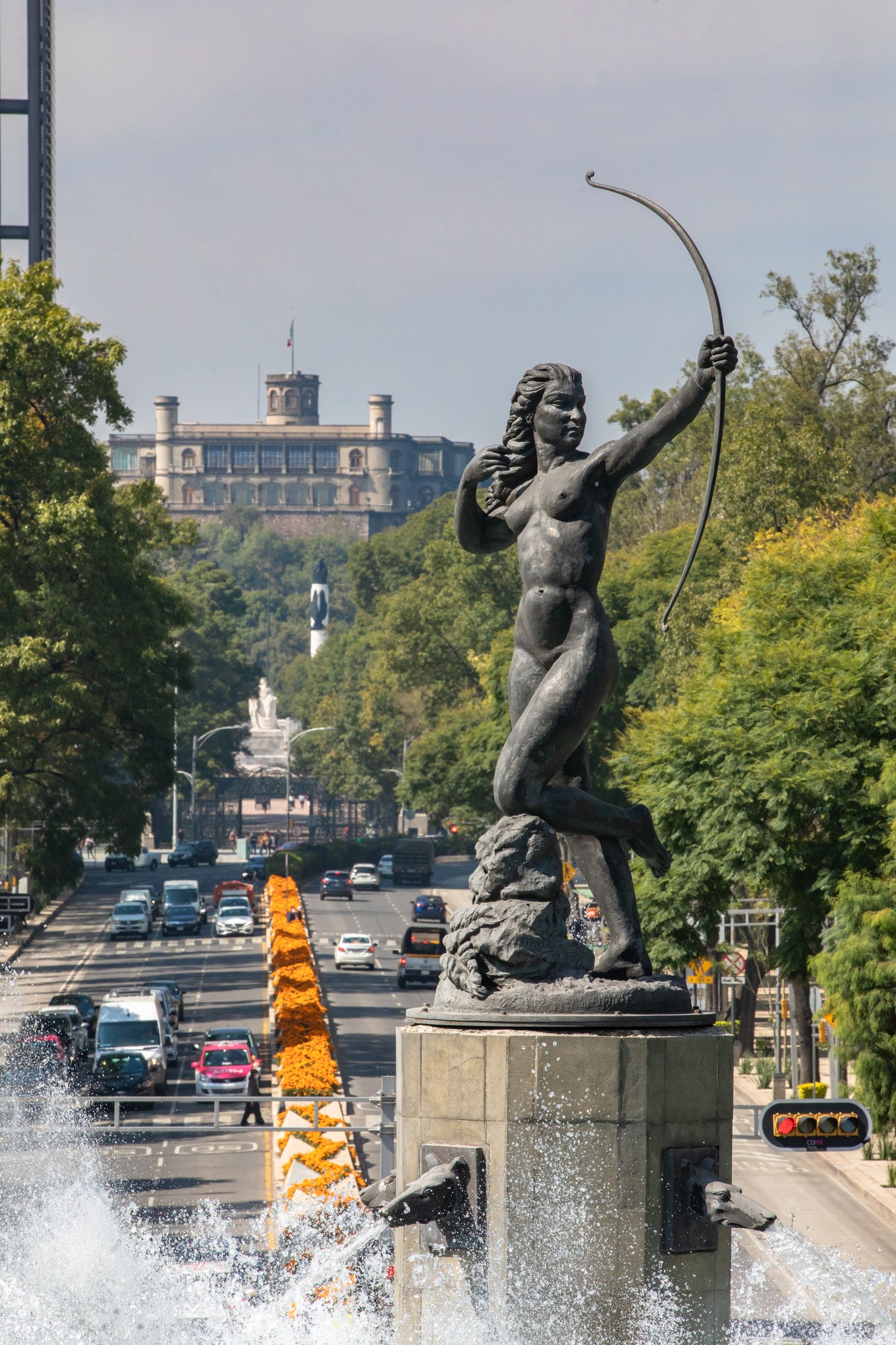
This monumental bronze sculpture depicts a classical female archer in dynamic contrapposto, her muscular form rising from a stone pedestal as she draws her bow skyward in a gesture of triumph and dominion. Created by Juan Fernando Olaguíbel and Vicente Mendiola, the work stands at the heart of Mexico City's Paseo de la Reforma, one of the city's most iconic thoroughfares, commanding the roundabout with commanding presence and archetypal grace. The figure's classical proportions and mythological reference point to early twentieth century modernist revival aesthetics, while its monumental scale and prominent civic placement assert it as a symbol of Mexican cultural identity and urban pride. Water fountains cascade dramatically around the base, animating the sculpture and creating a dynamic interplay between stone, bronze, and liquid movement. The work remains one of Mexico City's most recognizable public artworks, visible from considerable distances along the Reforma and serving as a gathering point and navigational landmark for the city's residents and visitors. Wikimedia Commons (CC BY-SA)

Medium
Bronze sculpture and stone fountain

Start the Discussion

Request access to join the discussion

About this work

Juan Fernando Olaguíbel & Vicente Mendiola, Diana the Huntress Fountain (La Diana Cazadora), 1942

This monumental bronze sculpture depicts a classical female archer in dynamic contrapposto, her muscular form rising from a stone pedestal as she draws her bow skyward in a gesture of triumph and dominion. Created by Juan Fernando Olaguíbel and Vicente Mendiola, the work stands at the heart of Mexico City's Paseo de la Reforma, one of the city's most iconic thoroughfares, commanding the roundabout with commanding presence and archetypal grace. The figure's classical proportions and mythological reference point to early twentieth century modernist revival aesthetics, while its monumental scale and prominent civic placement assert it as a symbol of Mexican cultural identity and urban pride. Water fountains cascade dramatically around the base, animating the sculpture and creating a dynamic interplay between stone, bronze, and liquid movement. The work remains one of Mexico City's most recognizable public artworks, visible from considerable distances along the Reforma and serving as a gathering point and navigational landmark for the city's residents and visitors. Wikimedia Commons (CC BY-SA)

Medium
Bronze sculpture and stone fountain
Year
1942
Seen at
Paseo de la Reforma roundabout

Related themes

Public Monument, Mexico City, Twentieth Century, Stone Pedestal, Civic Art, Monumental, Dynamic Pose, Bronze Sculpture, Urban Landmark, Architectural Sculpture, Modernist, Public Art, Female Form, Water Feature, Neoclassical, Iconic Landmark, Classical Mythology, Fountain, Figurative, Outdoor Sculpture