Join The Collection to save, track, and explore works like this.

Giovanni Anceschi — Struttura tricoma
Giovanni Anceschi

Struttura tricoma

1963

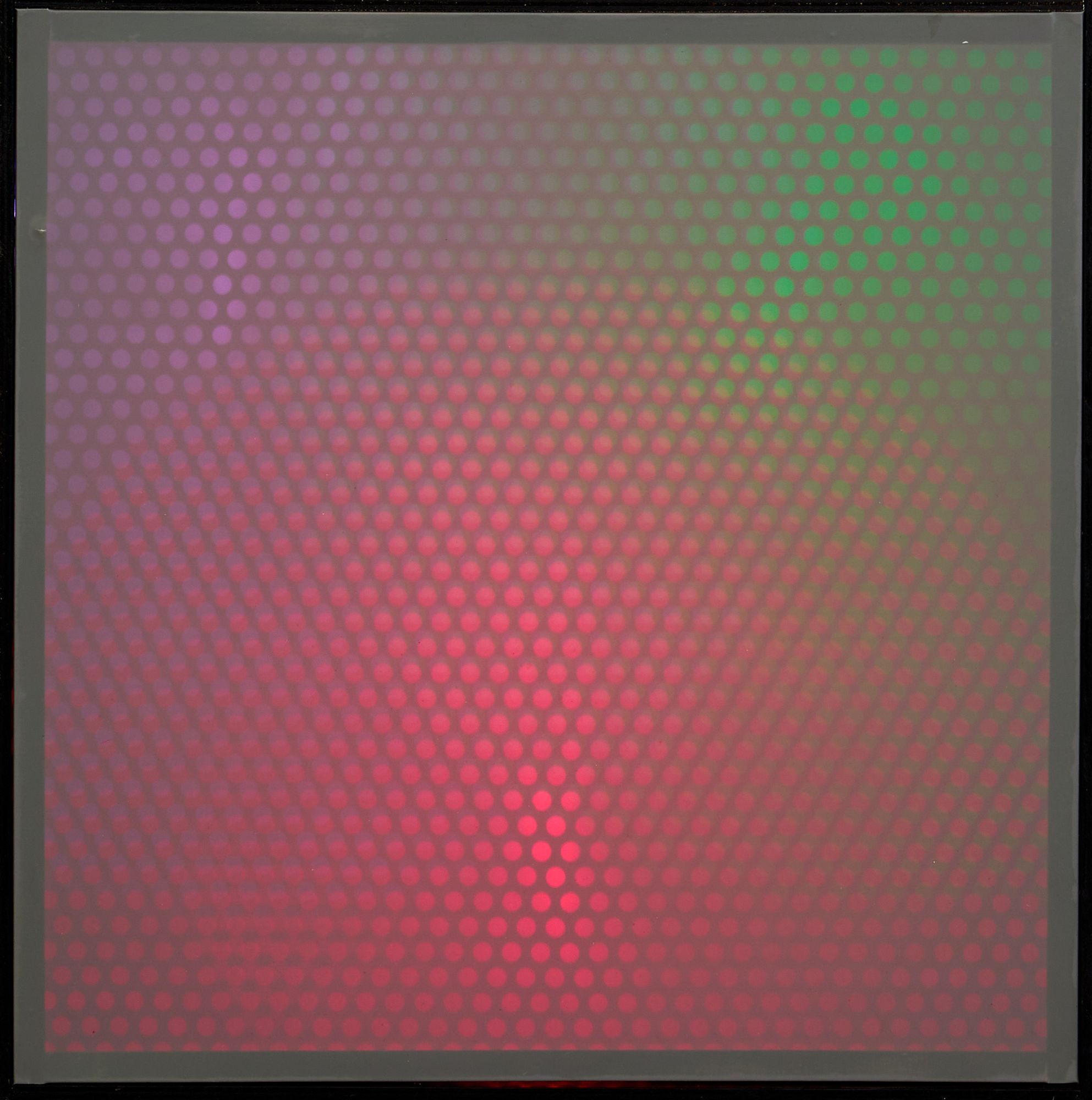
Struttura tricoma presents a luminous field of shifting color generated by the interaction of perforated metal sheeting, rotating light sources, and the subtle mechanics of an electric motor concealed within a cubic wooden housing. Completed in 1963 by Giovanni Anceschi, then a founding member of Milan's Gruppo T, the work belongs to a pivotal moment in Italian kinetic and programmed art when a generation of artists turned away from the canvas as a static object and toward light, movement, and viewer perception as the primary materials of aesthetic experience. The circular perforations in the metal sheet modulate the illumination passing through them, producing a moiré-like radiation of dots that migrates across the spectrum from deep crimson and magenta at the lower center to lilac and violet at the left and an intense emerald green at the upper right. This chromatic sweep is not painted but generated, meaning the image the viewer encounters is genuinely unstable and will differ depending on the position of the motor's cycle at any given moment of observation. Anceschi developed Struttura tricoma within the intellectual framework shared by Gruppo T colleagues Davide Boriani, Gianni Colombo, and Gabriele De Vecchi, all of whom were simultaneously investigating how mechanical and optical systems could produce works that resisted fixed readings. The group's theoretical grounding drew on Gestalt psychology, information theory, and a broader European conversation that connected them to contemporaries in France working within the GRAV collective and to kinetic artists across South America and Central Europe. Within this context, Anceschi's particular contribution was an interest in the phenomenology of color perception, and Struttura tricoma stands as one of his most resolved early explorations of how changing light conditions could disorient the viewer's ability to locate a stable pictorial surface, effectively collapsing the distinction between object, image, and atmosphere. For collectors, this work represents a rare opportunity to acquire a 1963 example from a formative figure whose institutional recognition has grown substantially in recent decades, with major survey exhibitions of programmed art at venues including the Palazzo Reale in Milan placing Gruppo T's work in renewed critical focus. The piece retains its original mechanical components and wooden housing, offering not only historical integrity but also the full kinetic experience that separates it from any documentary reproduction.

Medium
Box, wood, perforated metal sheet, light bulbs and electric motor

🔨 Auction Lot

Martini Studio d'Arte: Modern And Contemporary Art

June 10, 2026

Estimate: €8,000 to €10,000

Lot 9

Start the Discussion

Request access to join the discussion

About this work

Giovanni Anceschi, Struttura tricoma, 1963

Struttura tricoma presents a luminous field of shifting color generated by the interaction of perforated metal sheeting, rotating light sources, and the subtle mechanics of an electric motor concealed within a cubic wooden housing. Completed in 1963 by Giovanni Anceschi, then a founding member of Milan's Gruppo T, the work belongs to a pivotal moment in Italian kinetic and programmed art when a generation of artists turned away from the canvas as a static object and toward light, movement, and viewer perception as the primary materials of aesthetic experience. The circular perforations in the metal sheet modulate the illumination passing through them, producing a moiré-like radiation of dots that migrates across the spectrum from deep crimson and magenta at the lower center to lilac and violet at the left and an intense emerald green at the upper right. This chromatic sweep is not painted but generated, meaning the image the viewer encounters is genuinely unstable and will differ depending on the position of the motor's cycle at any given moment of observation. Anceschi developed Struttura tricoma within the intellectual framework shared by Gruppo T colleagues Davide Boriani, Gianni Colombo, and Gabriele De Vecchi, all of whom were simultaneously investigating how mechanical and optical systems could produce works that resisted fixed readings. The group's theoretical grounding drew on Gestalt psychology, information theory, and a broader European conversation that connected them to contemporaries in France working within the GRAV collective and to kinetic artists across South America and Central Europe. Within this context, Anceschi's particular contribution was an interest in the phenomenology of color perception, and Struttura tricoma stands as one of his most resolved early explorations of how changing light conditions could disorient the viewer's ability to locate a stable pictorial surface, effectively collapsing the distinction between object, image, and atmosphere. For collectors, this work represents a rare opportunity to acquire a 1963 example from a formative figure whose institutional recognition has grown substantially in recent decades, with major survey exhibitions of programmed art at venues including the Palazzo Reale in Milan placing Gruppo T's work in renewed critical focus. The piece retains its original mechanical components and wooden housing, offering not only historical integrity but also the full kinetic experience that separates it from any documentary reproduction.

Medium
Box, wood, perforated metal sheet, light bulbs and electric motor
Year
1963
Seen at
Martini Studio d'Arte

Related themes

Experimental Form, Light Installation, Avant Garde, Constructivist, European Artist, Kinetic Art, Geometric Abstract, Male Artist, Sculpture, Mixed Media, Immersive Work, Industrial Materials, Op Art, Italian Artist, Motorized Work, Perceptual Art, Interactive Art, Programmed Art, Violet And Green, Vibrant Color, Abstract