Join The Collection to save, track, and explore works like this.

Nanni Valentini — Untitled
Nanni Valentini

Untitled

1975

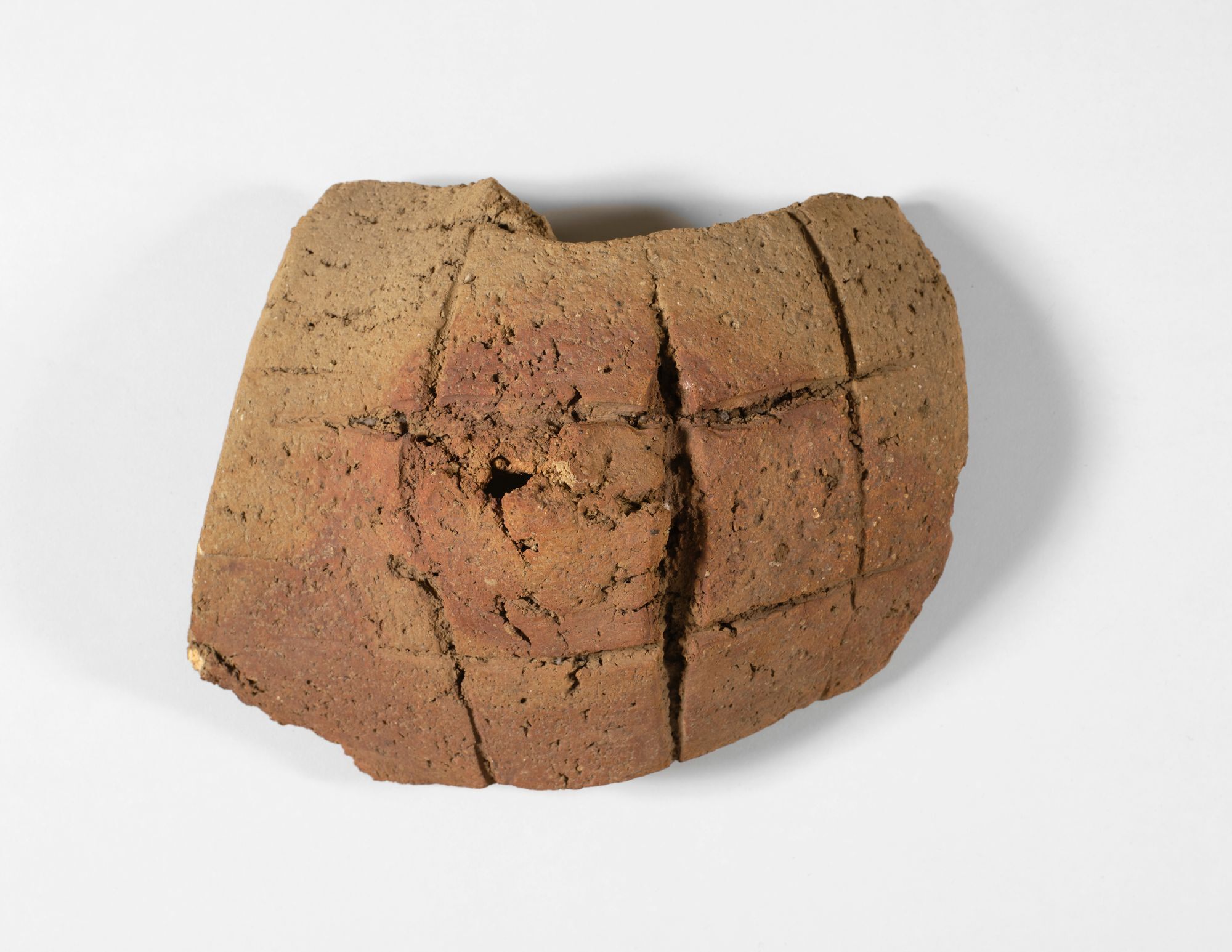
This untitled terracotta sculpture by Nanni Valentini presents itself as a dense, weathered mass of fired earth, its surface scored with a deliberate grid of incised lines that divide the form into a series of irregular rectangular planes. The work measures 13 by 23 by 27 centimeters, a compact yet weighty presence that rewards close physical attention. Across its surface, variations in tone shift from warm ochre to deeper reddish-brown, evidence of uneven firing temperatures and the expressive possibilities Valentini found within the kiln's transformative process. A rupture near the center of the form, where the clay has cracked and partially collapsed inward, reads not as damage but as an intentional disclosure of the material's inner logic, its vulnerability and resistance made simultaneously visible. Valentini, who worked in Milan and was closely associated with postwar Italian ceramic experimentation, approached terracotta as a medium capable of philosophical weight equal to bronze or stone. His practice during the 1970s engaged deeply with Arte Povera's broader interrogation of industrial culture, positioning raw and ancient materials against the aesthetics of technological modernity. The grid imposed upon this work carries that tension directly: a rational, ordering structure pressed into an inherently unpredictable and organic substance, with the material asserting its own nature through cracks, surface irregularities, and tonal accident. The result is a dialogue between human intention and earthly resistance that defines much of Valentini's most significant output from this period. Works from Valentini's 1975 production are relatively scarce in private collections outside Italy, and pieces that demonstrate this characteristic interplay of structural incision and expressive material behavior are particularly sought by collectors focused on postwar Italian sculpture and the Arte Povera constellation. The modest scale of this piece belies its conceptual density, functioning equally well within an intimate domestic setting or alongside larger institutional holdings. Its condition reflects the honest aging of an unglazed, deliberately raw surface, with no restorations or interventions, preserving the integrity of Valentini's original material choices. For collectors attentive to the history of ceramics as fine art rather than craft, this work represents a compelling point of entry into one of the more underrecognized figures of twentieth-century Italian sculpture.

Medium
Terracotta sculpture

🔨 Auction Lot

Martini Studio d'Arte: Modern And Contemporary Art

June 10, 2026

Estimate: €2,000 to €3,000

Lot 132
Start the Discussion

Request access to join the discussion

About this work

Nanni Valentini, Untitled, 1975

This untitled terracotta sculpture by Nanni Valentini presents itself as a dense, weathered mass of fired earth, its surface scored with a deliberate grid of incised lines that divide the form into a series of irregular rectangular planes. The work measures 13 by 23 by 27 centimeters, a compact yet weighty presence that rewards close physical attention. Across its surface, variations in tone shift from warm ochre to deeper reddish-brown, evidence of uneven firing temperatures and the expressive possibilities Valentini found within the kiln's transformative process. A rupture near the center of the form, where the clay has cracked and partially collapsed inward, reads not as damage but as an intentional disclosure of the material's inner logic, its vulnerability and resistance made simultaneously visible. Valentini, who worked in Milan and was closely associated with postwar Italian ceramic experimentation, approached terracotta as a medium capable of philosophical weight equal to bronze or stone. His practice during the 1970s engaged deeply with Arte Povera's broader interrogation of industrial culture, positioning raw and ancient materials against the aesthetics of technological modernity. The grid imposed upon this work carries that tension directly: a rational, ordering structure pressed into an inherently unpredictable and organic substance, with the material asserting its own nature through cracks, surface irregularities, and tonal accident. The result is a dialogue between human intention and earthly resistance that defines much of Valentini's most significant output from this period. Works from Valentini's 1975 production are relatively scarce in private collections outside Italy, and pieces that demonstrate this characteristic interplay of structural incision and expressive material behavior are particularly sought by collectors focused on postwar Italian sculpture and the Arte Povera constellation. The modest scale of this piece belies its conceptual density, functioning equally well within an intimate domestic setting or alongside larger institutional holdings. Its condition reflects the honest aging of an unglazed, deliberately raw surface, with no restorations or interventions, preserving the integrity of Valentini's original material choices. For collectors attentive to the history of ceramics as fine art rather than craft, this work represents a compelling point of entry into one of the more underrecognized figures of twentieth-century Italian sculpture.

Medium
Terracotta sculpture
Year
1975
Seen at
Martini Studio d'Arte

Related themes

Raw Materials, Terracotta, Small Scale, Twentieth Century, European Artist, Grid Pattern, Ochre And Brown, Male Artist, Industrial Critique, Modernist, Sculpture, Ceramic Art, Italian Artist, Material Process, Postwar Art, Abstract Sculpture, Arte Povera, Earth Tones, Fired Earth, Organic Form, Texture And Surface

More works by Nanni Valentini