Join The Collection to save, track, and explore works like this.

Sergio Dangelo — White moon
Sergio Dangelo

White moon

1961

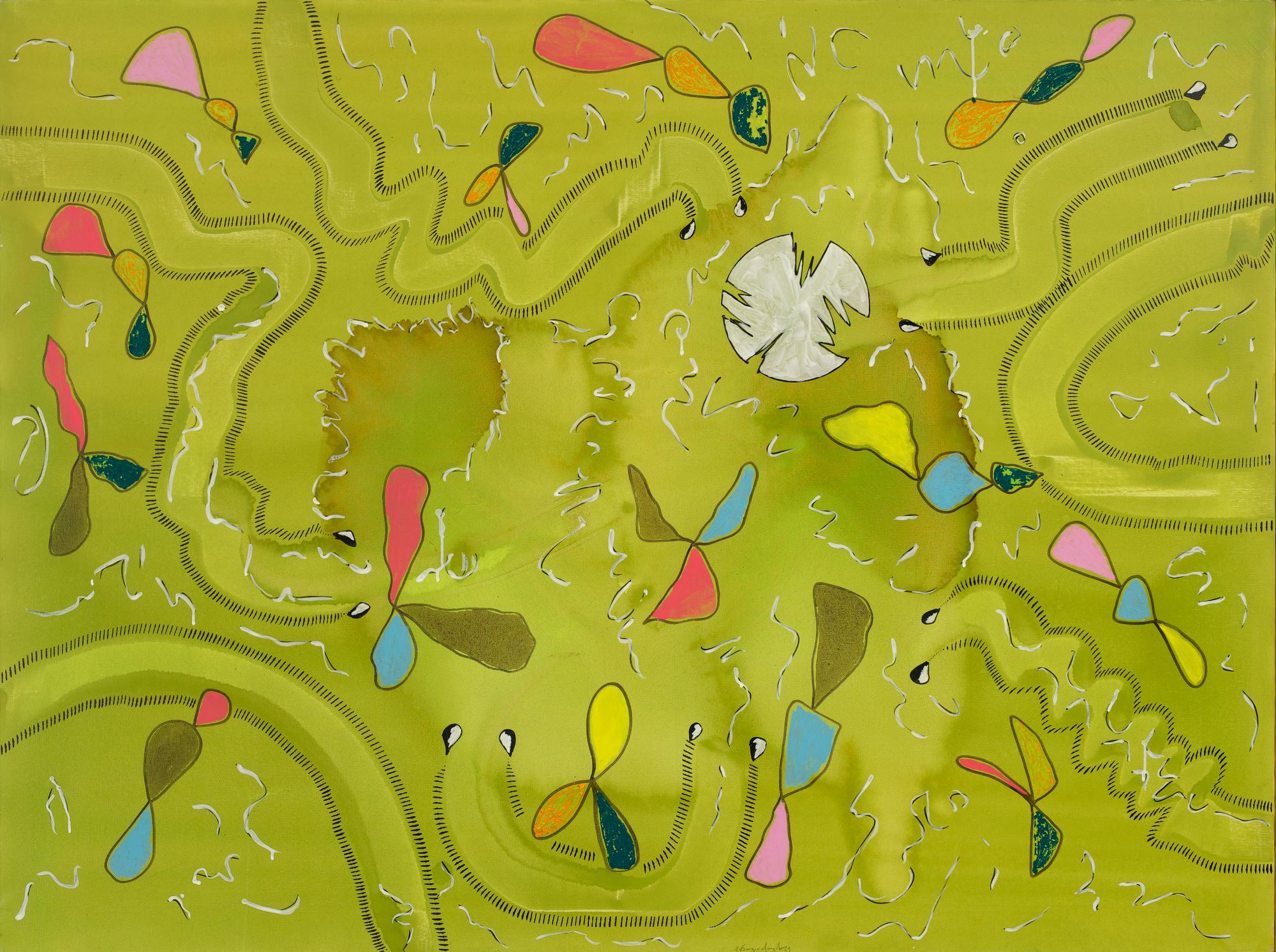
Painted in 1961 at the height of Sergio Dangelo's engagement with the Italian nuclear art movement, White Moon presents a luminous chartreuse field animated by biomorphic forms that drift, spin, and cluster across the canvas like microorganisms observed through an electron microscope. The composition refuses any single focal point, drawing the eye instead along sinuous dotted pathways and spiraling white lines that suggest both cosmic trajectories and cellular membranes. At the painting's approximate center, a white foliate shape, the titular moon, presides with quiet authority amid the surrounding chromatic energy, its pale silvery mass offering a moment of stillness within an otherwise restless pictorial ecology. Dangelo populates the field with paired teardrop and lobe forms rendered in coral, sky blue, saffron, teal, yellow-green, and dusty olive. These shapes evoke propellers, butterfly wings, or perhaps the paired lobes of dividing cells, never fully resolving into any single identification. This deliberate ambiguity connects Dangelo's practice to the broader Nucleare sensibility he helped articulate in the late 1940s and 1950s alongside Enrico Baj, a sensibility that positioned atomic and biological imagery as the defining visual language of the postwar condition. The dotted lines weaving through the composition recall both stitching and the dashed trajectories of particles in a cloud chamber, reinforcing a tension between the handmade and the scientific that runs throughout Dangelo's work of this period. At 120 by 160 centimeters, the canvas is substantial enough to envelop the viewer without overwhelming intimacy, and the oil medium allows for subtle tonal variations within the acid-green ground that reward close inspection. The painting has the clarity of a graphic sensibility married to the physical presence of painting, a combination that distinguishes Dangelo's mature work from contemporaneous abstraction in both France and the United States. White Moon stands as a particularly resolved example of his ability to synthesize surrealist automatism, nuclear iconography, and a distinctly Mediterranean decorative sensibility into a vision that feels simultaneously playful and unsettled, celebrating biological vitality while quietly registering the anxieties of an era shaped by atomic discovery.

Medium
Oil on canvas

🔨 Auction Lot

Martini Studio d'Arte: Modern And Contemporary Art

June 10, 2026

Estimate: €2,000 to €3,000

Lot 223

Start the Discussion

Request access to join the discussion

More by Sergio Dangelo

About this work

Sergio Dangelo, White moon, 1961

Painted in 1961 at the height of Sergio Dangelo's engagement with the Italian nuclear art movement, White Moon presents a luminous chartreuse field animated by biomorphic forms that drift, spin, and cluster across the canvas like microorganisms observed through an electron microscope. The composition refuses any single focal point, drawing the eye instead along sinuous dotted pathways and spiraling white lines that suggest both cosmic trajectories and cellular membranes. At the painting's approximate center, a white foliate shape, the titular moon, presides with quiet authority amid the surrounding chromatic energy, its pale silvery mass offering a moment of stillness within an otherwise restless pictorial ecology. Dangelo populates the field with paired teardrop and lobe forms rendered in coral, sky blue, saffron, teal, yellow-green, and dusty olive. These shapes evoke propellers, butterfly wings, or perhaps the paired lobes of dividing cells, never fully resolving into any single identification. This deliberate ambiguity connects Dangelo's practice to the broader Nucleare sensibility he helped articulate in the late 1940s and 1950s alongside Enrico Baj, a sensibility that positioned atomic and biological imagery as the defining visual language of the postwar condition. The dotted lines weaving through the composition recall both stitching and the dashed trajectories of particles in a cloud chamber, reinforcing a tension between the handmade and the scientific that runs throughout Dangelo's work of this period. At 120 by 160 centimeters, the canvas is substantial enough to envelop the viewer without overwhelming intimacy, and the oil medium allows for subtle tonal variations within the acid-green ground that reward close inspection. The painting has the clarity of a graphic sensibility married to the physical presence of painting, a combination that distinguishes Dangelo's mature work from contemporaneous abstraction in both France and the United States. White Moon stands as a particularly resolved example of his ability to synthesize surrealist automatism, nuclear iconography, and a distinctly Mediterranean decorative sensibility into a vision that feels simultaneously playful and unsettled, celebrating biological vitality while quietly registering the anxieties of an era shaped by atomic discovery.

Medium
Oil on canvas
Year
1961
Seen at
Martini Studio d'Arte

Related themes

Organic Abstraction, Male Artist, Gestural Mark Making, Scientific Influence, Modernist, Nuclear Art, Mid Century, Cool Tones, Nature Inspired, Oil On Canvas, Chartreuse Palette, Cellular Forms, Non Figurative, Italian, Cosmic Imagery, Large Format, European, Warm Accents, Abstract, Postwar, Biomorphic

More works by Sergio Dangelo