Join The Collection to save, track, and explore works like this.

Emilio Scanavino — La grande macchia
Emilio Scanavino

La grande macchia

1963

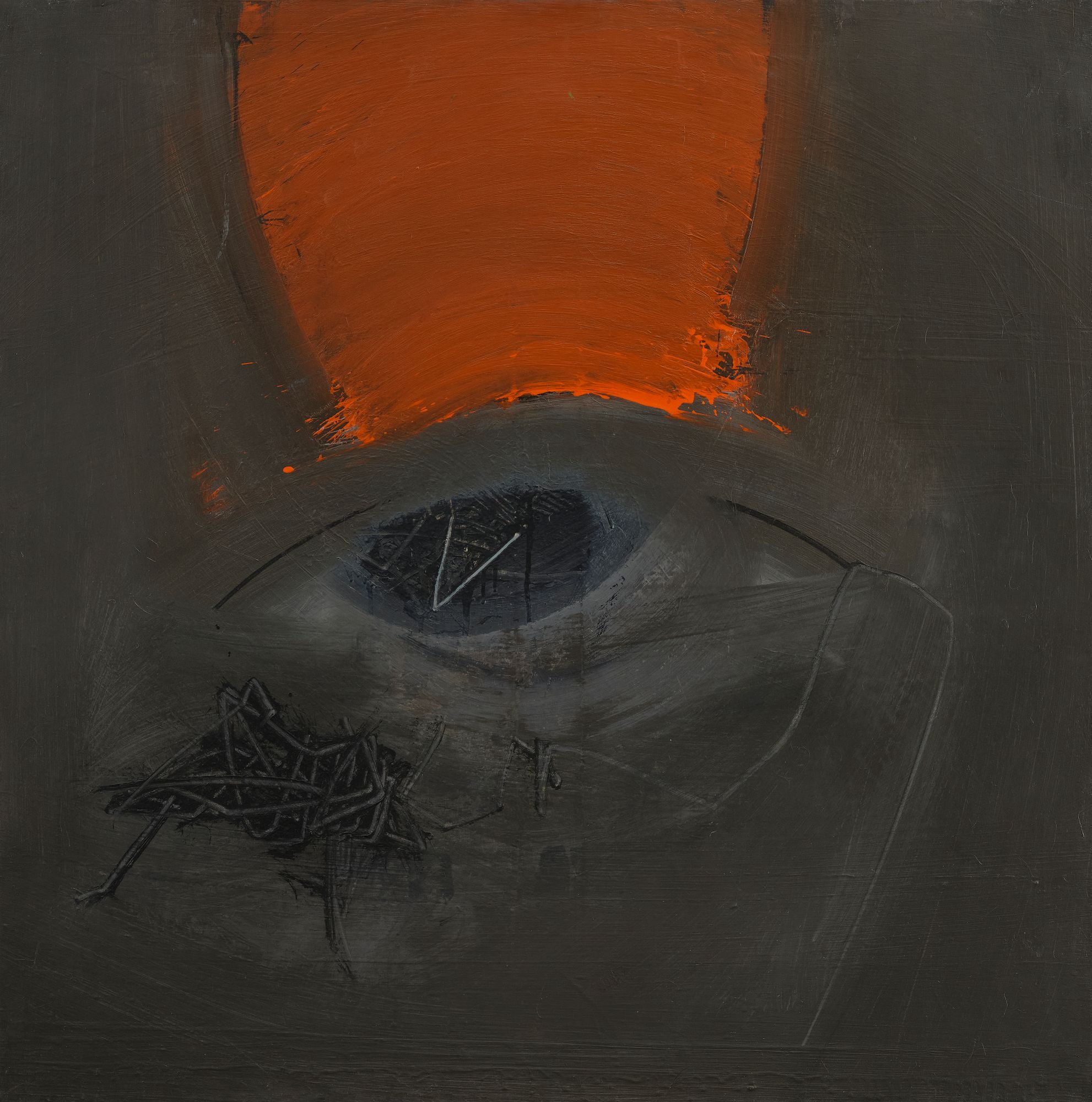
La grande macchia presents a brooding, nearly monochromatic field of dark grey-brown out of which emerges a central form suggesting an eye, rendered with a combination of painterly precision and visceral urgency. A vivid arc of orange-red occupies the upper register of the composition, functioning simultaneously as an eyelid, a horizon, and an open wound, its intense chromatic heat standing in stark contrast to the surrounding tonality. Below this luminous band, the eye itself gazes outward from a recessed, oval hollow, its iris rendered in deep blue-black and incised with linear marks that recall both handwriting and the structure of a pupil catching light. In the lower left quadrant, a tangle of what appears to be painted nails or sticks accumulates like detritus, grounding the image in the physical world even as the composition as a whole resists easy narrative interpretation. Scanavino developed his mature vocabulary in the postwar Italian context, engaging with the broader currents of Arte Informale while maintaining a consistently personal iconography centered on the sign, the mark, and the threshold between legibility and abstraction. La grande macchia, completed in 1963, belongs to a pivotal period in his practice when organic and architectural forms began to consolidate into recurring motifs, the eye among the most potent. For Scanavino, the eye was never merely a symbol of vision or surveillance; it functioned as a site of encounter between interior psychic space and the external world, a membrane rather than an instrument. The material surface of the painting rewards close attention. The grey field is worked with evident physical engagement, bearing the traces of scraping, layering, and revision that give the canvas a tactile density unusual even within the Informale tradition. The orange passages are applied with directional strokes that radiate outward, suggesting energy barely contained by the surrounding dark. The result is a work of considerable emotional gravity, one that operates as both object and presence in a room. At one hundred by one hundred centimeters, it commands space without ostentation, and its restrained palette ensures that the single burst of color carries extraordinary weight. La grande macchia represents Scanavino at the height of his expressive and compositional powers, and constitutes a significant example of Italian postwar painting for any serious collection.

Medium
Oil on canvas

🔨 Auction Lot

Martini Studio d'Arte: Modern And Contemporary Art

June 10, 2026

Estimate: €18,000 to €22,000

Lot 89

Start the Discussion

Request access to join the discussion

More by Emilio Scanavino

About this work

Emilio Scanavino, La grande macchia, 1963

La grande macchia presents a brooding, nearly monochromatic field of dark grey-brown out of which emerges a central form suggesting an eye, rendered with a combination of painterly precision and visceral urgency. A vivid arc of orange-red occupies the upper register of the composition, functioning simultaneously as an eyelid, a horizon, and an open wound, its intense chromatic heat standing in stark contrast to the surrounding tonality. Below this luminous band, the eye itself gazes outward from a recessed, oval hollow, its iris rendered in deep blue-black and incised with linear marks that recall both handwriting and the structure of a pupil catching light. In the lower left quadrant, a tangle of what appears to be painted nails or sticks accumulates like detritus, grounding the image in the physical world even as the composition as a whole resists easy narrative interpretation. Scanavino developed his mature vocabulary in the postwar Italian context, engaging with the broader currents of Arte Informale while maintaining a consistently personal iconography centered on the sign, the mark, and the threshold between legibility and abstraction. La grande macchia, completed in 1963, belongs to a pivotal period in his practice when organic and architectural forms began to consolidate into recurring motifs, the eye among the most potent. For Scanavino, the eye was never merely a symbol of vision or surveillance; it functioned as a site of encounter between interior psychic space and the external world, a membrane rather than an instrument. The material surface of the painting rewards close attention. The grey field is worked with evident physical engagement, bearing the traces of scraping, layering, and revision that give the canvas a tactile density unusual even within the Informale tradition. The orange passages are applied with directional strokes that radiate outward, suggesting energy barely contained by the surrounding dark. The result is a work of considerable emotional gravity, one that operates as both object and presence in a room. At one hundred by one hundred centimeters, it commands space without ostentation, and its restrained palette ensures that the single burst of color carries extraordinary weight. La grande macchia represents Scanavino at the height of his expressive and compositional powers, and constitutes a significant example of Italian postwar painting for any serious collection.

Medium
Oil on canvas
Year
1963
Seen at
Martini Studio d'Arte

Related themes

European Artist, Gestural Marks, Mid Century Modern, Dark Palette, Figurative Abstraction, Male Artist, Eye Motif, Modernist, Threshold Imagery, Abstract Painting, Italian Artist, Oil On Canvas, Sign And Symbol, Orange Accent, Psychic Interior, Large Format, Postwar Art, Abstract Expressionist, Body Imagery, Arte Informale, Earth Tones, Visceral Texture

More works by Emilio Scanavino