Join The Collection to save, track, and explore works like this.

Art Institute of Chicago

Spotted

Antonio Tempesta — The Fall of Phaeton
Antonio Tempesta

The Fall of Phaeton

1776

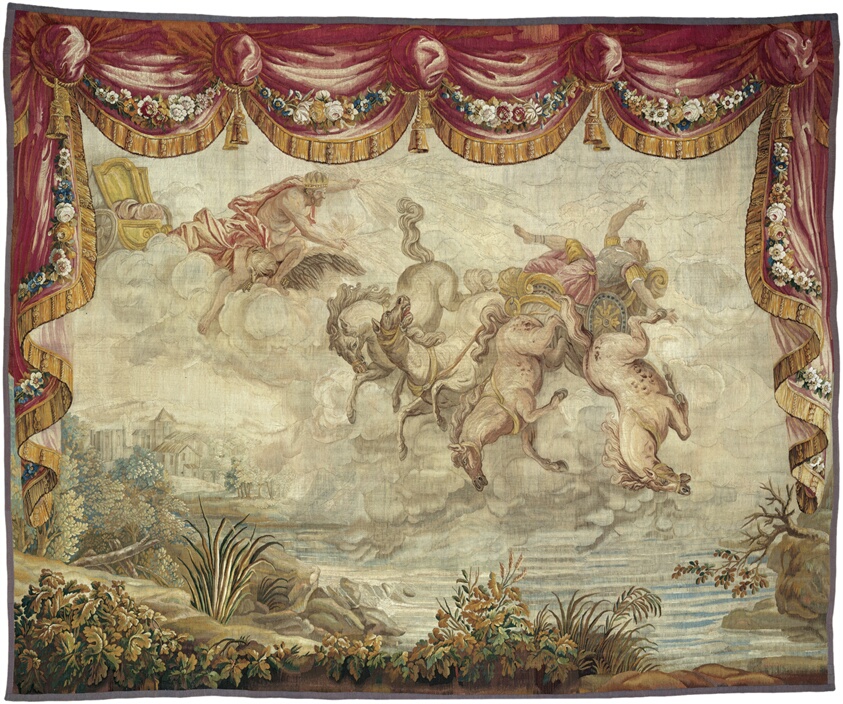
Phaeton’s overweening ambition to guide his father’s chariot of the sun through the sky is recorded in Ovid’s Metamorphoses, as is the disastrous outcome of his attempt, here presented in a dramatic scene that captures the tumultuous moment of Phaeton’s being struck down by a thunderbolt from Zeus. The scalloped valance and matching side curtains that frame the scene link it to The Arrival of Telemachus on Calypso’s Island. The two tapestries are part of a Story of Telemachus suite based on François Fénelon’s Adventures of Telemachus (Les Aventures de Télémaque; 1699), which was originally written as an ethical guide for the education of Louis, Duke of Burgundy (1618–1712), the grandson and heir of Louis XIV (r. 1643–1715). Phaeton’s story—particularly his death, as depicted in this tapestry—conveys the consequences of youthful intrepidity and pride, and like the tapestries’ source material, offers viewers a powerful moral lesson.

Medium
Wool and silk, slit and double interlocking tapestry weave
Dimensions

Start the Discussion

Request access to join the discussion

Spotted works by Antonio Tempesta

About this work

Antonio Tempesta, The Fall of Phaeton, 1776

Phaeton’s overweening ambition to guide his father’s chariot of the sun through the sky is recorded in Ovid’s Metamorphoses, as is the disastrous outcome of his attempt, here presented in a dramatic scene that captures the tumultuous moment of Phaeton’s being struck down by a thunderbolt from Zeus. The scalloped valance and matching side curtains that frame the scene link it to The Arrival of Telemachus on Calypso’s Island. The two tapestries are part of a Story of Telemachus suite based on François Fénelon’s Adventures of Telemachus (Les Aventures de Télémaque; 1699), which was originally written as an ethical guide for the education of Louis, Duke of Burgundy (1618–1712), the grandson and heir of Louis XIV (r. 1643–1715). Phaeton’s story—particularly his death, as depicted in this tapestry—conveys the consequences of youthful intrepidity and pride, and like the tapestries’ source material, offers viewers a powerful moral lesson.

Medium
Wool and silk, slit and double interlocking tapestry weave
Dimensions
351.2 x 286.3 cm
Year
1776
Seen at
Art Institute of Chicago, Chicago, IL

Related themes

Dramatic, Tapestry, Baroque, Textile, Italian, Narrative, Earth Tones, Mythological, 18th Century, Figurative

More works by Antonio Tempesta

Collected by

Art Institute of Chicago