Join The Collection to save, track, and explore works like this.

Ode Bertrand — Le Labyrinthe III
Ode Bertrand

Le Labyrinthe III

1999

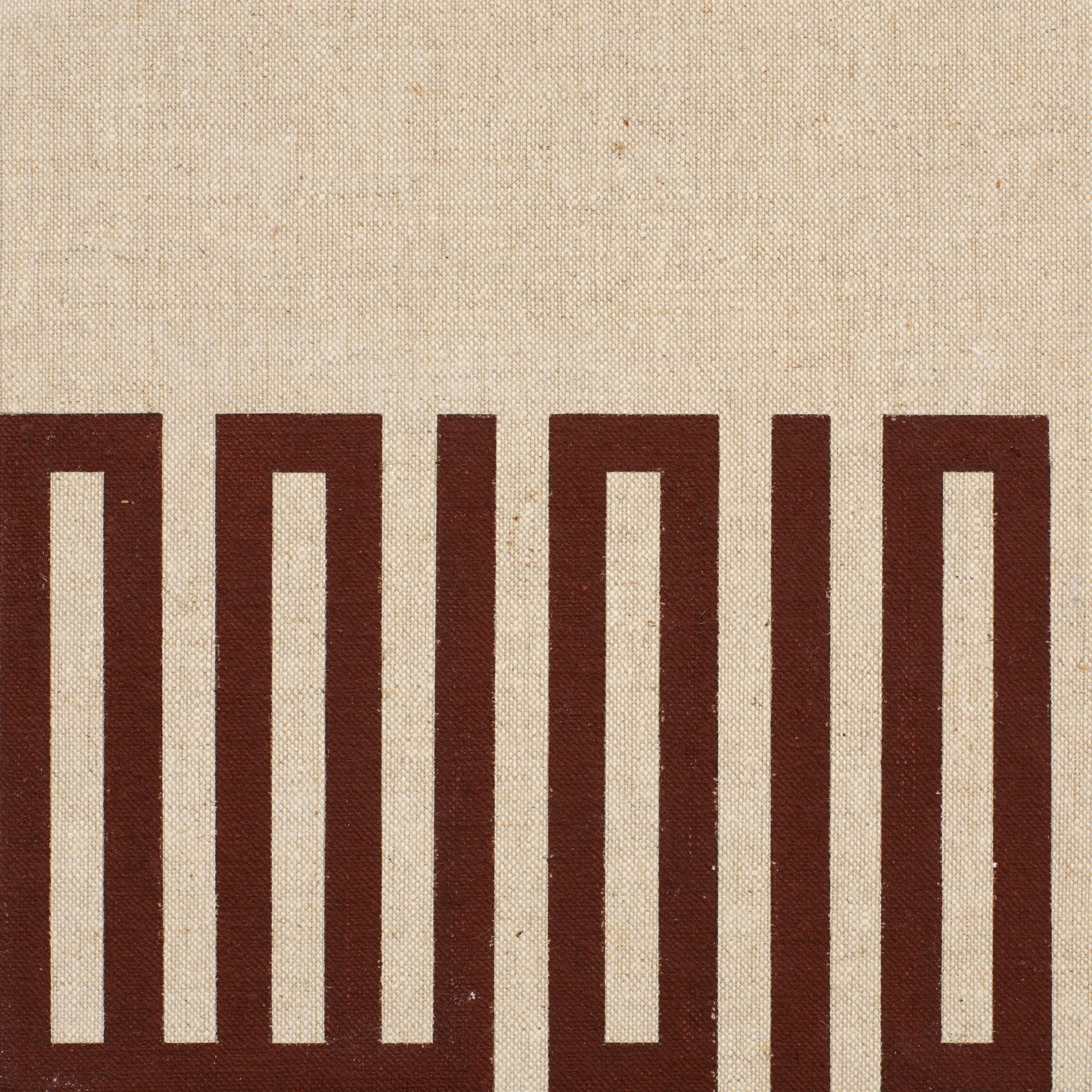
Le Labyrinthe III presents a tightly composed arrangement of deep burgundy rectangular forms set against a raw, unprimed linen ground. The repeated U-shaped elements march across the lower register of the canvas in a rhythmic procession, their open tops gesturing upward into the warm expanse of neutral fabric above. The interplay between positive and negative space is carefully calibrated, with the cream of the canvas weave reading as actively as the painted marks themselves. This two-tone austerity carries considerable visual tension, the geometric units appearing simultaneously like architectural crenellations, printed circuit pathways, or the upright teeth of an ancient comb. Ode Bertrand, the Belgian-born artist who spent much of her career working in Paris, was a committed practitioner of concrete and constructivist abstraction throughout the latter half of the twentieth century. Associated with the broader movement of post-war European geometric abstraction, she maintained a consistent investigation into seriality, rhythm, and the optical life of hard-edged form. Le Labyrinthe III, completed in 1999, belongs to a body of work in which the labyrinth serves as both literal subject and conceptual metaphor, evoking ideas of path, enclosure, and recursive movement without ever resorting to pictorial representation. The modest scale of twenty by twenty centimeters concentrates these concerns into an intimate and unusually focused object. The title invites contemplation of what it means to be inside or outside a system of forms, and the cropped composition reinforces this ambiguity, cutting the repeating units at both left and right edges so that the pattern implies continuation beyond the picture plane. The acrylic medium is handled with considerable restraint, the paint applied flatly and evenly in a manner that foregrounds structure over gesture. For collectors with an interest in European constructivism, concrete poetry, or the graphic traditions of Op art, this small canvas rewards close and sustained attention. Its apparent simplicity opens onto a quietly complex meditation on repetition and boundary, qualities that have ensured Bertrand's work an enduring place in the history of post-war European abstraction.

Medium
Acrylic on canvas

🔨 Auction Lot

Martini Studio d'Arte: Modern And Contemporary Art

June 10, 2026

Estimate: €1,000 to €2,000

Lot 198

Start the Discussion

Request access to join the discussion

About this work

Ode Bertrand, Le Labyrinthe III, 1999

Le Labyrinthe III presents a tightly composed arrangement of deep burgundy rectangular forms set against a raw, unprimed linen ground. The repeated U-shaped elements march across the lower register of the canvas in a rhythmic procession, their open tops gesturing upward into the warm expanse of neutral fabric above. The interplay between positive and negative space is carefully calibrated, with the cream of the canvas weave reading as actively as the painted marks themselves. This two-tone austerity carries considerable visual tension, the geometric units appearing simultaneously like architectural crenellations, printed circuit pathways, or the upright teeth of an ancient comb. Ode Bertrand, the Belgian-born artist who spent much of her career working in Paris, was a committed practitioner of concrete and constructivist abstraction throughout the latter half of the twentieth century. Associated with the broader movement of post-war European geometric abstraction, she maintained a consistent investigation into seriality, rhythm, and the optical life of hard-edged form. Le Labyrinthe III, completed in 1999, belongs to a body of work in which the labyrinth serves as both literal subject and conceptual metaphor, evoking ideas of path, enclosure, and recursive movement without ever resorting to pictorial representation. The modest scale of twenty by twenty centimeters concentrates these concerns into an intimate and unusually focused object. The title invites contemplation of what it means to be inside or outside a system of forms, and the cropped composition reinforces this ambiguity, cutting the repeating units at both left and right edges so that the pattern implies continuation beyond the picture plane. The acrylic medium is handled with considerable restraint, the paint applied flatly and evenly in a manner that foregrounds structure over gesture. For collectors with an interest in European constructivism, concrete poetry, or the graphic traditions of Op art, this small canvas rewards close and sustained attention. Its apparent simplicity opens onto a quietly complex meditation on repetition and boundary, qualities that have ensured Bertrand's work an enduring place in the history of post-war European abstraction.

Medium
Acrylic on canvas
Year
1999
Seen at
Martini Studio d'Arte

Related themes

Abstract Art, Labyrinth Theme, Constructivist, European Artist, Unprimed Linen, Seriality And Rhythm, Positive Negative Space, Belgian Artist, Modernist, Post War Art, Two Tone Palette, Small Scale Work, Pattern And Repetition, Acrylic On Linen, Geometric Abstraction, Burgundy And Cream, Concrete Art, Square Format, Neutral Tones, Female Artist, Hard Edge