Join The Collection to save, track, and explore works like this.

Mirko Basaldella — Elettra
Mirko Basaldella

Elettra

1969

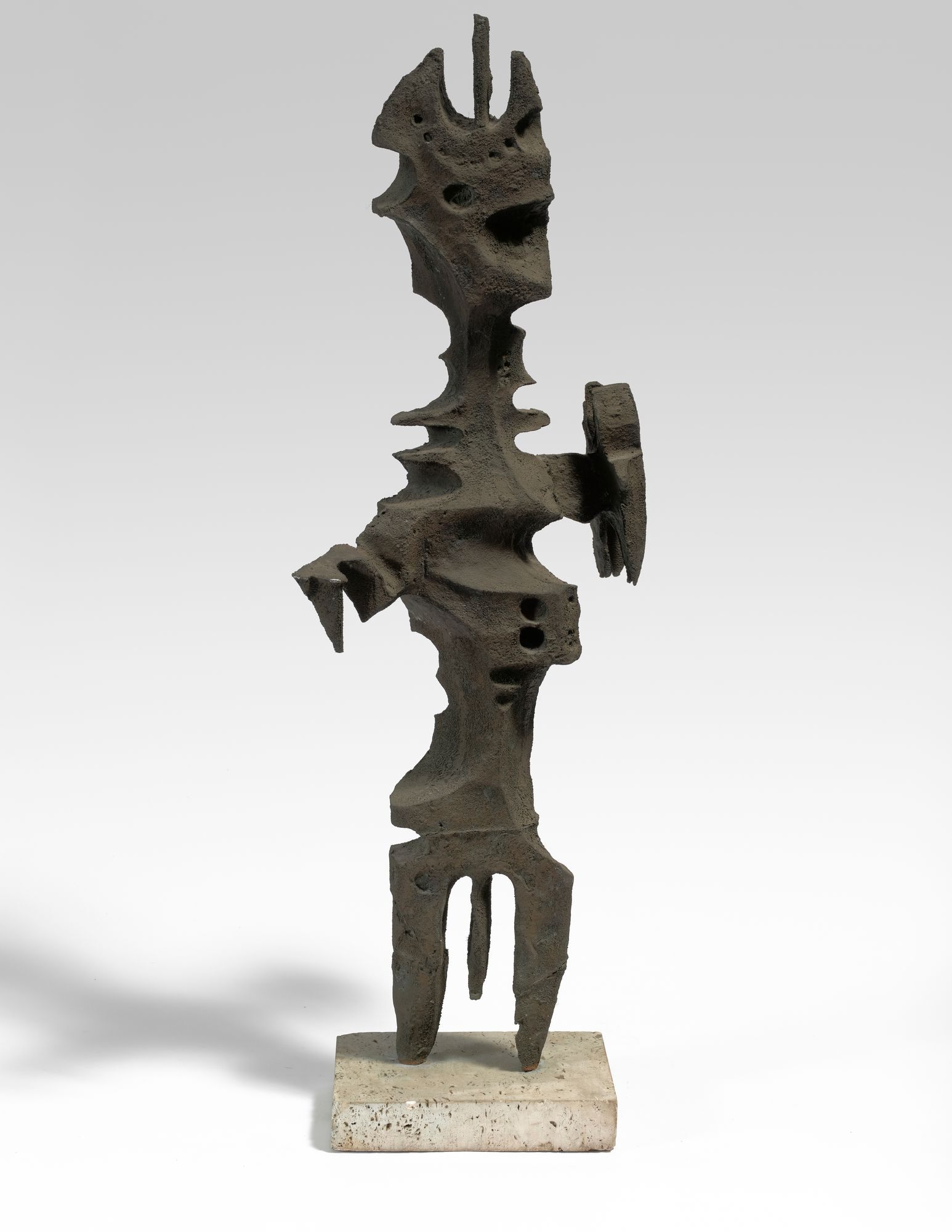
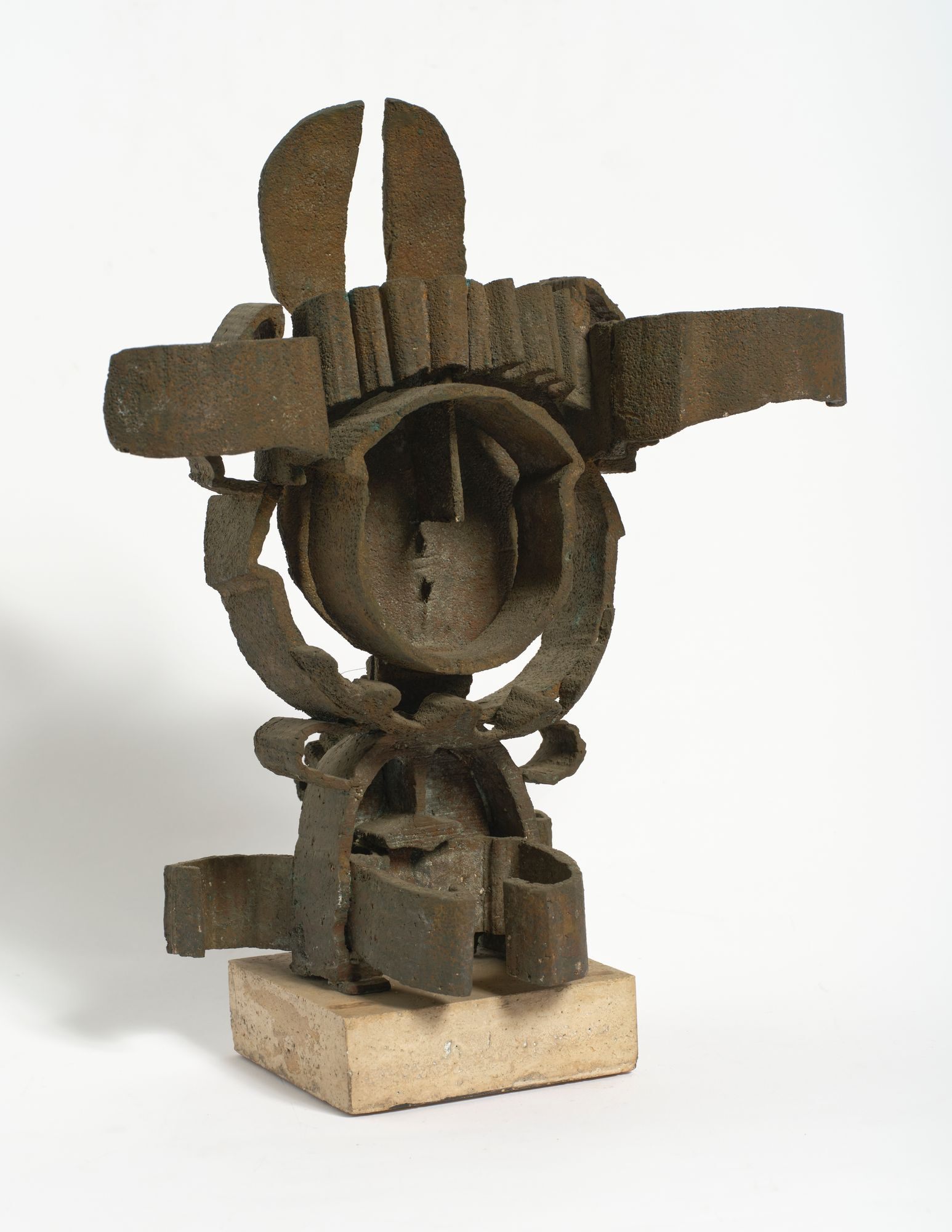
Elettra presents itself as a compact yet dynamically charged iron construction, its interlocking planes, arcs, and curved bands assembled into a vertical composition that simultaneously suggests mechanical form and organic vitality. The darkened, oxidized surface of the iron carries a rich patina of deep brown and muted green, lending the work a sense of age and material authority that belies its relatively modest dimensions. The central spherical element, partially enclosed by sweeping curved bands, anchors the composition while the horizontal arms extending outward at mid-height and the bifurcated form rising at the crown create a cruciform energy that pushes against the boundaries of its stone base. The roughly textured surfaces and visible seams of construction speak to a direct, hands-on engagement with material, a quality that places Elettra firmly within the tradition of assembled iron sculpture that emerged powerfully in postwar European art. Mirko Basaldella, known simply as Mirko, was one of the most significant Italian sculptors of the twentieth century, and Elettra belongs to the mature period of his career when his formal vocabulary had achieved its fullest expression. Having trained in Venice and later spent years in Rome, where his monumental bronze gates for the Ardeatine Caves Memorial cemented his international reputation, Mirko brought both classical discipline and modernist freedom to his sculptural practice. By the late 1960s, his work had absorbed the lessons of Cubism, Constructivism, and American Abstract Expressionist sculpture while retaining a distinctly Mediterranean sensibility rooted in myth, energy, and the human body as an organizing metaphor. The title Elettra, evoking both electricity and the mythological figure from Greek tragedy, suggests that this work operates on multiple registers, as both a study in formal tension and a meditation on charged, concentrated force. Works of this scale and date by Mirko are relatively uncommon in private hands, as much of his major output resides in public collections and institutional holdings in Italy and the United States. The stone base, integral to the presentation and likely original to the work, grounds the composition and provides a counterpoint to the restless movement of the iron above it. Elettra represents an exceptional opportunity to acquire a work by an artist whose contributions to postwar sculpture remain central to any serious engagement with the period, housed in a format that rewards close and repeated looking.

Medium
Iron sculpture, stone base

🔨 Auction Lot

Martini Studio d'Arte: Modern And Contemporary Art

June 10, 2026

Estimate: €2,000 to €3,000

Lot 38

Start the Discussion

Request access to join the discussion

More by Mirko Basaldella

About this work

Mirko Basaldella, Elettra, 1969

Elettra presents itself as a compact yet dynamically charged iron construction, its interlocking planes, arcs, and curved bands assembled into a vertical composition that simultaneously suggests mechanical form and organic vitality. The darkened, oxidized surface of the iron carries a rich patina of deep brown and muted green, lending the work a sense of age and material authority that belies its relatively modest dimensions. The central spherical element, partially enclosed by sweeping curved bands, anchors the composition while the horizontal arms extending outward at mid-height and the bifurcated form rising at the crown create a cruciform energy that pushes against the boundaries of its stone base. The roughly textured surfaces and visible seams of construction speak to a direct, hands-on engagement with material, a quality that places Elettra firmly within the tradition of assembled iron sculpture that emerged powerfully in postwar European art. Mirko Basaldella, known simply as Mirko, was one of the most significant Italian sculptors of the twentieth century, and Elettra belongs to the mature period of his career when his formal vocabulary had achieved its fullest expression. Having trained in Venice and later spent years in Rome, where his monumental bronze gates for the Ardeatine Caves Memorial cemented his international reputation, Mirko brought both classical discipline and modernist freedom to his sculptural practice. By the late 1960s, his work had absorbed the lessons of Cubism, Constructivism, and American Abstract Expressionist sculpture while retaining a distinctly Mediterranean sensibility rooted in myth, energy, and the human body as an organizing metaphor. The title Elettra, evoking both electricity and the mythological figure from Greek tragedy, suggests that this work operates on multiple registers, as both a study in formal tension and a meditation on charged, concentrated force. Works of this scale and date by Mirko are relatively uncommon in private hands, as much of his major output resides in public collections and institutional holdings in Italy and the United States. The stone base, integral to the presentation and likely original to the work, grounds the composition and provides a counterpoint to the restless movement of the iron above it. Elettra represents an exceptional opportunity to acquire a work by an artist whose contributions to postwar sculpture remain central to any serious engagement with the period, housed in a format that rewards close and repeated looking.

Medium
Iron sculpture, stone base
Year
1969
Seen at
Martini Studio d'Arte

Related themes

Iron Sculpture, Oxidized Surface, Three Dimensional, Constructivist, European Artist, Figurative Abstract, Assembled Construction, Vertical Composition, Male Artist, Modernist, Mid Century, Geometric Form, Organic Abstract, Italian Artist, Dark Tones, Welded Metal, Found Material, Postwar Art, Abstract Sculpture, Brown And Green, Textured Surface, Abstract

More works by Mirko Basaldella