Join The Collection to save, track, and explore works like this.

Nicola De Maria — Testa soave di un angelo
Nicola De Maria

Testa soave di un angelo

1987

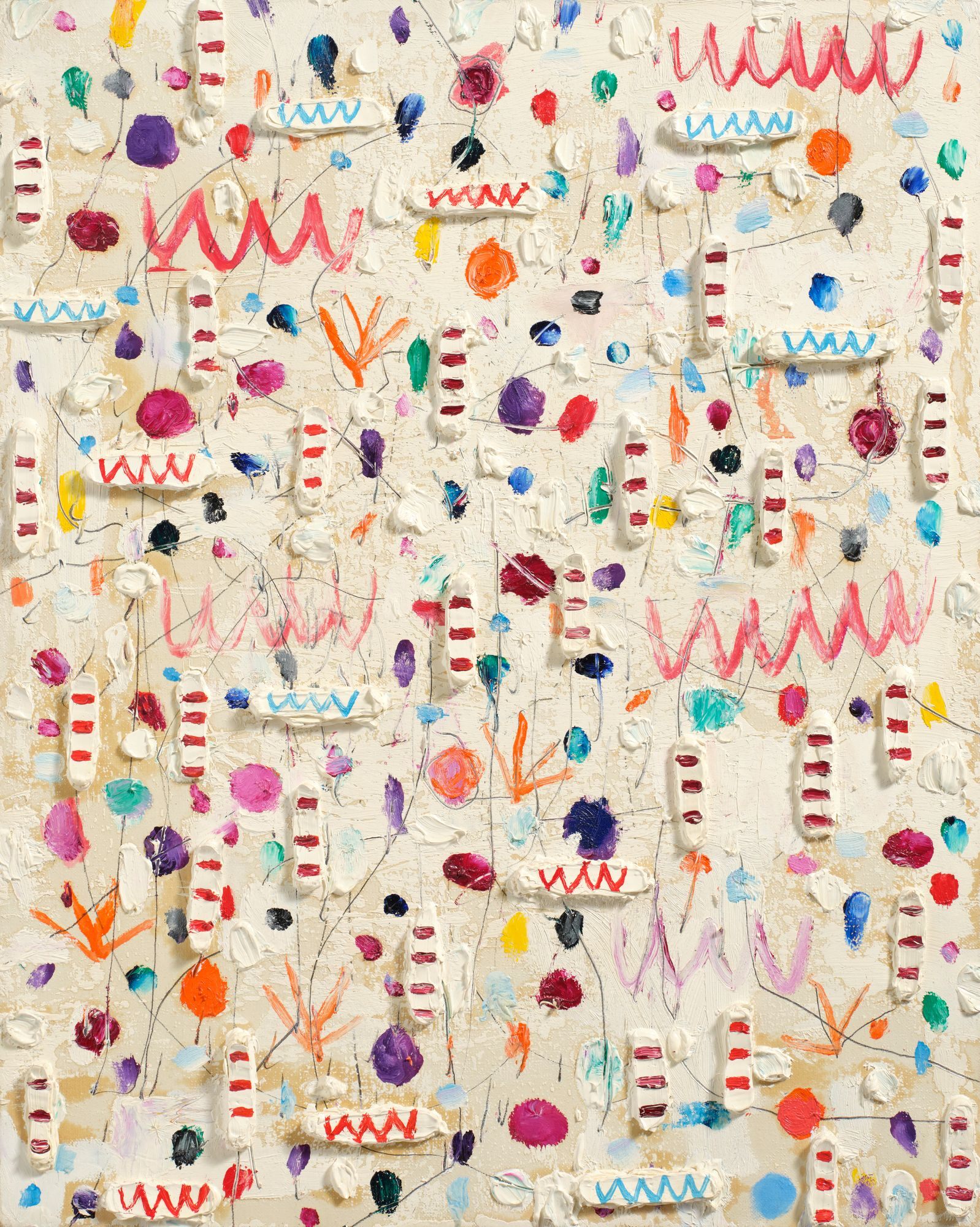
Testa soave di un angelo unfolds across a cream ground as a joyful accumulation of marks, each one insisting on its own presence while contributing to a larger, restless whole. De Maria builds the surface with impasto passages of white that protrude from the canvas, forming small oval and rectangular reliefs striated with deep reds and burgundies. Against these tactile anchors, the artist scatters gestural dots in magenta, cobalt, orange, purple, teal, and black, their edges loosened and blooming as though pressed quickly and instinctively into the wet paint. Zigzag and wave-like linear motifs drawn in coral, sky blue, and pink trace playful arcs across the composition, while graphite lines spider outward from various points, threading the elements together with a nervous, calligraphic energy. The overall effect hovers between notation and celebration, between the intimate scale of a handwritten page and the expansive generosity of a decorated world. The work belongs to De Maria's sustained engagement with what he termed the Regno dei fiori, or Kingdom of Flowers, a visionary pictorial universe governed by spiritual exuberance rather than rational order. Rooted in the Arte Povera generation yet resistant to its materialist austerity, De Maria pursued a resolutely lyrical path, drawing on ecstatic religious imagery, folk ornamentation, and the directness of children's mark-making to construct a visual language that feels both ancient and entirely personal. The title, meaning "gentle head of an angel," signals the devotional tenderness at the heart of his practice, where painting is understood as a form of blessing or invocation rather than a purely aesthetic exercise. At fifty by forty centimeters, Testa soave di un angelo rewards close inspection. The compressed format concentrates the painting's energy, and the interplay between the raised impasto forms and the fluid, spontaneous marks creates a constant oscillation between weight and lightness, structure and release. Works of this period represent De Maria at the height of his expressive confidence, fully committed to a chromatic vocabulary that is simultaneously joyful and rigorously intentional. For collectors drawn to European postwar painting and to artists who maintained a deeply humanist sensibility against the prevailing currents of their time, this canvas offers both historical significance and immediate, lasting visual pleasure.

Medium
Oil and graphite on canvas

🔨 Auction Lot

Martini Studio d'Arte: Modern And Contemporary Art

June 10, 2026

Estimate: €20,000 to €25,000

Lot 65
Start the Discussion

Request access to join the discussion

About this work

Nicola De Maria, Testa soave di un angelo, 1987

Testa soave di un angelo unfolds across a cream ground as a joyful accumulation of marks, each one insisting on its own presence while contributing to a larger, restless whole. De Maria builds the surface with impasto passages of white that protrude from the canvas, forming small oval and rectangular reliefs striated with deep reds and burgundies. Against these tactile anchors, the artist scatters gestural dots in magenta, cobalt, orange, purple, teal, and black, their edges loosened and blooming as though pressed quickly and instinctively into the wet paint. Zigzag and wave-like linear motifs drawn in coral, sky blue, and pink trace playful arcs across the composition, while graphite lines spider outward from various points, threading the elements together with a nervous, calligraphic energy. The overall effect hovers between notation and celebration, between the intimate scale of a handwritten page and the expansive generosity of a decorated world. The work belongs to De Maria's sustained engagement with what he termed the Regno dei fiori, or Kingdom of Flowers, a visionary pictorial universe governed by spiritual exuberance rather than rational order. Rooted in the Arte Povera generation yet resistant to its materialist austerity, De Maria pursued a resolutely lyrical path, drawing on ecstatic religious imagery, folk ornamentation, and the directness of children's mark-making to construct a visual language that feels both ancient and entirely personal. The title, meaning "gentle head of an angel," signals the devotional tenderness at the heart of his practice, where painting is understood as a form of blessing or invocation rather than a purely aesthetic exercise. At fifty by forty centimeters, Testa soave di un angelo rewards close inspection. The compressed format concentrates the painting's energy, and the interplay between the raised impasto forms and the fluid, spontaneous marks creates a constant oscillation between weight and lightness, structure and release. Works of this period represent De Maria at the height of his expressive confidence, fully committed to a chromatic vocabulary that is simultaneously joyful and rigorously intentional. For collectors drawn to European postwar painting and to artists who maintained a deeply humanist sensibility against the prevailing currents of their time, this canvas offers both historical significance and immediate, lasting visual pleasure.

Medium
Oil and graphite on canvas
Year
1987
Seen at
Martini Studio d'Arte

Related themes

Abstract Art, Mark Making, European Artist, Spiritual Theme, Figurative Abstract, Lyrical Abstraction, Folk Influence, Male Artist, Mixed Media, Italian Artist, Joyful Expression, Oil On Canvas, Neo-Expressionist, Celestial Imagery, Gestural Abstraction, Contemporary Painting, Multicolor Palette, Impasto Technique, Decorative Art, Arte Povera, Vibrant Color, Transavanguardia

More works by Nicola De Maria