Join The Collection to save, track, and explore works like this.

Eugenio Miccini — Untitled
Eugenio Miccini

Untitled

1964

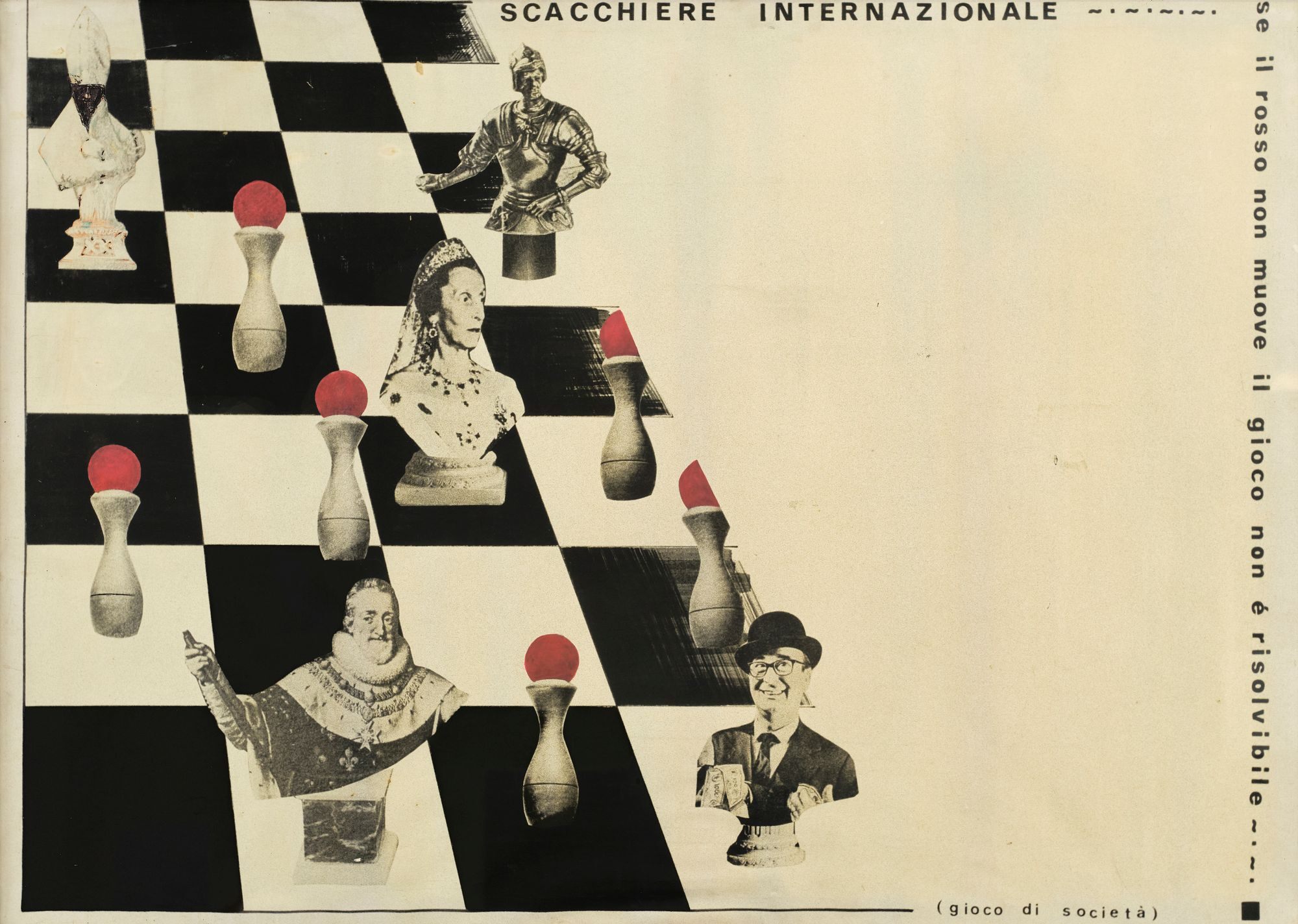
This collage-based work by Eugenio Miccini presents a chessboard rendered in sharp perspective, populated not with conventional game pieces but with a provocative mix of historical busts, bowling pins crowned with red spheres, and a contemporary figure rendered in photographic newsprint. The Italian text anchoring the composition reads "Scacchiere Internazionale" (International Chessboard) along the top, while the vertical text along the right margin declares "se il rosso non muove il gioco non è risolvibile" (if the red does not move, the game cannot be resolved), with the subdued caption "(gioco di società)" (social game) running along the bottom. The red spheres, small but visually insistent, become the operative element in the entire composition, suggesting that political agency or revolutionary force is the only variable capable of breaking a stalemate between entrenched power structures. Miccini was a founding figure of the Gruppo 70 movement in Florence and a central practitioner of what Italian critics termed "poesia visiva," visual poetry that fused linguistic text with graphic imagery to produce meaning neither element could achieve alone. This work exemplifies that method with particular clarity. The historical busts, evoking European monarchs and aristocratic culture, are placed alongside a smiling contemporary man holding what appear to be banknotes, collapsing centuries of hierarchical power into a single satirical tableau. The chessboard becomes a metaphor for geopolitical maneuvering during the Cold War period, with the red spheres carrying an unmistakable ideological resonance given the year of production, 1964, a moment of acute international tension and domestic Italian political debate about the role of the Communist Party in coalition government. The work belongs to a richly productive period in Miccini's output when he was experimenting broadly with offset printing, photomontage, and typographic intervention. The combination of emulsion on canvas with direct artistic intervention gives the piece a material complexity that distinguishes it from purely paper-based works of the period, lending it both the intimacy of printed matter and the presence of a painted surface. For collectors interested in Italian neo-avant-garde practice, Concrete poetry, or the broader intersection of political art and semiotics in the 1960s, this work represents a precise and historically grounded example of how Miccini transformed the flat surface into a field of contested meaning.

Medium
Emulsion on canvas, intervention of the artist

🔨 Auction Lot

Martini Studio d'Arte: Modern And Contemporary Art

June 10, 2026

Estimate: €2,000 to €3,000

Lot 209

Start the Discussion

Request access to join the discussion

About this work

Eugenio Miccini, Untitled, 1964

This collage-based work by Eugenio Miccini presents a chessboard rendered in sharp perspective, populated not with conventional game pieces but with a provocative mix of historical busts, bowling pins crowned with red spheres, and a contemporary figure rendered in photographic newsprint. The Italian text anchoring the composition reads "Scacchiere Internazionale" (International Chessboard) along the top, while the vertical text along the right margin declares "se il rosso non muove il gioco non è risolvibile" (if the red does not move, the game cannot be resolved), with the subdued caption "(gioco di società)" (social game) running along the bottom. The red spheres, small but visually insistent, become the operative element in the entire composition, suggesting that political agency or revolutionary force is the only variable capable of breaking a stalemate between entrenched power structures. Miccini was a founding figure of the Gruppo 70 movement in Florence and a central practitioner of what Italian critics termed "poesia visiva," visual poetry that fused linguistic text with graphic imagery to produce meaning neither element could achieve alone. This work exemplifies that method with particular clarity. The historical busts, evoking European monarchs and aristocratic culture, are placed alongside a smiling contemporary man holding what appear to be banknotes, collapsing centuries of hierarchical power into a single satirical tableau. The chessboard becomes a metaphor for geopolitical maneuvering during the Cold War period, with the red spheres carrying an unmistakable ideological resonance given the year of production, 1964, a moment of acute international tension and domestic Italian political debate about the role of the Communist Party in coalition government. The work belongs to a richly productive period in Miccini's output when he was experimenting broadly with offset printing, photomontage, and typographic intervention. The combination of emulsion on canvas with direct artistic intervention gives the piece a material complexity that distinguishes it from purely paper-based works of the period, lending it both the intimacy of printed matter and the presence of a painted surface. For collectors interested in Italian neo-avant-garde practice, Concrete poetry, or the broader intersection of political art and semiotics in the 1960s, this work represents a precise and historically grounded example of how Miccini transformed the flat surface into a field of contested meaning.

Medium
Emulsion on canvas, intervention of the artist
Year
1964
Seen at
Martini Studio d'Arte

Related themes

Avant Garde, Visual Poetry, European Artist, Neo Avant Garde, Conceptual, Male Artist, Experimental Art, Mixed Media, Collage, Italian Artist, Social Commentary, Black And White, Paper Works, Power Structures, Political Art, Red Accent, Symbolic Imagery, Satirical Art, Text And Image, Figurative