Join The Collection to save, track, and explore works like this.

Damien Hirst — The Forgotten Dead
Damien Hirst

The Forgotten Dead

1997

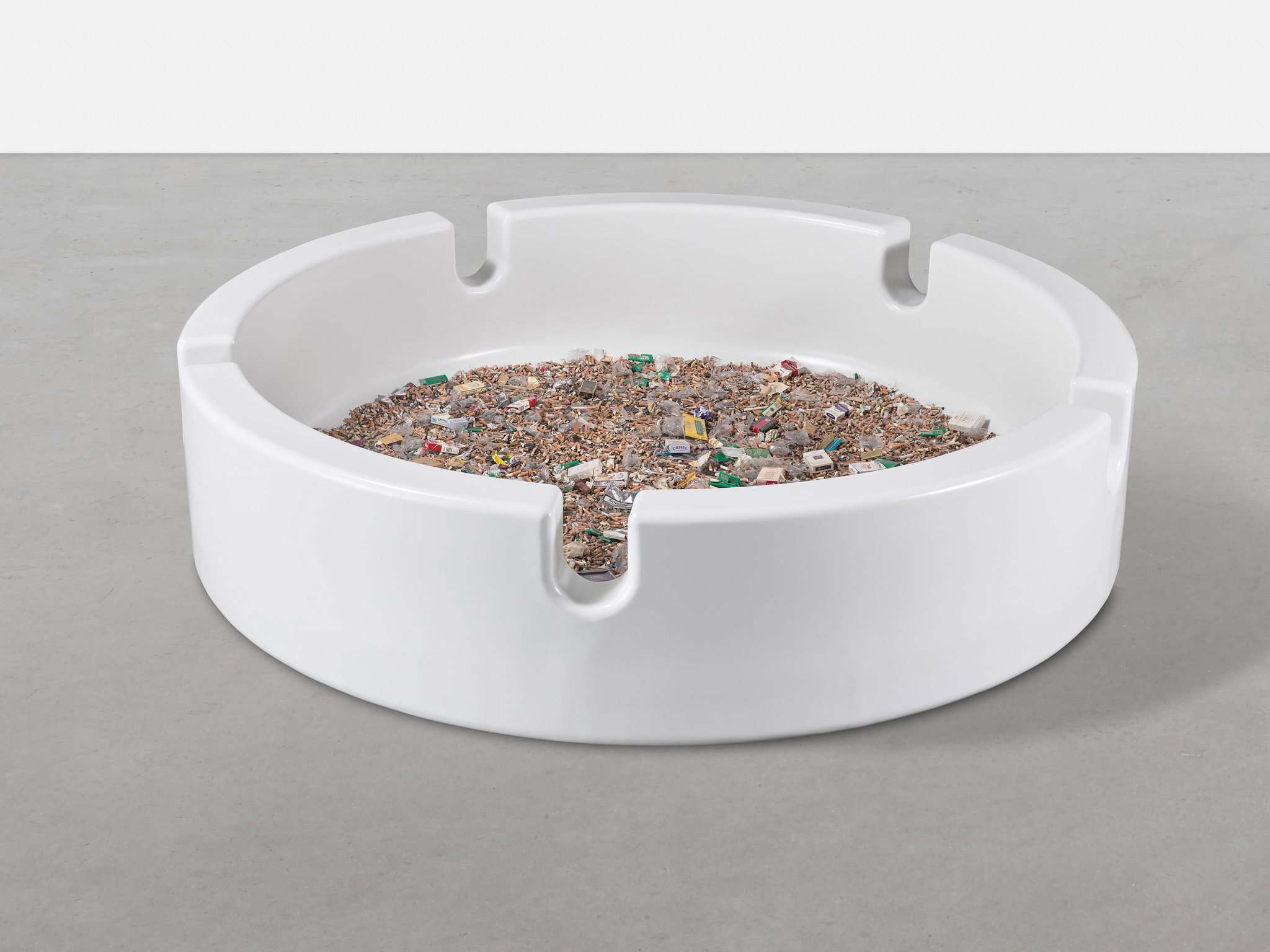
The Forgotten Dead is a viscerally provocative work from Damien Hirst's broader meditation on mortality, addiction, and the detritus of human existence, constructed from the literal remnants of consumption — cigarettes, packaging, drug paraphernalia, ash, and discarded wrappers encasing a painted fibreglass form. The exhaustive list of materials is itself a curatorial statement: these are not art supplies but the physical residue of human vice and vulnerability, arranged with Hirst's characteristically clinical precision to force confrontation with themes of decay, neglect, and the body's fragility. Created in 1997, the work sits within the cultural aftermath of the YBA movement, where Hirst and his contemporaries weaponised shock and materiality to interrogate life, death, and consumer society. The title carries a mournful moral charge — the forgotten dead are not just the deceased but those whose suffering goes unacknowledged, those undone by addiction and poverty, rendered invisible by society. As the only pre-existing piece in the Triple Trouble collection, its inclusion recontextualises Hirst's archival power within a contemporary collaborative framework, asking how the provocations of the 1990s still resonate today.

Medium
Painted fibreglass, cigarettes, cigarette packaging, tobacco packaging, cigarette papers, matches, tissues, sweet wrappings, plastic bottle top, drug paraphernalia, paper and ash
Dimensions

For Sale

Start the Discussion

Request access to join the discussion

About this work

Damien Hirst, The Forgotten Dead, 1997

The Forgotten Dead is a viscerally provocative work from Damien Hirst's broader meditation on mortality, addiction, and the detritus of human existence, constructed from the literal remnants of consumption — cigarettes, packaging, drug paraphernalia, ash, and discarded wrappers encasing a painted fibreglass form. The exhaustive list of materials is itself a curatorial statement: these are not art supplies but the physical residue of human vice and vulnerability, arranged with Hirst's characteristically clinical precision to force confrontation with themes of decay, neglect, and the body's fragility. Created in 1997, the work sits within the cultural aftermath of the YBA movement, where Hirst and his contemporaries weaponised shock and materiality to interrogate life, death, and consumer society. The title carries a mournful moral charge — the forgotten dead are not just the deceased but those whose suffering goes unacknowledged, those undone by addiction and poverty, rendered invisible by society. As the only pre-existing piece in the Triple Trouble collection, its inclusion recontextualises Hirst's archival power within a contemporary collaborative framework, asking how the provocations of the 1990s still resonate today.

Medium
Painted fibreglass, cigarettes, cigarette packaging, tobacco packaging, cigarette papers, matches, tissues, sweet wrappings, plastic bottle top, drug paraphernalia, paper and ash
Dimensions
66 x 254 cm
Year
1997
Seen at
HENI, London, United Kingdom

Related themes

Consumer Culture, Assemblage, Memento Mori, Vanitas Imagery, Nineteen Nineties, Conceptual Art, Death Symbolism, Dark Meditation, British Contemporary, Found Objects

More works by Damien Hirst

Collected by

Alex Capecelatro, Sarah Greenspan, Hamilton Selway Gallery, Brittany Laques