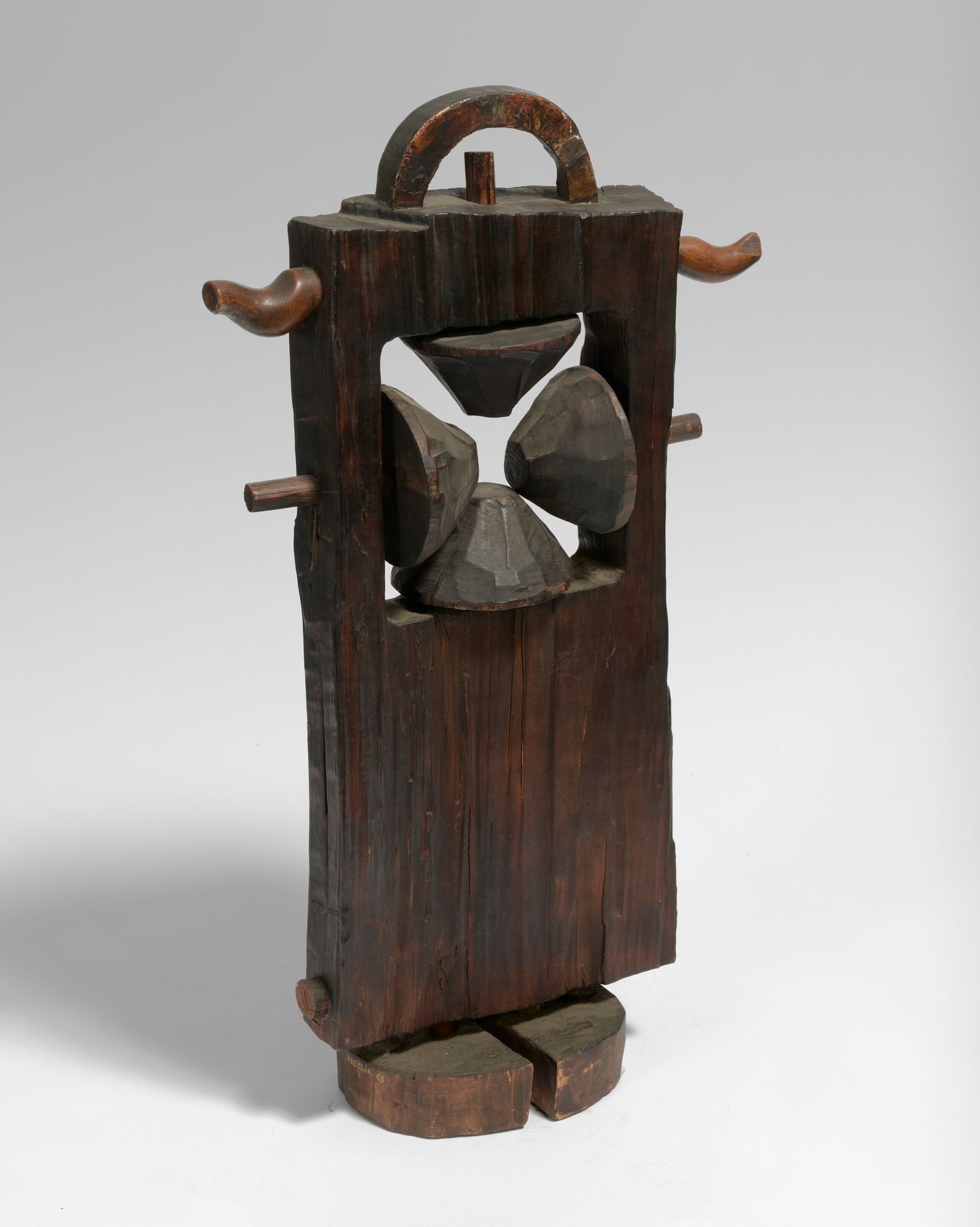
Robot
1963
Created in 1963, this striking wooden sculpture by Czech artist Vladimir Preclik presents a commanding anthropomorphic form assembled from darkened timber and lighter wooden elements. Standing at 80 centimeters tall, the work derives its visual power from the contrast between the rough-hewn, heavily weathered central body and the smoother, warmer-toned appendages that extend from its sides. A semicircular arch crowns the composition at the top, suggesting a head or halo, while two curved horn-like protrusions at shoulder height lend the figure an almost ceremonial authority. At its base, rounded feet-like forms ground the sculpture firmly, completing the figural reading. Within the rectangular cavity at the figure's center, a cluster of conical forms interlocks in a tight, mechanical arrangement, evoking gears, pistons, or some interior organic system simultaneously. The title "Robot" places this work squarely within the postwar European fascination with industrialization, mechanization, and the uneasy relationship between humanity and the machine. Preclik, working in Czechoslovakia during the early 1960s, occupied a cultural moment in which socialist modernity promoted technological optimism while artists navigated complex questions about individual agency and collective systems. By constructing his robot from wood rather than metal, Preclik introduces a fundamental tension into the work: the material is ancient, organic, and handworked, yet the form it describes is mechanical and impersonal. This contradiction gives the sculpture a peculiar warmth and melancholy that purely industrial materials could not achieve. Preclik was among the most significant Czech sculptors of the twentieth century, celebrated for his ability to synthesize folk tradition, modernist abstraction, and social commentary into works of considerable formal intelligence. His sculptures from this period often employed simplified, totemic forms that drew on Central European craft heritage while engaging directly with the formal concerns of international modernism. This example demonstrates his mastery of found and worked timber as an expressive medium, with the natural cracking and grain of the wood becoming an active element of the composition rather than incidental surface quality. Measuring 80 by 45.5 by 18.5 centimeters, the work is compact yet physically commanding, an ideal scale for institutional or private display. It represents a rare opportunity to acquire a significant work from a defining moment in Czech postwar sculpture.
- Medium
- Wooden sculpture
🔨 Auction Lot
Martini Studio d'Arte: Modern And Contemporary Art
June 10, 2026
Estimate: €3,000 to €4,000
Lot 234
Start the Discussion
Request access to join the discussion