Join The Collection to save, track, and explore works like this.

Art Institute of Chicago

Spotted

Faith Ringgold — Black Light Series #7: Ego Painting
Faith Ringgold

Black Light Series #7: Ego Painting

1969

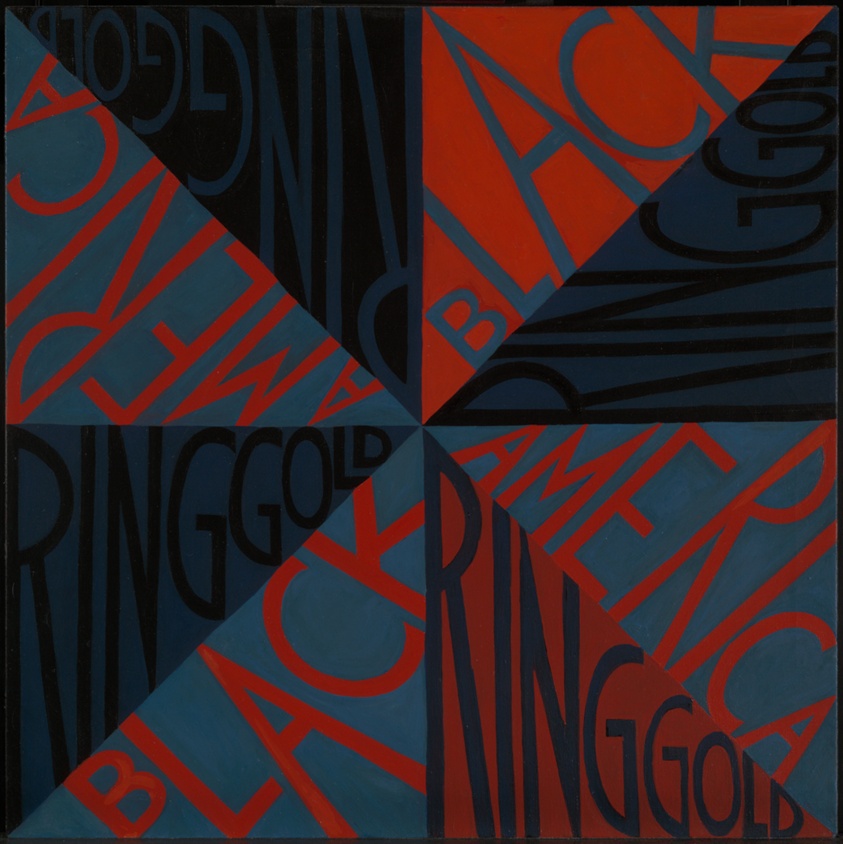
Faith Ringgold’s practice developed during the civil rights and women’s movements of the 1960s. An ardent activist throughout this period and into the 1970s, Ringgold was inspired by the Black Arts Movement and became a lifelong advocate for the increased representation of female and black artists in museum collections and exhibitions. At the same time, she brought political and social activism into her paintings, sculptures, textiles, and performances. Although perhaps best known for her later “story quilts” begun in the 1980s, Ringgold’s paintings of the 1960s, such as Black Light Series #7: Ego Painting, are a foundational body of work increasingly recognized for their powerful formal and social investigations of the color black. One of the first works in which Ringgold integrated text into her compositions, Ego Painting borrows its design from the political posters she was creating at the time. It likewise takes its compositional format—a square divided into eight triangles—from textile designs of the Kuba Kingdom of the Democratic Republic of Congo, a recurring format in her work of this time. Adopting an unconventional approach to the artist’s signature, she employed her name as both visual form and content, with image and text fully integrated into the red, black, and gray composition. Ringgold would move away from painting in the 1970s, yet with this powerful body of early work she asserted herself into the lineage and discourse of painting while also embodying a pivotal and profound moment in United States history.

Medium
Oil on canvas
Dimensions

Start the Discussion

Request access to join the discussion

Spotted works by Faith Ringgold

About this work

Faith Ringgold, Black Light Series #7: Ego Painting, 1969

Faith Ringgold’s practice developed during the civil rights and women’s movements of the 1960s. An ardent activist throughout this period and into the 1970s, Ringgold was inspired by the Black Arts Movement and became a lifelong advocate for the increased representation of female and black artists in museum collections and exhibitions. At the same time, she brought political and social activism into her paintings, sculptures, textiles, and performances. Although perhaps best known for her later “story quilts” begun in the 1980s, Ringgold’s paintings of the 1960s, such as Black Light Series #7: Ego Painting, are a foundational body of work increasingly recognized for their powerful formal and social investigations of the color black. One of the first works in which Ringgold integrated text into her compositions, Ego Painting borrows its design from the political posters she was creating at the time. It likewise takes its compositional format—a square divided into eight triangles—from textile designs of the Kuba Kingdom of the Democratic Republic of Congo, a recurring format in her work of this time. Adopting an unconventional approach to the artist’s signature, she employed her name as both visual form and content, with image and text fully integrated into the red, black, and gray composition. Ringgold would move away from painting in the 1970s, yet with this powerful body of early work she asserted herself into the lineage and discourse of painting while also embodying a pivotal and profound moment in United States history.

Medium
Oil on canvas
Dimensions
76 x 76 cm
Year
1969
Seen at
Art Institute of Chicago, Chicago, IL

Related themes

Bold Colors, Vibrant, American, Spiritual, African American, Portrait, Black Light, Abstract, Oil on Canvas, Contemporary

More works by Faith Ringgold

Collected by

Art Institute of Chicago