Join The Collection to save, track, and explore works like this.

Jannis Spyropoulos — Orassis n. 9
Jannis Spyropoulos

Orassis n. 9

1964

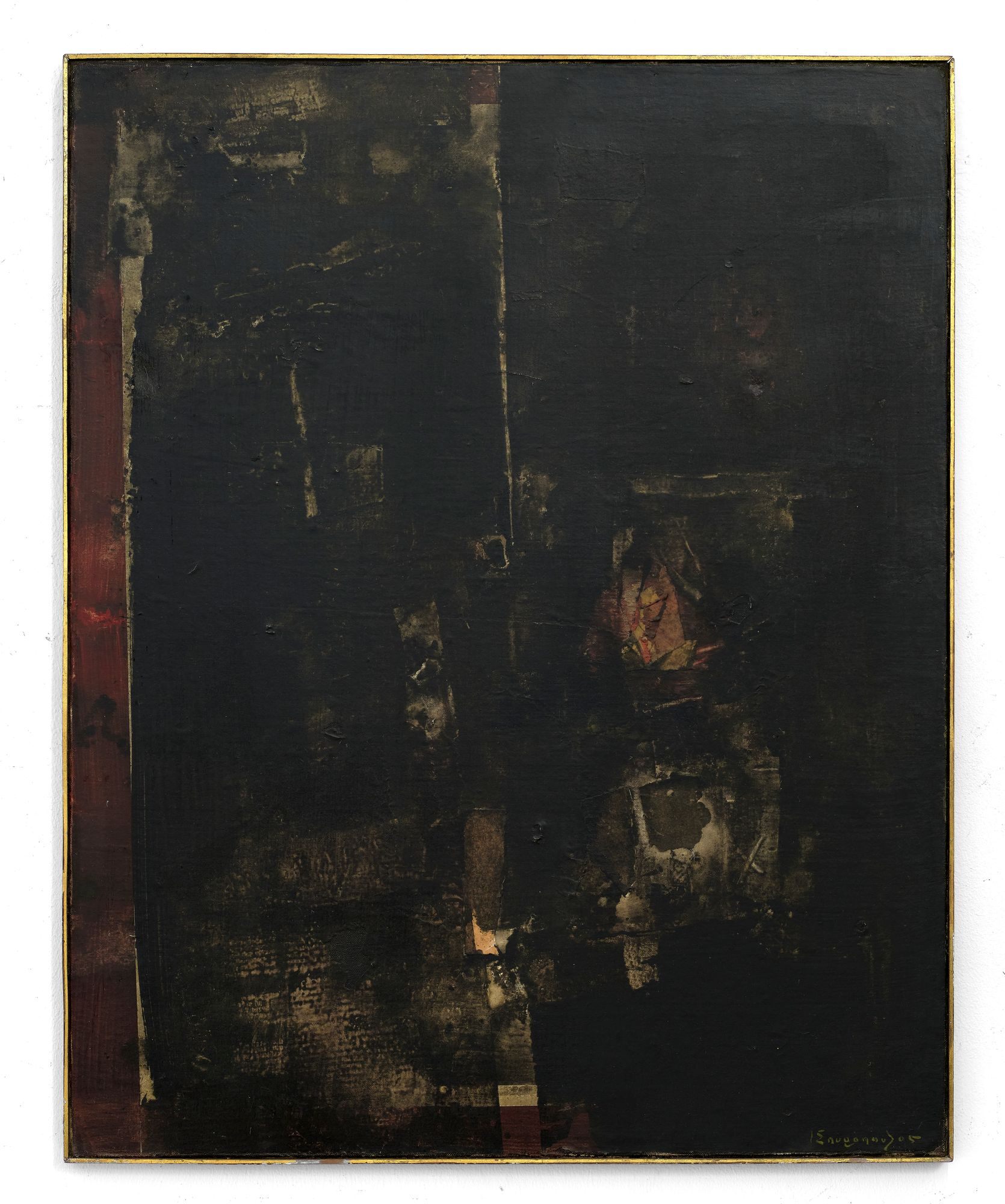
Orassis n. 9 commands attention through its profound dialogue between darkness and emergence. Spyropoulos constructs a near-total field of dense black, layered with oil paint built up through repeated applications that create subtle topographical variation across the canvas surface. Against this nocturnal ground, fragmented passages of grey, ochre, and muted crimson surface like memories half-recovered, neither fully present nor entirely absent. A vertical red band along the left edge provides a quiet structural anchor, while scattered collage elements embedded within the composition introduce materiality that draws the eye inward and rewards sustained looking. The scale, intimate at 81.5 by 65 centimeters, concentrates the work's considerable emotional weight into an encounter that feels private and searching. This painting belongs to the mature period of Spyropoulos's practice, when he had firmly established his place within the European abstract movement while retaining a distinctly Mediterranean sensibility rooted in light, memory, and the archaeology of place. Trained in Athens and later embraced by the Parisian art world, Spyropoulos developed a language of controlled excavation, covering and uncovering paint to suggest strata of experience rather than singular expression. In Orassis n. 9, the collage elements are not decorative but structural, functioning as embedded fragments that interrupt the painted surface with a different order of reality. The result is a composition that operates on multiple temporal registers simultaneously, old and new, buried and revealed. For collectors, this work represents a compelling opportunity to acquire a signed and dated canvas from one of the most significant Greek artists of the twentieth century, a figure who won the UNESCO prize at the Venice Biennale in 1960 and whose work is held in major institutional collections internationally. The physical presence of the painting, with its impasto surfaces, collage inclusions, and tonal depth, exceeds what reproduction conveys. Orassis n. 9 belongs to a lineage that connects Art Informel to a broader philosophical inquiry into perception, time, and the limits of visibility, making it relevant not only as a historical document but as a living aesthetic object. Its restraint is a form of confidence, and its darkness is generative rather than closed.

Medium
Oil and collage on canvas

🔨 Auction Lot

Martini Studio d'Arte: Modern And Contemporary Art

June 10, 2026

Estimate: €6,000 to €8,000

Lot 216

Start the Discussion

Request access to join the discussion

About this work

Jannis Spyropoulos, Orassis n. 9, 1964

Orassis n. 9 commands attention through its profound dialogue between darkness and emergence. Spyropoulos constructs a near-total field of dense black, layered with oil paint built up through repeated applications that create subtle topographical variation across the canvas surface. Against this nocturnal ground, fragmented passages of grey, ochre, and muted crimson surface like memories half-recovered, neither fully present nor entirely absent. A vertical red band along the left edge provides a quiet structural anchor, while scattered collage elements embedded within the composition introduce materiality that draws the eye inward and rewards sustained looking. The scale, intimate at 81.5 by 65 centimeters, concentrates the work's considerable emotional weight into an encounter that feels private and searching. This painting belongs to the mature period of Spyropoulos's practice, when he had firmly established his place within the European abstract movement while retaining a distinctly Mediterranean sensibility rooted in light, memory, and the archaeology of place. Trained in Athens and later embraced by the Parisian art world, Spyropoulos developed a language of controlled excavation, covering and uncovering paint to suggest strata of experience rather than singular expression. In Orassis n. 9, the collage elements are not decorative but structural, functioning as embedded fragments that interrupt the painted surface with a different order of reality. The result is a composition that operates on multiple temporal registers simultaneously, old and new, buried and revealed. For collectors, this work represents a compelling opportunity to acquire a signed and dated canvas from one of the most significant Greek artists of the twentieth century, a figure who won the UNESCO prize at the Venice Biennale in 1960 and whose work is held in major institutional collections internationally. The physical presence of the painting, with its impasto surfaces, collage inclusions, and tonal depth, exceeds what reproduction conveys. Orassis n. 9 belongs to a lineage that connects Art Informel to a broader philosophical inquiry into perception, time, and the limits of visibility, making it relevant not only as a historical document but as a living aesthetic object. Its restraint is a form of confidence, and its darkness is generative rather than closed.

Medium
Oil and collage on canvas
Year
1964
Seen at
Martini Studio d'Arte

Related themes

Black And Ochre, European Artist, Archaeological Theme, Dark Palette, Lyrical Abstraction, Male Artist, Informal Art, Modernist, Mixed Media, Nocturnal, Abstract Painting, Medium Format, Collage, Oil On Canvas, Memory And Place, Postwar Art, Greek Artist, Mediterranean Sensibility, Earth Tones, Paris School, Textured Surface, Abstract