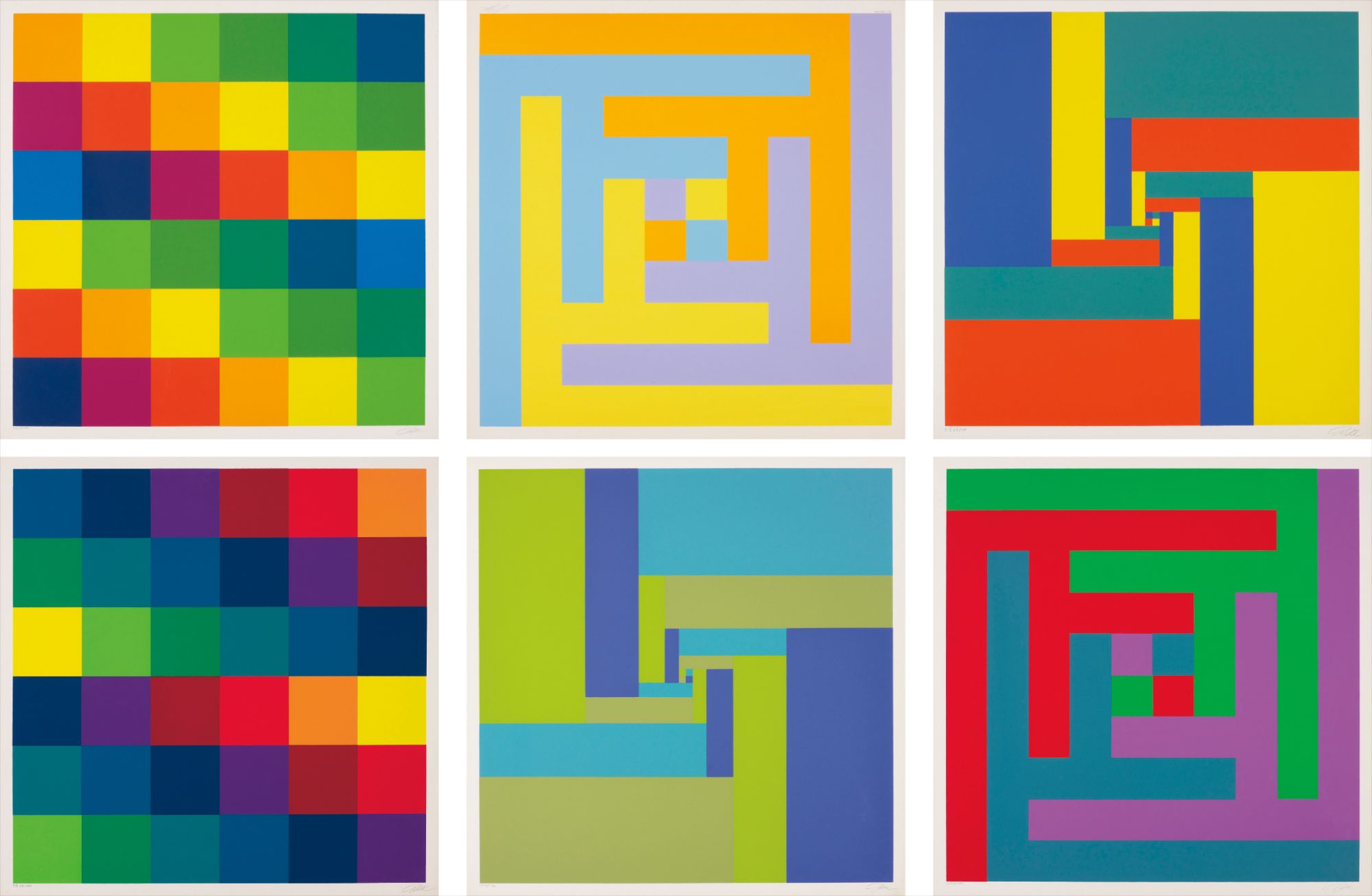
Richard Paul Lohse
1
Works
Richard Paul Lohse was a Swiss painter and graphic artist who became one of the most important figures in Concrete Art, a movement that emphasized pure geometric abstraction based on mathematical principles and modular systems. Born in Zurich, Lohse was largely self-taught and began his career in commercial art and advertising before dedicating himself fully to painting in the 1940s. His work is characterized by systematic color arrangements, serial structures, and modular compositions that follow strict mathematical ordering principles. Unlike purely intuitive abstraction, Lohse's paintings are governed by predetermined rules and systems, making the structural logic of each work transparent and reproducible. Lohse developed his signature style of "serial and modular order" in which color bands and geometric elements are arranged according to mathematical progressions and permutations. His paintings often feature vertical and horizontal color bands that shift systematically across the canvas, creating dynamic optical effects while maintaining rigorous structural order. Major works include his "Fifteen Systematic Color Series" (1950-55) and numerous variations on modular themes throughout the 1960s and 1970s. He was a founding member of the Allianz group of Swiss artists in 1937 and co-editor of the influential journal "Abstrakt/Konkret." His theoretical writings on Concrete Art were as important as his paintings, articulating the philosophical and political dimensions of systematic abstract art. Lohse's work has been exhibited extensively in major European institutions, including retrospectives at the Kunstmuseum Winterthur, Kunsthaus Zürich, and various international venues. His influence extended beyond Switzerland, contributing significantly to the development of Systematic Painting, Op Art, and Minimalism. He believed that rational, systematic art could serve progressive social purposes, reflecting democratic principles through its transparent, non-hierarchical structures. Today, his works are held in major museum collections worldwide, and he is recognized as a crucial link between early geometric abstraction and later systematic and conceptual art practices.
Artists in conversation