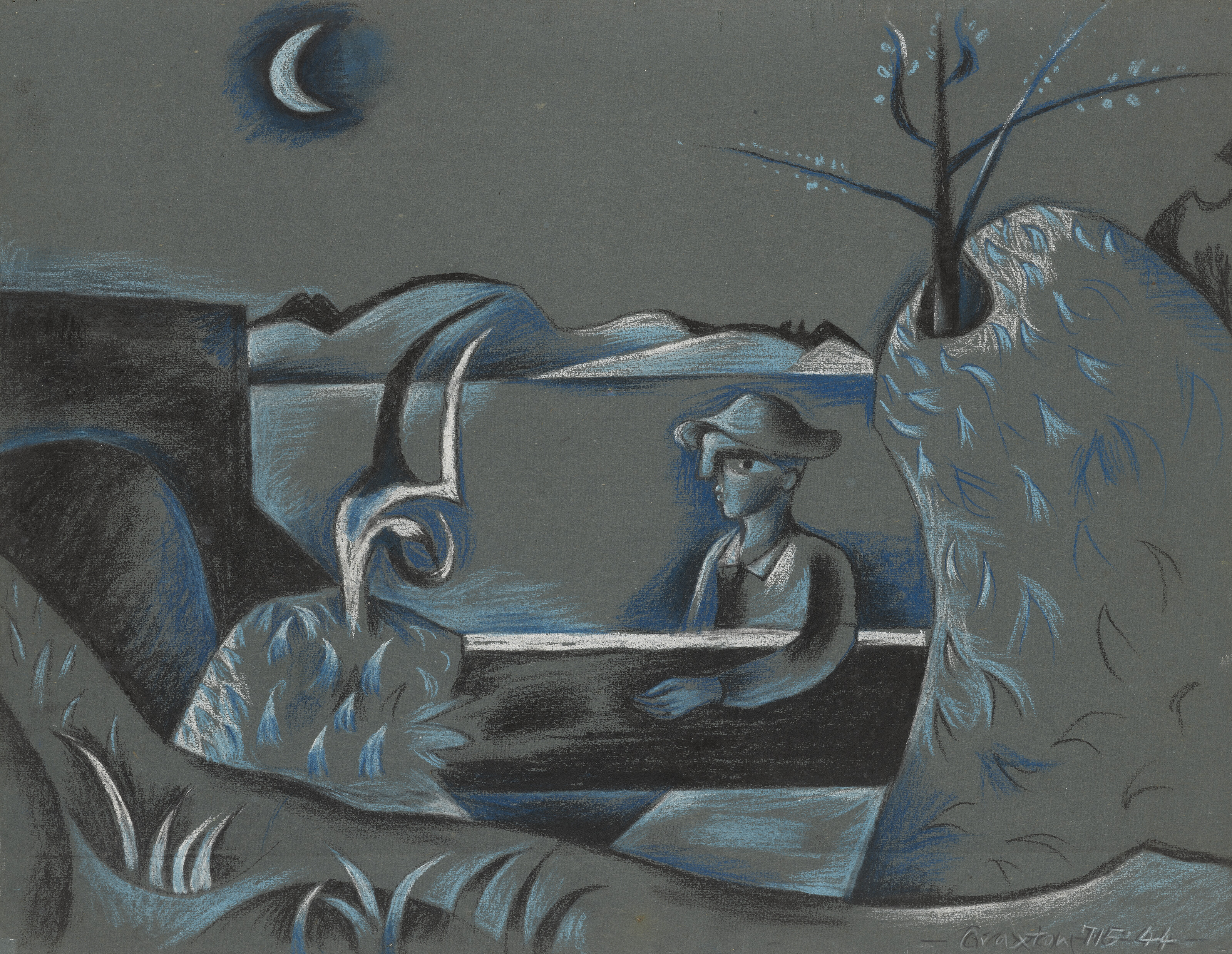
Study for Dark Landscape
"Study for Dark Landscape" exemplifies John Craxton's distinctive approach to modernist landscape painting, wherein he synthesized elements of Cubism and Surrealism to create richly textured, psychologically charged compositions. The work demonstrates Craxton's characteristic use of dark, earthy tones and fragmented forms to evoke the emotional intensity of natural settings rather than their literal appearance. As a preparatory study, it reveals the artist's methodical process in developing the layered, dreamlike quality that defines his mature style.
- Signed
- Yes
- Spotted At
- Auction House · Christie's
Notes
EXHIBITED probably London, Christopher Hull Gallery, John Craxton and Lucian Freud, April - May 1984. Conditions of sale Brought to you by Pippa Jacomb Director, Head of Day Sale PJACOMB@CHRISTIES.COM +44 (0) 20 7389 2293 LOT ESSAY Study for Dark Landscape was created at a pivotal moment for John Craxton. The 21-year-old artist had just held a sell-out exhibition at the Leicester Galleries. Now, after the high hopes of the D-Day Landings in June, the summer of 1944 reality was agonisingly slow military advances and a new onslaught on the home front from V1 'doodlebug' bombs. The setting is Alderholt, on the Hampshire-Dorset border, where John Craxton and Lucian Freud spent prolonged war-time periods with the painter E.Q. Nicholson and her family. It further relates to the wild scenery of Pembrokeshire which the two roving friends had also explored when not based in adjoining London studios, and to Italian prisoners-of-war they had seen labouring in Welsh fields. Completed in a London blackout, Study for Dark Landscape is a response to that renewed atmosphere of menace. Bright moons were renamed Bomber Moons. John Craxton worried that the image was too dark, but patron Peter Watson, who bought the ensuing painting now in Tate, loved the 'gas-flame' blue. This work relates closely to a Reaper with Mushroom drawing still with the Craxton Estate. The main change between this study and the Tate's painting would be the addition of a mushroom in the reaper-like-figure's one visible hand. Mushrooms grow in the dark. A dead tree shaped like bull horns emerges from a bush as a live one sprouts from rock. Both Craxton and Freud were brushing with Surrealism at this moment, having attended Soho dinners with E.L.T Mesens, Robert Melville, Roland Penrose and Eileen Agar. And John Craxton had just celebrated his Leicester Galleries triumph by buying, for £15, a Max Ernst painting from the Surrealist artist's 'Loplop' dove-in-forest series. Its air of trapped flight matched the buyer's mood almost two years before he finally escaped to Greece. We are very grateful to Ian Collins for preparing this catalogue entry. READ MORE
🔨 Auction Lot
Modern British and Irish Art Day Sale
March 19, 2026
Estimate: $35,000 – $55,000
Sold: $38,100
Lot 110
More by John Craxton
Start the Discussion
Request access to join the discussion