Join The Collection to save, track, and explore works like this.

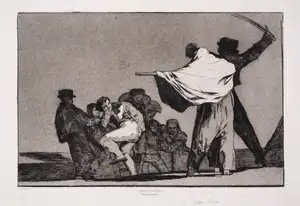
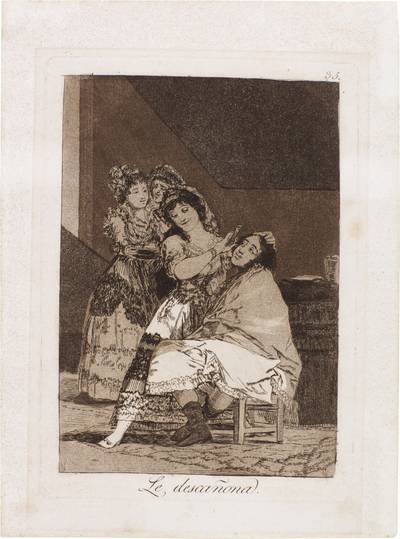
Francisco José de Goya y Lucientes — Dos a uno, meten la paja en el culo (Qué guerrero), from the four additional plates for 'Los Proverbios'

Francisco José de Goya y Lucientes

Dos a uno, meten la paja en el culo (Qué guerrero), from the four additional plates for 'Los Proverbios'

This satirical etching and aquatint by Goya belongs to his series of "Proverbios" (Proverbs), created between 1816 and 1824 but not printed until 1877, presenting a scatological and darkly humorous commentary on human folly and vice. The title, which translates to a crude reference involving straw, exemplifies Goya's late work's biting social critique and grotesque imagery characteristic of his "Black Paintings" period. The print survives in relatively good condition despite a repaired tear, and its modest dimensions belie the intensity and provocation of Goya's composition.

Medium
Etching and aquatint, circa 1816-1824, but printed 1877, on cream laid paper, platemark 245 x 355 mm (9 5/8 x 14 in), sheet 258 x 375 mm (10 1/8 x 14 3/4 in), repaired tear to lower centre within the margin, (unframed), Literature:, Harris 266 iii, Condition, Related Lots, BACK TO AUCTION CATALOGUE, Francisco José de Goya y Lucientes (1746-1828) Bailando en una cuerda floja (Disparate puntual), from 'Los Proverbios', Estimate: £3,000 - 5,000, Francisco José de Goya y Lucientes (1746-1828) Dispar

🔨 Auction Lot

Prints & Works on Paper 1500-2026

March 31, 2026

Lot 282

Start the Discussion

Request access to join the discussion

Spotted works by Francisco José de Goya y Lucientes
About this work

Francisco José de Goya y Lucientes, Dos a uno, meten la paja en el culo (Qué guerrero), from the four additional plates for 'Los Proverbios'

This satirical etching and aquatint by Goya belongs to his series of "Proverbios" (Proverbs), created between 1816 and 1824 but not printed until 1877, presenting a scatological and darkly humorous commentary on human folly and vice. The title, which translates to a crude reference involving straw, exemplifies Goya's late work's biting social critique and grotesque imagery characteristic of his "Black Paintings" period. The print survives in relatively good condition despite a repaired tear, and its modest dimensions belie the intensity and provocation of Goya's composition.

Medium
Etching and aquatint, circa 1816-1824, but printed 1877, on cream laid paper, platemark 245 x 355 mm (9 5/8 x 14 in), sheet 258 x 375 mm (10 1/8 x 14 3/4 in), repaired tear to lower centre within the margin, (unframed), Literature:, Harris 266 iii, Condition, Related Lots, BACK TO AUCTION CATALOGUE, Francisco José de Goya y Lucientes (1746-1828) Bailando en una cuerda floja (Disparate puntual), from 'Los Proverbios', Estimate: £3,000 - 5,000, Francisco José de Goya y Lucientes (1746-1828) Dispar
Seen at
Forum Auctions, London, UK

Related themes

Print, 18th-19th Century, Satirical social commentary, Dark and grotesque, Los Proverbios series, Human folly and vice, Romanticism, Etching and Aquatint, Spanish Artist, Surrealist Precursor

More works by Francisco José de Goya y Lucientes
Collected by

Art Institute of Chicago