Join The Collection to save, track, and explore works like this.

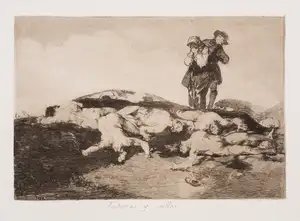
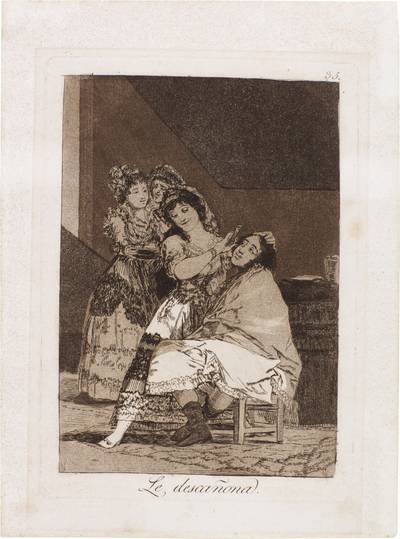
Francisco José de Goya y Lucientes — Enterrar y Callar, from 'Los Desastres de la Guerra (The Disasters of War)'
Francisco José de Goya y Lucientes

Enterrar y Callar, from 'Los Desastres de la Guerra (The Disasters of War)'

This etching from Goya's powerful series "Los Desastres de la Guerra" depicts the brutal consequences of war through the Spanish title "Enterrar y Callar" (Bury and Keep Silent), capturing scenes of death and enforced silence that characterize the horrors of conflict. Created around 1810 during the Peninsular War but not printed until 1863, the work exemplifies Goya's mastery of aquatint technique to convey darkness and suffering through dramatic contrasts of light and shadow. The print's delayed publication reflects the political sensitivity of its subject matter, as Goya's unflinching documentation of war's atrocities remained too controversial for public viewing during his lifetime.

Medium
Etching with aquatint, circa 1810 but printed 1863, from the First Edition, on cream wove paper without watermark, platemark 160 x 235 mm (6 1/4 x 9 1/4 in), sheet 250 x 340 mm (9 3/4 x 13 1/2 in), pin holes to left margin, faint creases in the upper right corner, (unframed), Literature:, Harris 138, Condition, Related Lots, BACK TO AUCTION CATALOGUE, Francisco José de Goya y Lucientes (1746-1828) Bailando en una cuerda floja (Disparate puntual), from 'Los Proverbios', Estimate: £3,000 - 5,000,

🔨 Auction Lot

Prints & Works on Paper 1500-2026

March 31, 2026

Lot 283

Start the Discussion

Request access to join the discussion

Spotted works by Francisco José de Goya y Lucientes
About this work

Francisco José de Goya y Lucientes, Enterrar y Callar, from 'Los Desastres de la Guerra (The Disasters of War)'

This etching from Goya's powerful series "Los Desastres de la Guerra" depicts the brutal consequences of war through the Spanish title "Enterrar y Callar" (Bury and Keep Silent), capturing scenes of death and enforced silence that characterize the horrors of conflict. Created around 1810 during the Peninsular War but not printed until 1863, the work exemplifies Goya's mastery of aquatint technique to convey darkness and suffering through dramatic contrasts of light and shadow. The print's delayed publication reflects the political sensitivity of its subject matter, as Goya's unflinching documentation of war's atrocities remained too controversial for public viewing during his lifetime.

Medium
Etching with aquatint, circa 1810 but printed 1863, from the First Edition, on cream wove paper without watermark, platemark 160 x 235 mm (6 1/4 x 9 1/4 in), sheet 250 x 340 mm (9 3/4 x 13 1/2 in), pin holes to left margin, faint creases in the upper right corner, (unframed), Literature:, Harris 138, Condition, Related Lots, BACK TO AUCTION CATALOGUE, Francisco José de Goya y Lucientes (1746-1828) Bailando en una cuerda floja (Disparate puntual), from 'Los Proverbios', Estimate: £3,000 - 5,000,
Seen at
Forum Auctions, London, UK

Related themes

Dark And Haunting, 18th-19th Century, Romanticism, Political Commentary, Etching and Aquatint, War And Violence, Spanish Artist, Social Critique, Print Series, Human Suffering

More works by Francisco José de Goya y Lucientes
Collected by

Art Institute of Chicago