Join The Collection to save, track, and explore works like this.

Antonio Calderara — Natura morta
Antonio Calderara

Natura morta

1948

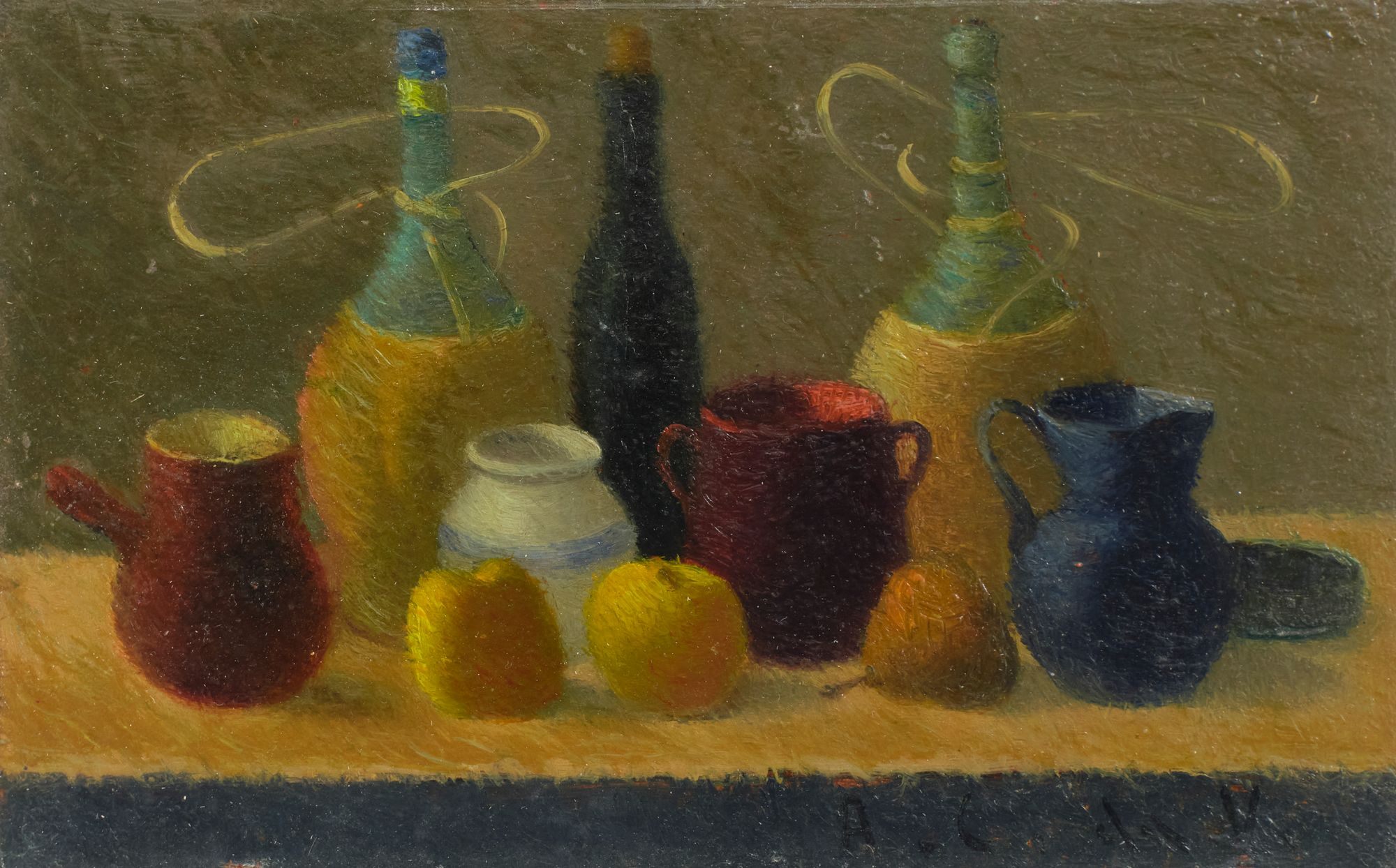
This intimate still life gathers a carefully chosen assembly of vessels and fruit on a shallow tabletop, rendered in oil on board with an almost meditative restraint. Three straw-wrapped bottles rise from the background, their green glass necks catching soft light against a muted olive ground, while a slender dark bottle stands among them like a silent counterpoint. Arranged across the foreground are a red earthenware pitcher, a small white ceramic pot, a deep burgundy two-handled cup, and a cobalt blue jug, each object given its own weight and presence through Calderara's methodical yet tender brushwork. Two yellow-green apples and a small orange fruit punctuate the composition with warmth, their rounded forms echoing the curves of the surrounding ceramics. The palette is earthy and considered, built from ochres, umbers, and muted greens, offset by the more saturated accents of red, cobalt, and citrus yellow. Painted in 1948, this work belongs to an early and formative period in Antonio Calderara's career, before his decisive turn toward geometric abstraction in the 1950s. At this stage the Milanese painter was still working within a figurative tradition, though already demonstrating the quietude and compositional economy that would define his mature practice. The influence of Morandi is discernible in the grouping of humble domestic objects and the sense that each vessel occupies its space with philosophical intention, yet Calderara's touch carries its own lyrical quality, particularly in the loose, spiraling highlights on the bottle necks that enliven an otherwise still scene. The small format, measuring just under eleven by seventeen centimeters, intensifies the sense of concentrated attention that the work demands. Works by Calderara from this figurative period are comparatively rare and occupy a singular place in his broader oeuvre, offering collectors an opportunity to trace the origins of one of Italy's most quietly influential abstract painters. The oil on board support lends the surface a fine, close-grained texture that holds the paint with particular richness, and the modest scale makes the painting suitable for intimate domestic display while retaining genuine scholarly and historical significance. As interest in mid-century Italian art continues to grow internationally, early works such as this one serve as essential points of reference for understanding the transition from postwar realism toward the contemplative abstraction for which Calderara is now celebrated.

Medium
Oil on board

🔨 Auction Lot

Martini Studio d'Arte: Modern And Contemporary Art

June 10, 2026

Estimate: €5,000 to €7,000

Lot 123
Start the Discussion

Request access to join the discussion

About this work

Antonio Calderara, Natura morta, 1948

This intimate still life gathers a carefully chosen assembly of vessels and fruit on a shallow tabletop, rendered in oil on board with an almost meditative restraint. Three straw-wrapped bottles rise from the background, their green glass necks catching soft light against a muted olive ground, while a slender dark bottle stands among them like a silent counterpoint. Arranged across the foreground are a red earthenware pitcher, a small white ceramic pot, a deep burgundy two-handled cup, and a cobalt blue jug, each object given its own weight and presence through Calderara's methodical yet tender brushwork. Two yellow-green apples and a small orange fruit punctuate the composition with warmth, their rounded forms echoing the curves of the surrounding ceramics. The palette is earthy and considered, built from ochres, umbers, and muted greens, offset by the more saturated accents of red, cobalt, and citrus yellow. Painted in 1948, this work belongs to an early and formative period in Antonio Calderara's career, before his decisive turn toward geometric abstraction in the 1950s. At this stage the Milanese painter was still working within a figurative tradition, though already demonstrating the quietude and compositional economy that would define his mature practice. The influence of Morandi is discernible in the grouping of humble domestic objects and the sense that each vessel occupies its space with philosophical intention, yet Calderara's touch carries its own lyrical quality, particularly in the loose, spiraling highlights on the bottle necks that enliven an otherwise still scene. The small format, measuring just under eleven by seventeen centimeters, intensifies the sense of concentrated attention that the work demands. Works by Calderara from this figurative period are comparatively rare and occupy a singular place in his broader oeuvre, offering collectors an opportunity to trace the origins of one of Italy's most quietly influential abstract painters. The oil on board support lends the surface a fine, close-grained texture that holds the paint with particular richness, and the modest scale makes the painting suitable for intimate domestic display while retaining genuine scholarly and historical significance. As interest in mid-century Italian art continues to grow internationally, early works such as this one serve as essential points of reference for understanding the transition from postwar realism toward the contemplative abstraction for which Calderara is now celebrated.

Medium
Oil on board
Year
1948
Seen at
Martini Studio d'Arte

Related themes

Meditative Quiet, Fruit Subject, Interior Scene, Male Artist, Modernist, Lyrical Realism, Post War Art, Ochre And Umber, Domestic Objects, Earthy Palette, Early Twentieth Century, Italian Artist, Muted Tones, Cobalt Blue Accent, Tabletop Composition, Pre Abstraction, Ceramic And Vessel, Oil on Board, Figurative, Still Life, European Painting

More works by Antonio Calderara