Join The Collection to save, track, and explore works like this.

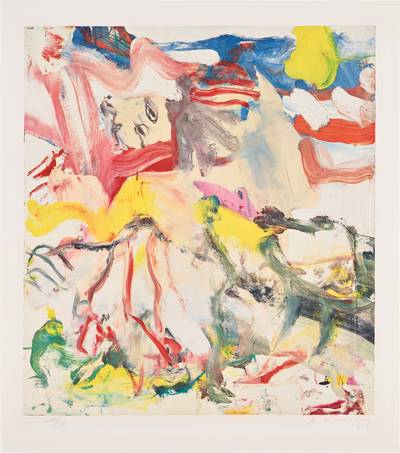
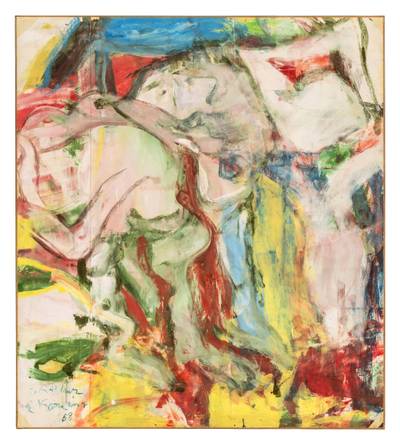
Willem de Kooning — Willem de Kooning’s rapid progression from representational to non-representational painting occurred during the late 1950s into the early 1960s. His legendary Women series over, he began to find inspiration from sources other than the human form, namely that of landscape. In addition, the sharp lines and geometric patterns that had categorized his earlier work began to smooth out into curvatures and fields of space and color. This gave de Kooning’s new work a more reflective element, as it no longer contained the anger and rigor of his earlier paintings and drawings. De Kooning also began to venture into the realm of sculpture, bringing his newly found fluidity and softness into the third dimension. In his works on paper, de Kooning followed the same trajectory: definite figure began to morph into indefinite shape, smoother yet more mysterious than before.
Willem de Kooning

Willem de Kooning’s rapid progression from representational to non-representational painting occurred during the late 1950s into the early 1960s. His legendary Women series over, he began to find inspiration from sources other than the human form, namely that of landscape. In addition, the sharp lines and geometric patterns that had categorized his earlier work began to smooth out into curvatures and fields of space and color. This gave de Kooning’s new work a more reflective element, as it no longer contained the anger and rigor of his earlier paintings and drawings. De Kooning also began to venture into the realm of sculpture, bringing his newly found fluidity and softness into the third dimension. In his works on paper, de Kooning followed the same trajectory: definite figure began to morph into indefinite shape, smoother yet more mysterious than before.

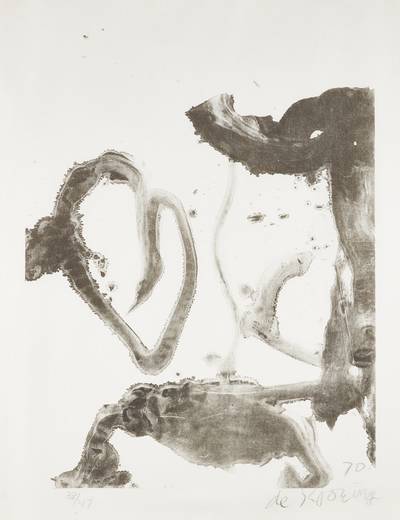
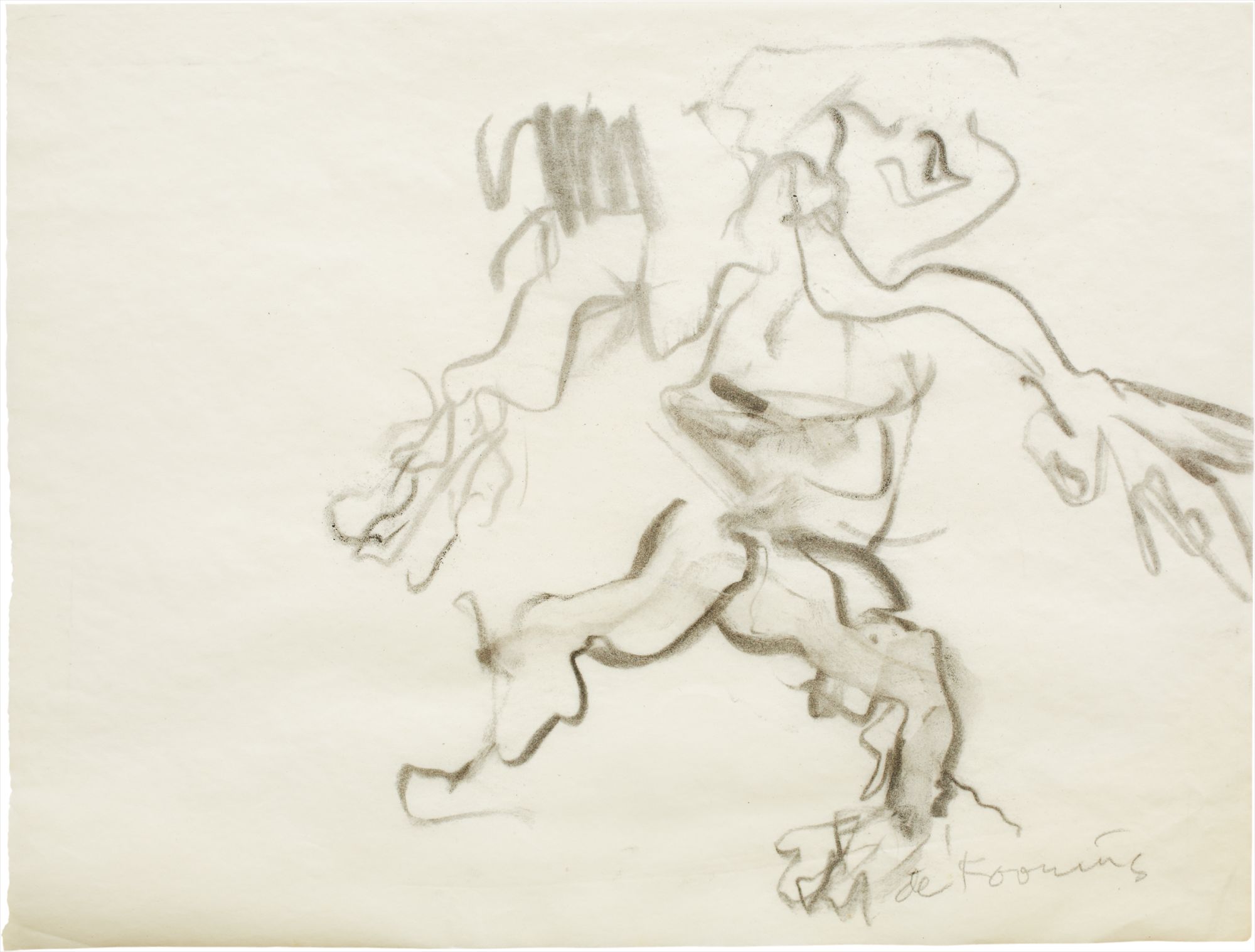
This dynamic charcoal on paper work by Willem de Kooning exemplifies his transitional period of the late 1950s to early 1960s, as bold, gestural marks give way to softer, more fluid forms that blur the boundary between figuration and abstraction. Moving beyond the raw intensity of his Women series, de Kooning draws inspiration from landscape, allowing shapes to dissolve into sweeping curves and expansive fields of tone. The work reflects a newfound sense of mystery and contemplation, with charcoal's inherent expressiveness serving as the perfect medium to capture this evolution toward the indefinite and the sublime.

Medium
charcoal on paper

🔨 Auction Lot

Contemporary Art Day Sale

May 17, 2013

Start the Discussion

Request access to join the discussion

Spotted works by Willem de Kooning

About this work

Willem de Kooning, Willem de Kooning’s rapid progression from representational to non-representational painting occurred during the late 1950s into the early 1960s. His legendary Women series over, he began to find inspiration from sources other than the human form, namely that of landscape. In addition, the sharp lines and geometric patterns that had categorized his earlier work began to smooth out into curvatures and fields of space and color. This gave de Kooning’s new work a more reflective element, as it no longer contained the anger and rigor of his earlier paintings and drawings. De Kooning also began to venture into the realm of sculpture, bringing his newly found fluidity and softness into the third dimension. In his works on paper, de Kooning followed the same trajectory: definite figure began to morph into indefinite shape, smoother yet more mysterious than before.

This dynamic charcoal on paper work by Willem de Kooning exemplifies his transitional period of the late 1950s to early 1960s, as bold, gestural marks give way to softer, more fluid forms that blur the boundary between figuration and abstraction. Moving beyond the raw intensity of his Women series, de Kooning draws inspiration from landscape, allowing shapes to dissolve into sweeping curves and expansive fields of tone. The work reflects a newfound sense of mystery and contemplation, with charcoal's inherent expressiveness serving as the perfect medium to capture this evolution toward the indefinite and the sublime.

Medium
charcoal on paper
Seen at
Phillips, New York, London, Hong Kong

Related themes

Mid Century Modern, Gestural Mark-Making, Dutch Artist, Non-Representational, Male Artist, Fluid Forms, Charcoal Drawing, Abstract Expressionism, Landscape Abstraction, Works on Paper, Monochromatic, Master Artist

More works by Willem de Kooning

Collected by

Art Institute of Chicago