Join The Collection to save, track, and explore works like this.

Art Institute of Chicago

Spotted

Alma Thomas — Starry Night and the Astronauts
Alma Thomas

Starry Night and the Astronauts

1972

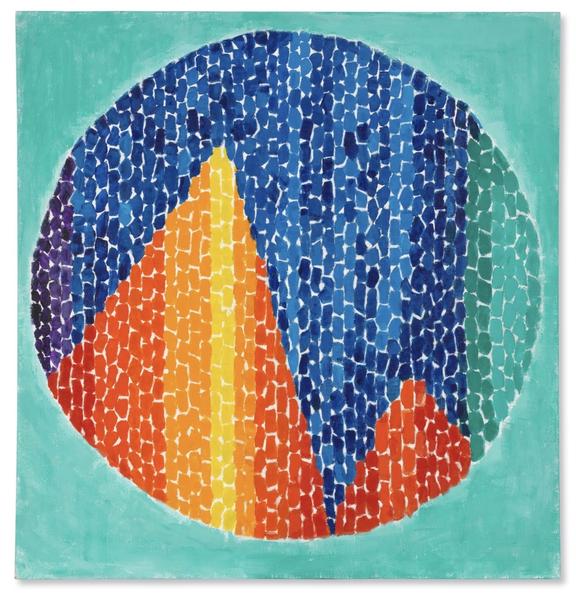
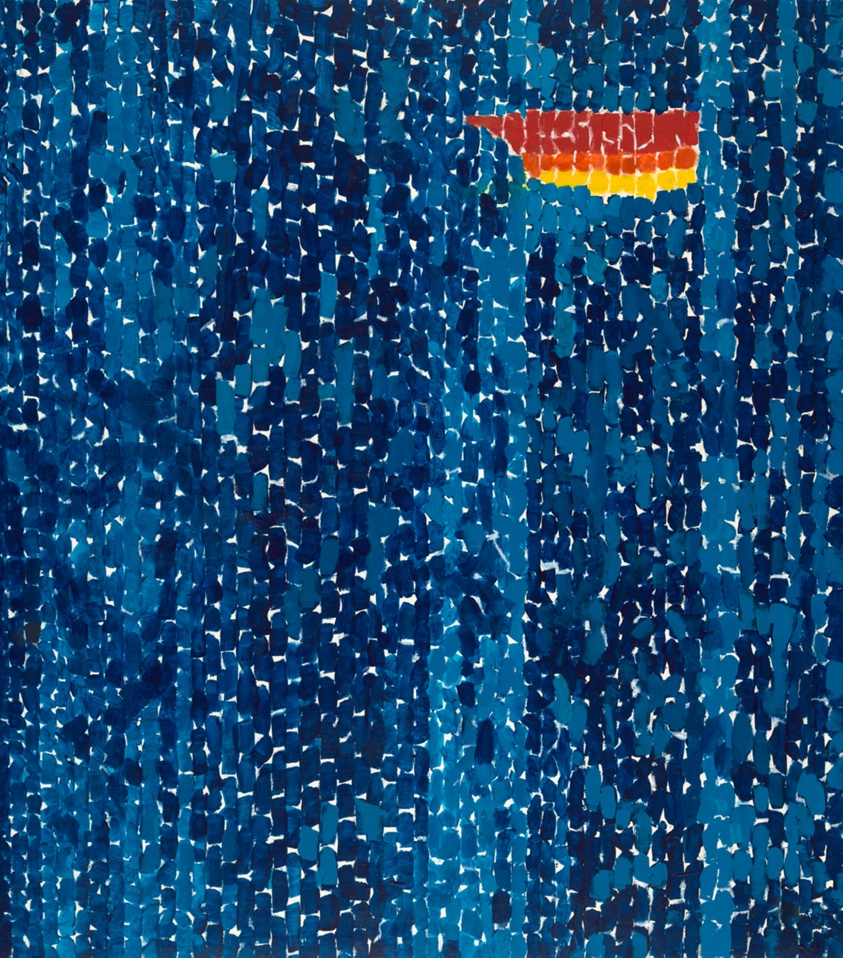
After decades as a representational painter, in her seventies Alma Thomas turned to abstraction, creating shimmering, mosaic-like fields of color with rhythmic dabs of paint that were often inspired by forms from nature. The artist had been fascinated with space exploration since the late 1960s, and her later paintings often referenced America’s manned Apollo missions to the moon. Although she had never flown, Thomas began to paint as if she were in an airplane, capturing what she described as shifting patterns of light and streaks of color. “You look down on things,” she explained. “You streak through the clouds so fast. . . . You see only streaks of color.” Starry Night and the Astronauts evokes the open expanse and celestial patterns of a night sky, but despite its narrative title, the work could also be read as an aerial view of a watery surface, playing with our sense of immersion within an otherwise flat picture plane. The viewer is immersed not only in the sense of organic expanse that this painting achieves, however, but also in an encounter with Thomas’s process: the surface here is clearly constructed stroke by stroke. Meanwhile, the glimpses of raw canvas between each primary-colored mark seem as vivid as the applied paint itself—almost as if the composition were backlit. Thomas relied on the enlivening properties of color throughout her late-blooming career. “Color is life,” she once proclaimed, “and light is the mother of color.” This painting was created in 1972, when the artist was eighty. In the same year, she became the first African American woman to receive a solo exhibition at a major art museum, the Whitney Museum of American Art in New York City.

Medium
Acrylic on canvas
Dimensions

Start the Discussion

Request access to join the discussion

About this work

Alma Thomas, Starry Night and the Astronauts, 1972

After decades as a representational painter, in her seventies Alma Thomas turned to abstraction, creating shimmering, mosaic-like fields of color with rhythmic dabs of paint that were often inspired by forms from nature. The artist had been fascinated with space exploration since the late 1960s, and her later paintings often referenced America’s manned Apollo missions to the moon. Although she had never flown, Thomas began to paint as if she were in an airplane, capturing what she described as shifting patterns of light and streaks of color. “You look down on things,” she explained. “You streak through the clouds so fast. . . . You see only streaks of color.” Starry Night and the Astronauts evokes the open expanse and celestial patterns of a night sky, but despite its narrative title, the work could also be read as an aerial view of a watery surface, playing with our sense of immersion within an otherwise flat picture plane. The viewer is immersed not only in the sense of organic expanse that this painting achieves, however, but also in an encounter with Thomas’s process: the surface here is clearly constructed stroke by stroke. Meanwhile, the glimpses of raw canvas between each primary-colored mark seem as vivid as the applied paint itself—almost as if the composition were backlit. Thomas relied on the enlivening properties of color throughout her late-blooming career. “Color is life,” she once proclaimed, “and light is the mother of color.” This painting was created in 1972, when the artist was eighty. In the same year, she became the first African American woman to receive a solo exhibition at a major art museum, the Whitney Museum of American Art in New York City.

Medium
Acrylic on canvas
Dimensions
152.4 x 134.6 cm
Year
1972
Seen at
Art Institute of Chicago, Chicago, IL

Related themes

Acrylic, Post-War, Unique Work, Large Scale, Painting, Contemporary

More works by Alma Thomas

Collected by

Sarah Greenspan, Art Institute of Chicago