Join The Collection to save, track, and explore works like this.

Alexander Calder — Two Horizontals and Nine Verticals
Alexander Calder

Two Horizontals and Nine Verticals

1956

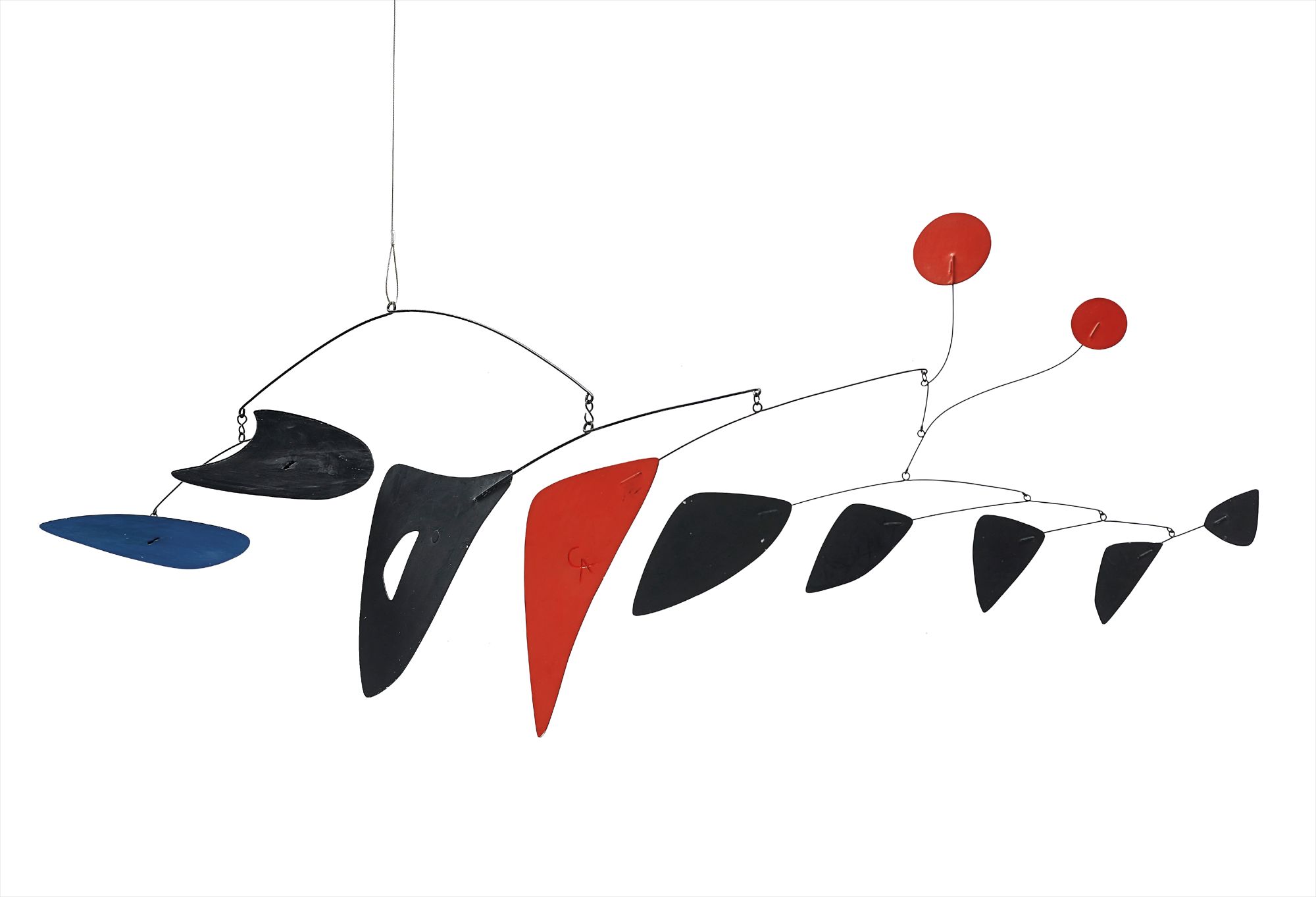
Two Horizontals and Nine Verticals exemplifies Alexander Calder's revolutionary concept of the mobile, where delicately balanced elements of painted metal shift and dance in response to the gentlest air currents. The work's precisely engineered yet seemingly effortless arrangement of horizontal arms and suspended vertical forms creates an ever-changing composition that defies the traditional stillness of sculpture. Through this kinetic interplay, Calder transformed sculpture into a living, temporal art form that exists not in a single fixed moment, but in the infinite variety of its continuous movement through space and time.

Medium
"Why must sculpture be static? You look at abstraction, sculptured or painted, an entirely exciting arrangement of planes, nuclei, entirely without meaning. It would be perfect but always still. The next step is sculpture in motion." Alexander Calder

🔨 Auction Lot

20th Century & Contemporary Art Evening Sale

November 16, 2016

Start the Discussion

Request access to join the discussion

About this work

Alexander Calder, Two Horizontals and Nine Verticals, 1956

Two Horizontals and Nine Verticals exemplifies Alexander Calder's revolutionary concept of the mobile, where delicately balanced elements of painted metal shift and dance in response to the gentlest air currents. The work's precisely engineered yet seemingly effortless arrangement of horizontal arms and suspended vertical forms creates an ever-changing composition that defies the traditional stillness of sculpture. Through this kinetic interplay, Calder transformed sculpture into a living, temporal art form that exists not in a single fixed moment, but in the infinite variety of its continuous movement through space and time.

Medium
"Why must sculpture be static? You look at abstraction, sculptured or painted, an entirely exciting arrangement of planes, nuclei, entirely without meaning. It would be perfect but always still. The next step is sculpture in motion." Alexander Calder
Year
1956
Seen at
Phillips, New York, London, Hong Kong

Related themes

Steel Medium, Dynamic Composition, Abstract Art, 20th Century, Geometric Forms, Renowned Artist, Male Artist, Primary Colors, Mixed Media, Mobile Sculpture, Kinetic Sculpture, American Artist, Modernism, Minimalist Palette, Three-Dimensional, Playful Mood

More works by Alexander Calder

Collected by

Alex Capecelatro, Sebastián In Situ, Jonathan Murray, Hamilton Selway Gallery