Join The Collection to save, track, and explore works like this.

Sandro de Alexandris — Nero ortogonale
Sandro de Alexandris

Nero ortogonale

1969

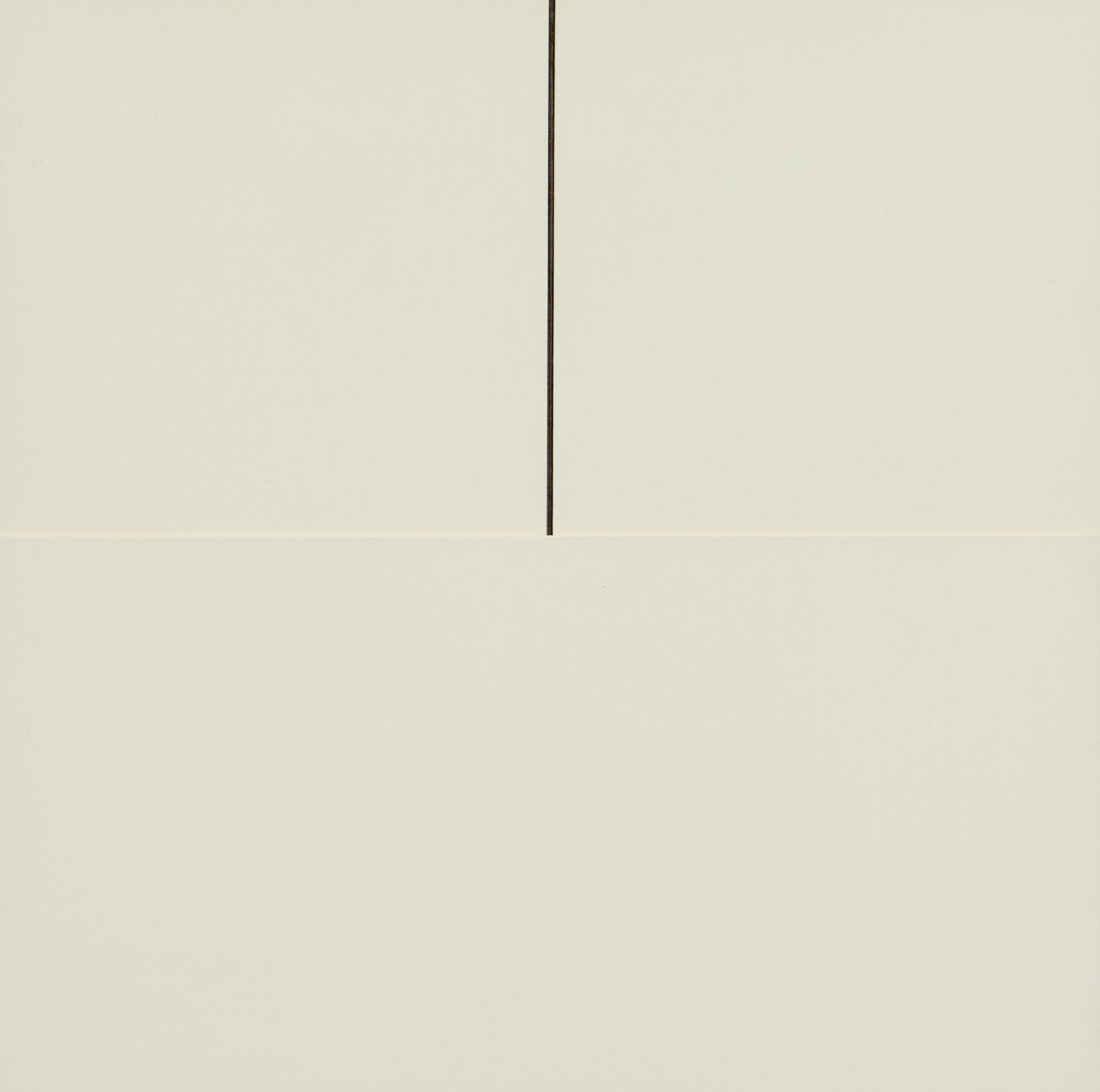
Nero ortogonale presents two elemental marks on an off-white ground: a vertical line descending from the upper edge to the approximate center of the composition, and a horizontal line extending across the full width of the picture plane at precisely the point where the vertical terminates. The vertical does not cross the horizontal. It arrives, stops, and surrenders its energy to a boundary it cannot breach. The result is a composition of extraordinary economy, in which the entire visual and conceptual weight of the work is carried by a single right angle that never fully forms, a meeting that is also a refusal. Sandro de Alexandris, working in Turin during the late 1960s, was deeply embedded in the Conceptual and Analytical art tendencies emerging from that city, a milieu that included Arte Povera but also extended into more rigorously geometric and process-oriented practices. This work belongs to the latter current. The choice of Schoeller engraved cardboard applied to board is not incidental. The lines are not drawn or painted but physically incised, meaning the marks exist as material events in the surface rather than as deposits of pigment. The subtle relief this produces rewards close looking, giving the lines a presence that photographic reproduction tends to flatten. The support itself becomes part of the argument. The year 1969 places Nero ortogonale at a moment of intense critical pressure on painting and on the conventions governing how marks communicate. De Alexandris strips the pictorial field to its most reduced grammar, a field, a line, an interruption, and asks what relational meaning can survive such reduction. The work refuses the expressive gesture entirely, yet it is not cold. There is a latent tension in the asymmetry between the active vertical and the passive horizontal, between descent and arrest. Collectors drawn to the rigorous Italian Conceptual tradition, particularly to artists working in proximity to figures such as Castellani, Bonalumi, and the Zero group, will find in this small, precise object a work that repays sustained attention. Its modesty of scale and means is inseparable from the seriousness of its inquiry.

Medium
Schoeller engraved cardboard applied on board

🔨 Auction Lot

Martini Studio d'Arte: Modern And Contemporary Art

June 10, 2026

Estimate: €500 to €1,000

Lot 196

Start the Discussion

Request access to join the discussion

More by Sandro de Alexandris

About this work

Sandro de Alexandris, Nero ortogonale, 1969

Nero ortogonale presents two elemental marks on an off-white ground: a vertical line descending from the upper edge to the approximate center of the composition, and a horizontal line extending across the full width of the picture plane at precisely the point where the vertical terminates. The vertical does not cross the horizontal. It arrives, stops, and surrenders its energy to a boundary it cannot breach. The result is a composition of extraordinary economy, in which the entire visual and conceptual weight of the work is carried by a single right angle that never fully forms, a meeting that is also a refusal. Sandro de Alexandris, working in Turin during the late 1960s, was deeply embedded in the Conceptual and Analytical art tendencies emerging from that city, a milieu that included Arte Povera but also extended into more rigorously geometric and process-oriented practices. This work belongs to the latter current. The choice of Schoeller engraved cardboard applied to board is not incidental. The lines are not drawn or painted but physically incised, meaning the marks exist as material events in the surface rather than as deposits of pigment. The subtle relief this produces rewards close looking, giving the lines a presence that photographic reproduction tends to flatten. The support itself becomes part of the argument. The year 1969 places Nero ortogonale at a moment of intense critical pressure on painting and on the conventions governing how marks communicate. De Alexandris strips the pictorial field to its most reduced grammar, a field, a line, an interruption, and asks what relational meaning can survive such reduction. The work refuses the expressive gesture entirely, yet it is not cold. There is a latent tension in the asymmetry between the active vertical and the passive horizontal, between descent and arrest. Collectors drawn to the rigorous Italian Conceptual tradition, particularly to artists working in proximity to figures such as Castellani, Bonalumi, and the Zero group, will find in this small, precise object a work that repays sustained attention. Its modesty of scale and means is inseparable from the seriousness of its inquiry.

Medium
Schoeller engraved cardboard applied on board
Year
1969
Seen at
Martini Studio d'Arte

Related themes

Small Scale, Late Modernist, Engraved Surface, Reductive Composition, Minimalist, Male Artist, Mixed Media, Conceptual Art, European Art, Form and Space, Italian Artist, Structural Tension, Black And White, Geometric Abstraction, Negative Space, Process Art, Line Work, Analytical Art, Works on Board, Arte Povera, Neutral Tones, Abstract

More works by Sandro de Alexandris