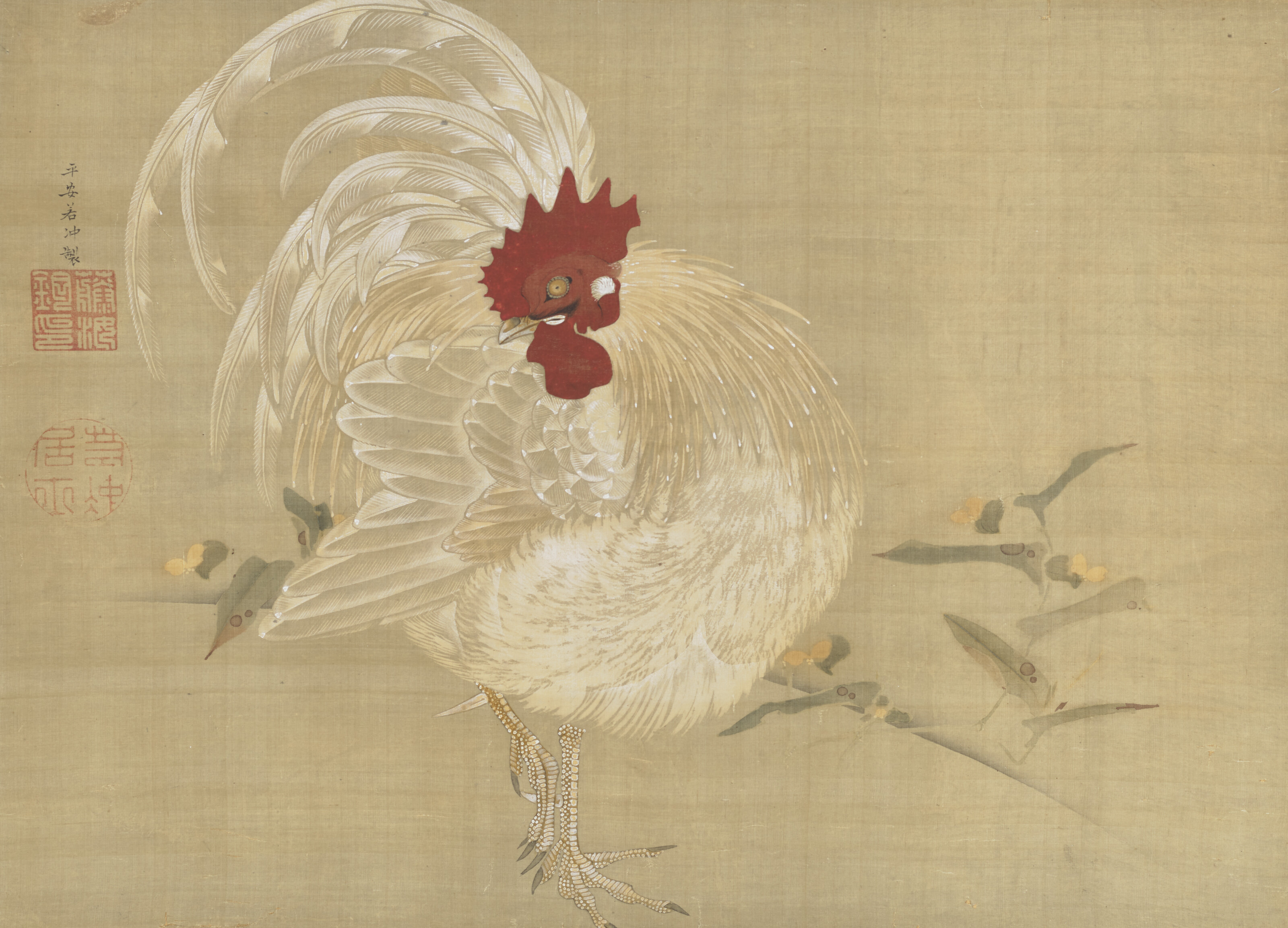
Rooster and Branch
"Rooster and Branch" by Ito Jakuchu exemplifies the Edo period Japanese artist's distinctive approach to natural subjects through bold compositional choices and meticulous detail. The painting showcases Jakuchu's characteristic use of vivid mineral pigments and decorative patterning, transforming the humble rooster into a subject of monumental presence and visual complexity. This work reflects Jakuchu's ability to balance ornamental beauty with observational accuracy, establishing him as one of Japan's most innovative painters of the 18th century.
- Signed
- Yes
- Spotted At
- Auction House · Christie's
Notes
LOT ESSAY Jakuchu grew up in a prosperous merchant household in Kyoto’s Nishiki-koji district, at the center of a bustling fish and vegetable market. A devout Buddhist with no interest in commerce or the pleasure quarters, he took up painting full time in his mid-thirties and was obsessively absorbed in his work for over half a century. As for his subject matter, it seems that he raised chickens at home. They play a significant role in his oeuvre. His white rooster is considered an early work, because the artist was not yet painting on the reverse of the silk (ura-saishiki), a technique he introduced later to create more vibrant colors. Some of the white pigment (gofun) has either fallen off or been removed during cleaning. This painting is said to have belonged to the well-known American scholar Richard Lane (1926-2002), who lived in Kyoto and whose collection of Japanese art is now in the Honolulu Museum of Art. (For a brief biography of Lane, see Impressions, the journal of the Japanese Art Society of America, no. 26 (2004) www.japaneseartsoc.org.
🔨 Auction Lot
Japanese and Korean Art
March 24, 2026
Estimate: $20,000 – $30,000
Lot 32
Start the Discussion
Request access to join the discussion