Join The Collection to save, track, and explore works like this.

Art Institute of Chicago

Spotted

Frank Lloyd Wright — Spindle Cube Chair
Frank Lloyd Wright

Spindle Cube Chair

1902

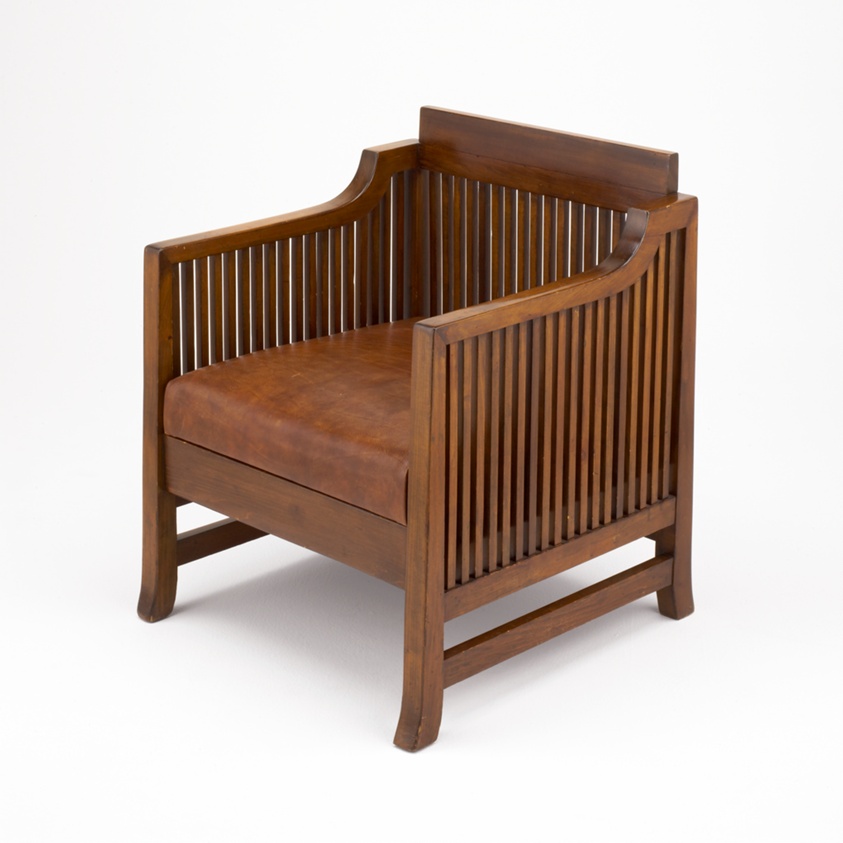
This elegant spindle cube chair is an early example from Frank Lloyd Wright’s home and studio. In 1889 Wright built a house for his young family on Forest Avenue in Oak Park, a new suburb just west of Chicago; ten years later, he opened an attached studio and designed it and the home’s interior in accordance with his philosophy of simplicity and integrity of materials. Among his furniture experiments were heavy, solid cube chairs. By the first decade of the twentieth century, Wright had refined his early design into that of this chair, adding spindles, a subtly tapering crest rail, and gently curving leg ends to produce an effect that is equal parts sophistication and simplicity. The spindles themselves were a legacy of William Morris–inspired ladder-back dining chairs, as well as the Arts and Crafts approach of contrasting positive and negative space. This chair was also influenced by the reticulated ceilings and walls of Japanese homes.

Medium
Poplar and leather
Dimensions

Start the Discussion

Request access to join the discussion

Spotted works by Frank Lloyd Wright

About this work

Frank Lloyd Wright, Spindle Cube Chair, 1902

This elegant spindle cube chair is an early example from Frank Lloyd Wright’s home and studio. In 1889 Wright built a house for his young family on Forest Avenue in Oak Park, a new suburb just west of Chicago; ten years later, he opened an attached studio and designed it and the home’s interior in accordance with his philosophy of simplicity and integrity of materials. Among his furniture experiments were heavy, solid cube chairs. By the first decade of the twentieth century, Wright had refined his early design into that of this chair, adding spindles, a subtly tapering crest rail, and gently curving leg ends to produce an effect that is equal parts sophistication and simplicity. The spindles themselves were a legacy of William Morris–inspired ladder-back dining chairs, as well as the Arts and Crafts approach of contrasting positive and negative space. This chair was also influenced by the reticulated ceilings and walls of Japanese homes.

Medium
Poplar and leather
Dimensions
73.7 x 73.7 cm
Year
1902
Seen at
Art Institute of Chicago, Chicago, IL

Related themes

Geometric, Functional Art, Wood, Minimalist, American, Sculptural, Early Modern, Furniture Design, Modern, Architecture

More works by Frank Lloyd Wright

Collected by

Art Institute of Chicago