Matta's Cosmic Vision Burns Ever Brighter
Artist Spotlight · The Collection Editorial
“I try to paint the sensation of thinking, the feeling of being alive in a universe that is not at rest.”
Matta, interview circa 1960s
In 2022, the Centre Pompidou in Paris reaffirmed what devoted collectors and art historians have long understood: Roberto Matta is one of the twentieth century's most electrifying and irreplaceable visionaries. The museum's holdings of his work, alongside landmark retrospectives at institutions including the Museum of Modern Art in New York and the Museo Nacional Centro de Arte Reina Sofía in Madrid, have cemented his standing not as a footnote between movements but as a singular force who shaped the very course of postwar painting. Today, with renewed scholarly attention and a global collector base spanning Santiago to Seoul, the moment to encounter Matta's work feels more urgent and alive than ever. Roberto Sebastián Matta Echaurren was born in Santiago, Chile, in 1911 into an educated, cosmopolitan family of Basque and Spanish heritage.
Matta
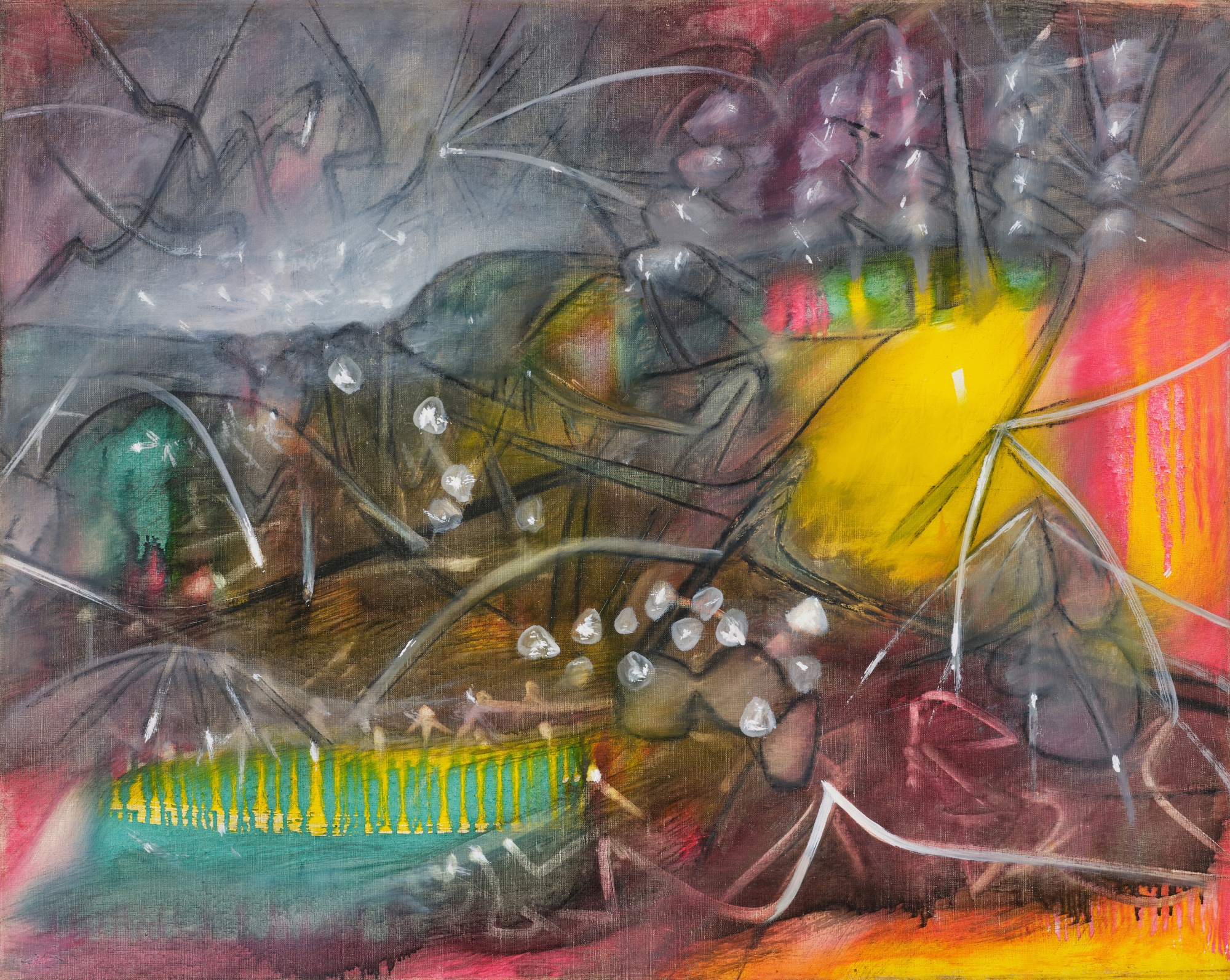
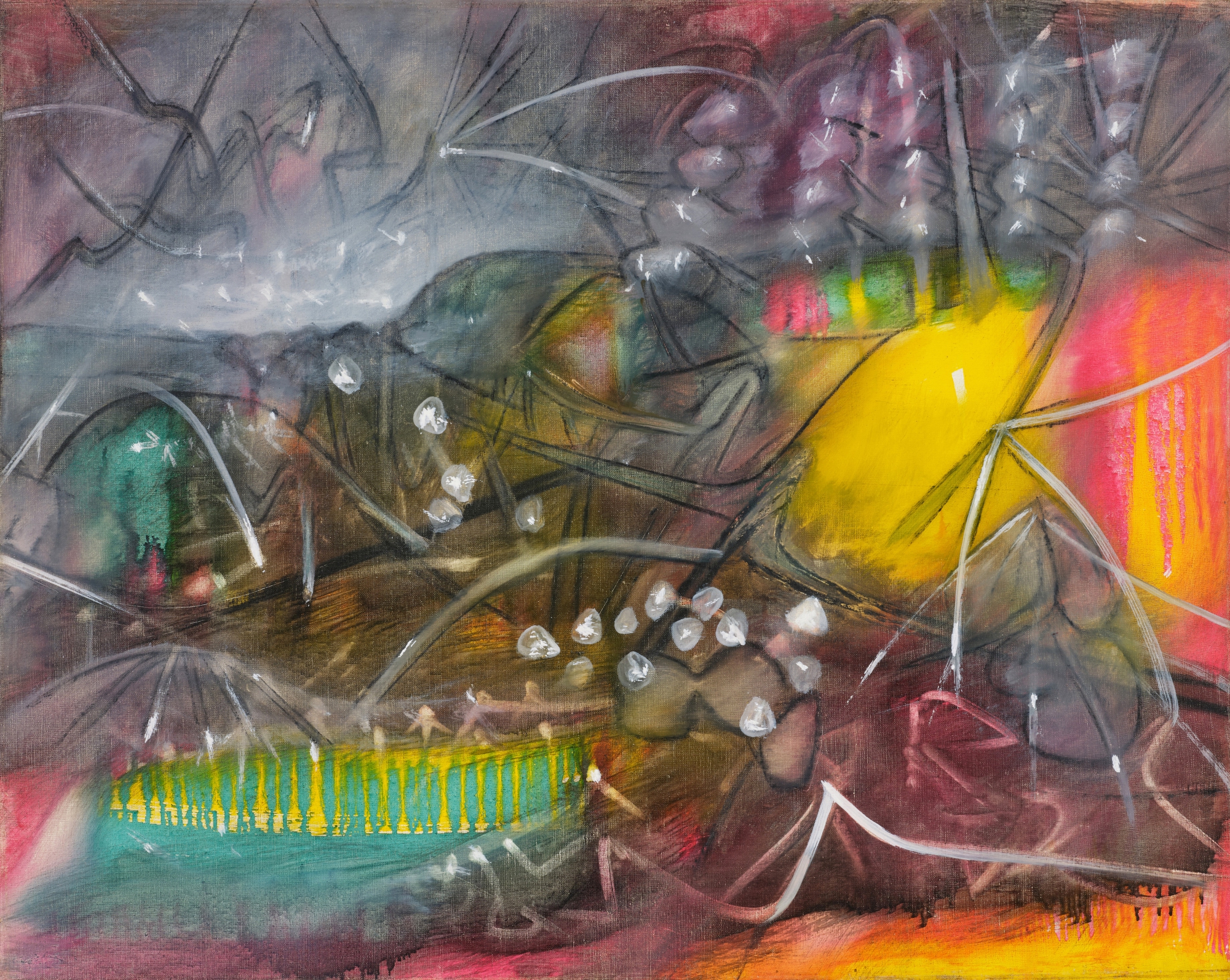
Eclosion, 1952
He trained as an architect at the Pontificia Universidad Católica de Chile before moving to Europe in the mid 1930s, a journey that would prove decisive. In Paris he worked briefly in the studio of the legendary modernist architect Le Corbusier, absorbing lessons in spatial logic and structural imagination that would later manifest in the vast, vertiginous architectures of his painted universes. It was in Paris, too, that Matta encountered Salvador Dalí, who introduced him to André Breton and the inner circle of Surrealism. Breton welcomed him immediately, recognising in the young Chilean an intuitive grasp of the unconscious and an almost reckless courage to follow imagery wherever it led.
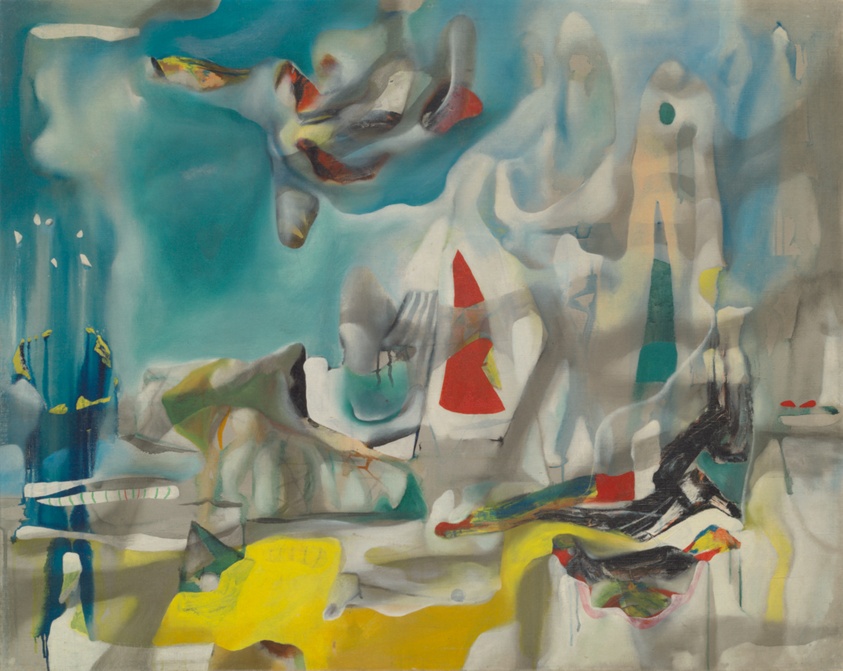
Matta formally joined the Surrealist group in 1937 and within a year had developed a body of work that astonished even his peers. His earliest paintings, which he called inscapes, were fluid, luminous environments that seemed to depict neither landscape nor abstraction but something in between: the psychological geography of the mind itself. Thin washes of oil, applied with rags and unconventional tools, created glowing atmospheric depths from which biomorphic forms and crackling linear energies emerged. When Matta arrived in New York in 1939, fleeing the war in Europe alongside many other Surrealist exiles, he brought these techniques with him and shared them with extraordinary generosity.
Matta
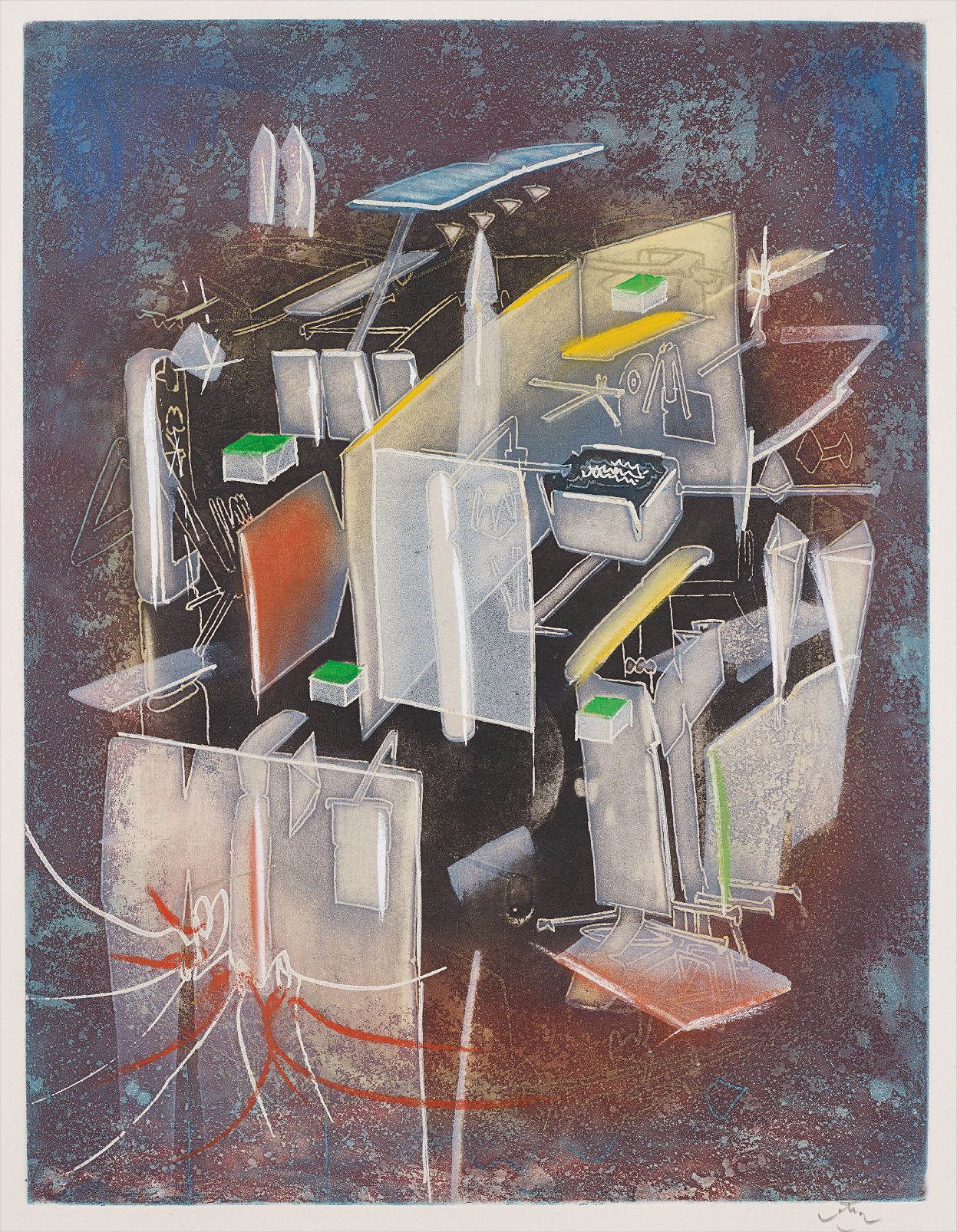
Etre hommande, plate VIII, from Hom'mere III, L'Ergonaute
Young American painters gathered around him. Arshile Gorky absorbed his use of automatism and fluid pigment. Willem de Kooning engaged with his electric linearity. Jackson Pollock was among those who found in Matta's example permission to loosen the grip of figuration.
“An inscape is a space where the outer and inner worlds meet, where the unconscious becomes landscape.”
Matta, statement on his work
The debt that Abstract Expressionism owes to Matta is substantial and well documented by critics including Clement Greenberg and art historian Martica Sawin. Through the 1940s and into the 1950s, Matta's ambition expanded dramatically in scale and philosophical scope. He began to incorporate mechanical and cosmic imagery alongside his biomorphic vocabulary, creating paintings that read as operational diagrams of forces beyond human comprehension. Works from this period feel at once ancient and futuristic, as though mapping the psychological aftermath of the atomic age.
Matta
Psychological Morphology, 1938
His 1952 painting The Rosenberg Trial, a searing response to the execution of Julius and Ethel Rosenberg, demonstrated that his art was never divorced from political conscience. The same year produced Eclosion, a composition of breathtaking luminosity in which forms seem to hatch, burst, and bloom in a space that suggests both cellular biology and cosmic explosion. On the Edge of a Dream, painted in 1956, extends this vocabulary into something more tender and introspective, the canvas suffused with a blue interior light that feels genuinely dreamlike in the most rigorous Surrealist sense. L'Interrompu from 1958 captures the interrupted tension that gives so much of his mature work its restless, unresolved energy, figures and forces caught in perpetual becoming.
For collectors, Matta's works on paper represent one of the most compelling entry points into his universe. Drawings such as To Picture Orbits for the Most Complex Conflicts from 1949 and Morphologie des significations from 1950, executed in colored pencil and graphite, reveal the intricate logic beneath the apparent chaos of his painted surfaces. These works reward close looking with an extraordinary density of marks and spatial invention. His printmaking practice, represented by works such as the hand colored etching and aquatint from the Hom'mere III series, brings the same cosmological drama into intimate formats that feel no less ambitious for their scale.
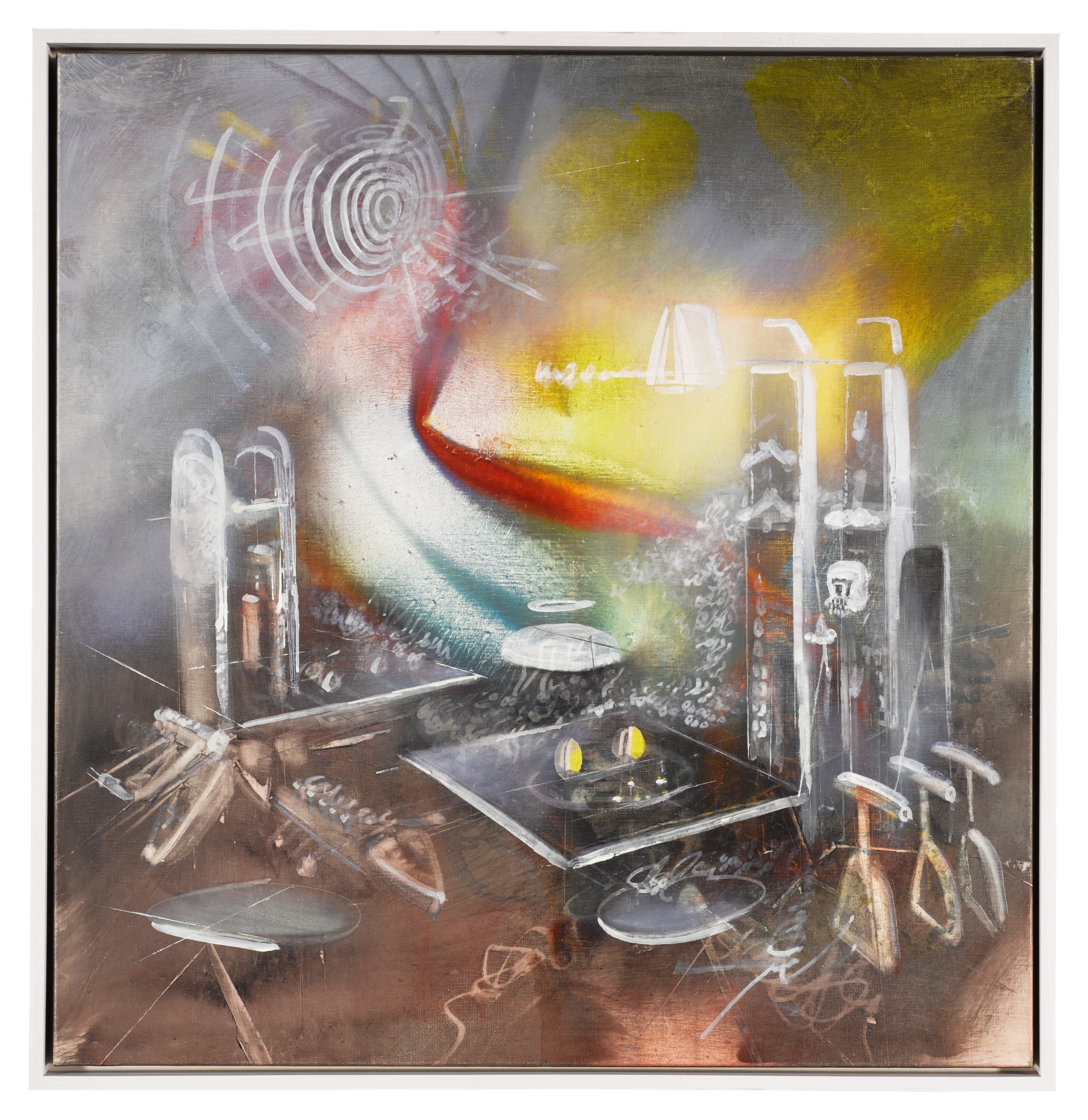
Matta
Écrire son cri, 1975
Later works such as Creative Net work from 1984 and L'orient from 1972 show an artist who never settled into formula, continuing to push his imagery toward new political and metaphysical territories through a career that spanned seven extraordinary decades. At auction, Matta's market has shown consistent strength and growing international depth. Major works have achieved significant results at Christie's, Sotheby's, and Phillips, with large scale oils from his peak period of the late 1940s through the 1960s commanding the highest premiums. Collectors are drawn not only to the visual power of the work but to its art historical centrality: to own a significant Matta is to hold a key document in the story of how European Surrealism transformed into American abstraction and then radiated back outward to influence Latin American modernism, Arte Povera, and beyond.
Works on paper and pastels offer a more accessible threshold without any sacrifice of quality or significance, and the prints, particularly those with extensive hand coloring, occupy a special place for collectors who prize the intimate intersection of concept and craft. Matta's position within art history is unique precisely because he belongs fully to no single national or movement based category. He is claimed by Surrealism, by the New York School, by Latin American modernism, and by European postwar painting all at once. Artists as different as Roberto Echaurren Matta's own sons Gordon and Ramuntcho Matta, as well as figures like Wifredo Lam, Yves Tanguy, and the mature Philip Guston, share resonances with his practice that speak to how broadly his influence radiated.
The biomorphic figuration that energises so much contemporary painting owes a quiet but real debt to the freedoms Matta established. Matta died in Civitavecchia, Italy, in 2002, at the age of ninety one, having produced a body of work of staggering breadth and consistency. He never stopped asking the hardest questions: about consciousness, about violence, about the inner life of matter and the political life of the imagination. That combination of fearlessness and formal intelligence is precisely what makes his work feel not historical but immediate.
To spend time with a Matta painting is to enter a space where the boundaries between the psychological and the cosmic, between the personal and the political, dissolve into pure pictorial energy. For collectors who seek work that rewards not just admiration but genuine intellectual adventure, there are few artists who give more.
Featured Works
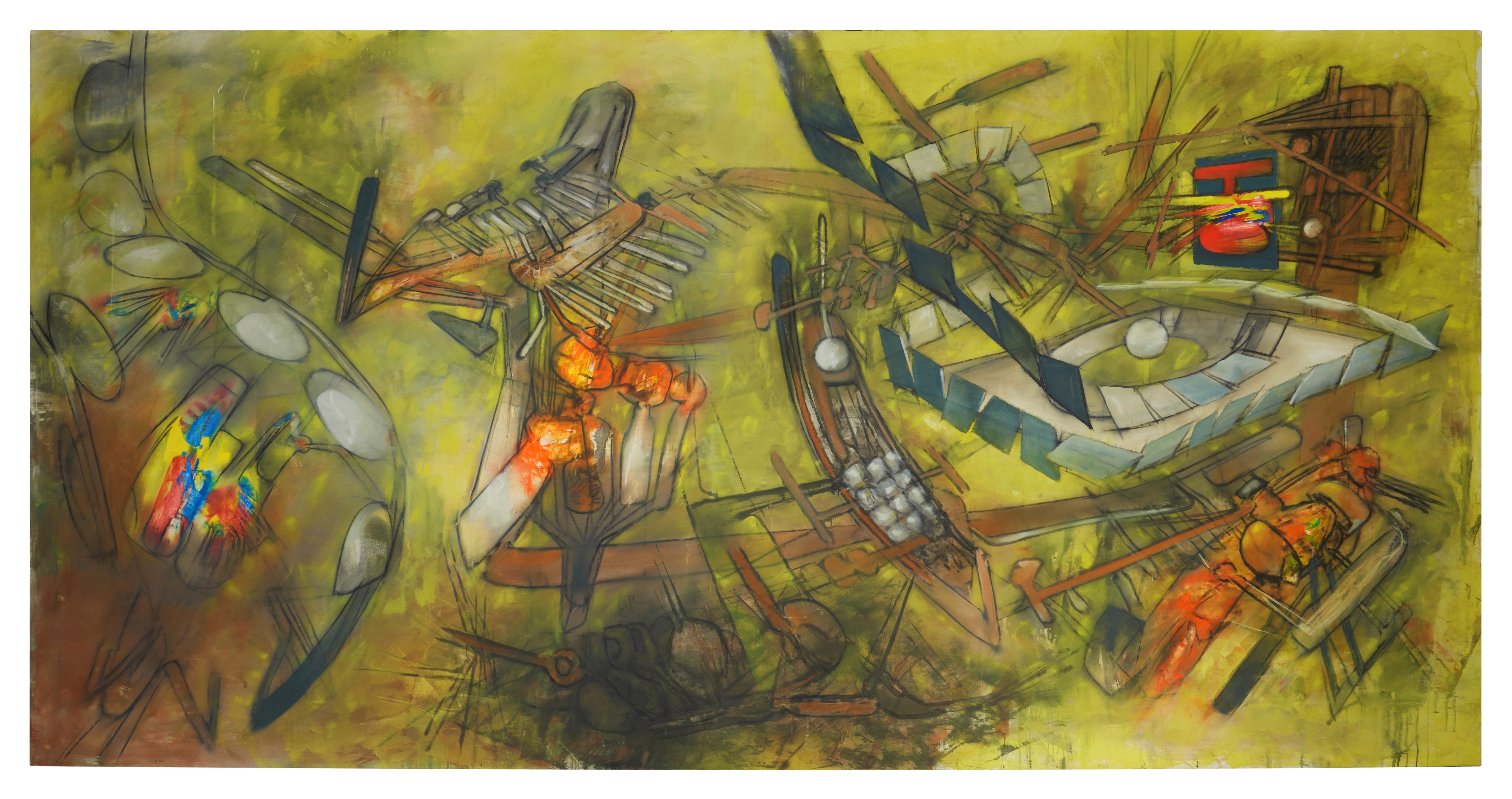
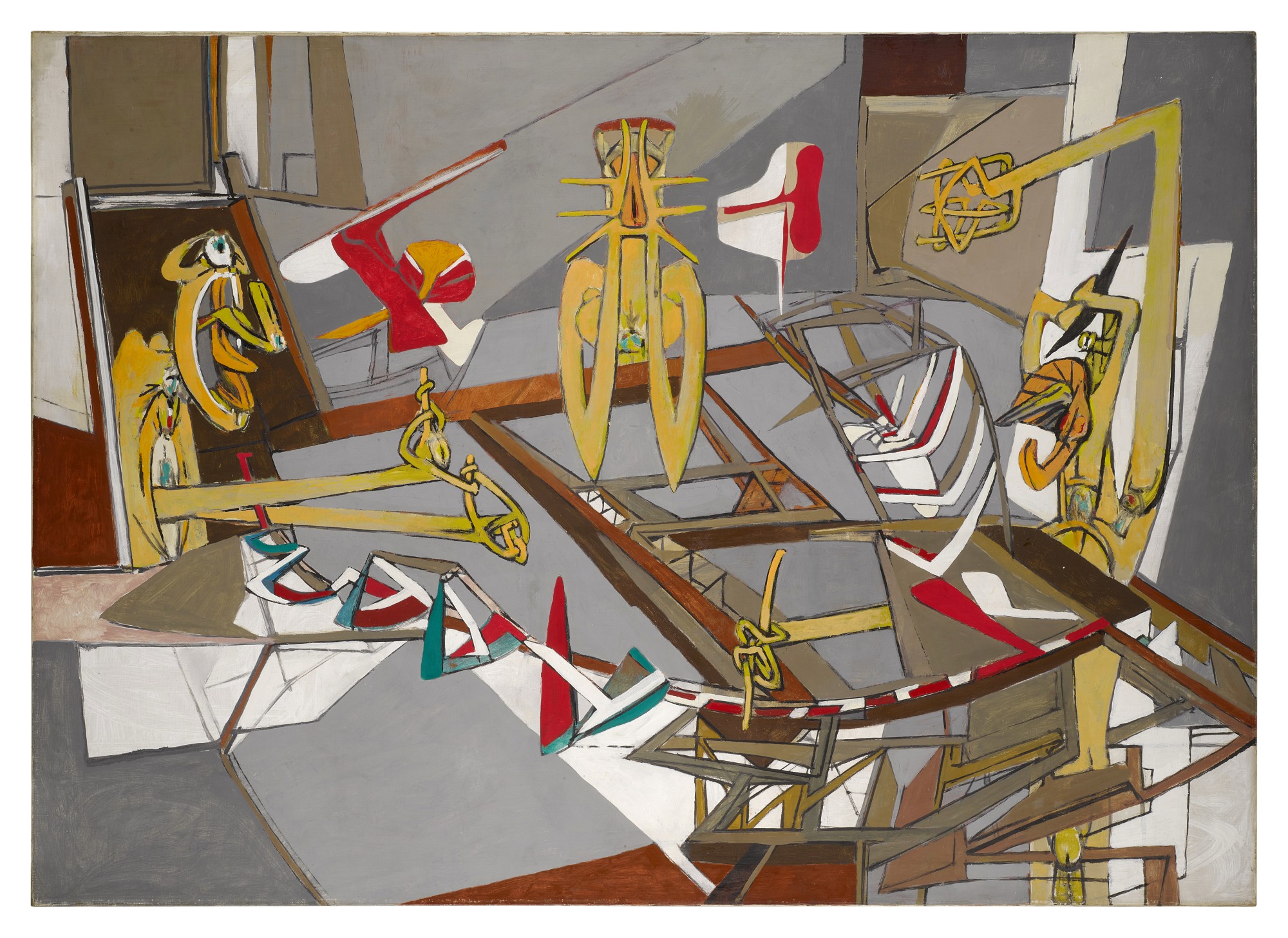
Explore books about Matta
Matta: A Retrospective
Museum of Modern Art
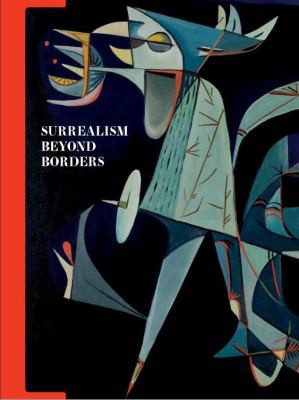
Matta 1911-2002
Fundació Joan Miró
Matta: Catalogue Raisonné
Germano Celant and others
Matta: The Eye and the Storm
Valerie Preston-Dunlop
Matta: Paintings, Drawings, Prints
Pierre Matisse Gallery
Roberto Matta: The Architect's Dream
Mercedes Gómez García