Henri Manguin
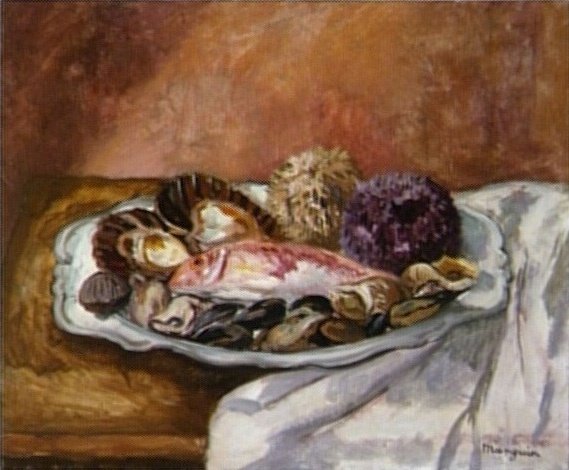
Henri Manguin, Painter of Radiant Joy
Artist Spotlight · The Collection Editorial
There is a particular quality of Mediterranean light that resists description, a warmth that seems to emanate not just from the sun but from the very pigment on the canvas. No artist of the early twentieth century captured that feeling more consistently, more honestly, or with more unabashed pleasure than Henri Manguin. As renewed scholarly and market attention turns toward the inner circle of Fauvism, collectors and curators alike are rediscovering that Manguin was never a peripheral figure but rather one of the movement's most devoted and gifted practitioners, a painter whose work rewards sustained looking and whose reputation is, at long last, being restored to its rightful place. Henri Charles Manguin was born in Paris in 1874, into a comfortable bourgeois family that allowed him to pursue his passion for painting from an early age.
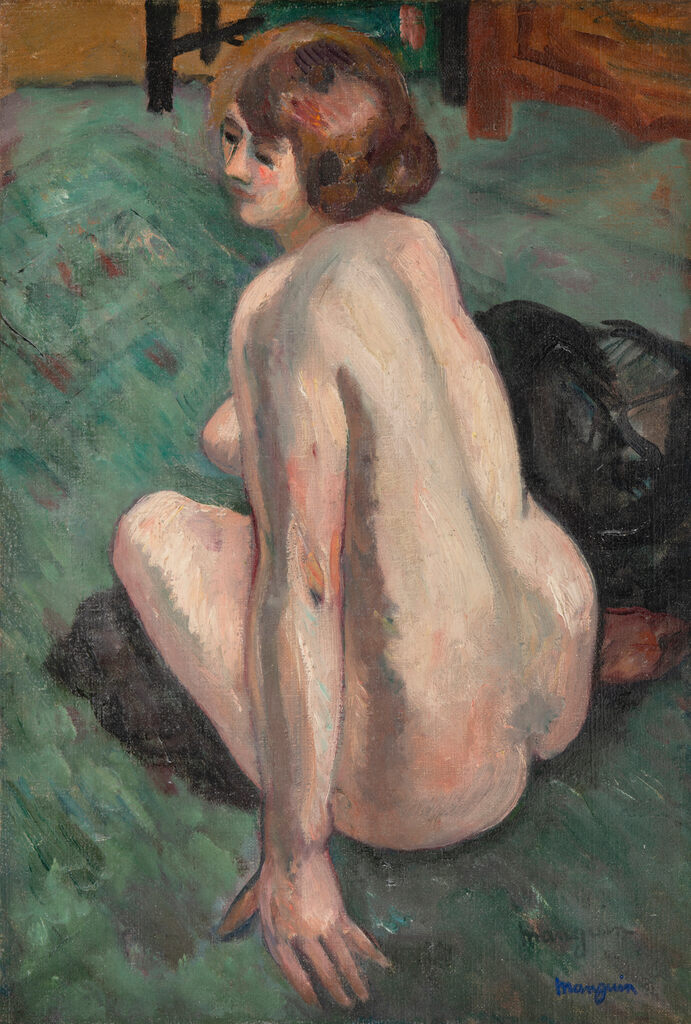
Henri Manguin
Grenouillette, nu de dos, 1922
He entered the École des Beaux Arts in 1894 and found his way into the studio of Gustave Moreau, one of the most consequential teaching ateliers in the history of French art. There he joined a generation of extraordinary talents including Henri Matisse, Albert Marquet, and Charles Camoin. Moreau was an unusual teacher, far less interested in enforcing academic convention than in encouraging his students to look closely at the great colorists, Delacroix above all, and to trust their own instincts. For Manguin, this was a formative liberation.
He absorbed the lesson deeply and spent the rest of his career enacting it. By the early 1900s Manguin was a central presence in the Parisian avant garde. He exhibited at the legendary Salon d'Automne of 1905, the exhibition where the critic Louis Vauxcelles famously dubbed the group of color saturated painters "les fauves," the wild beasts. Manguin showed alongside Matisse, Derain, and Vlaminck, and his canvases held their own in that electric company.
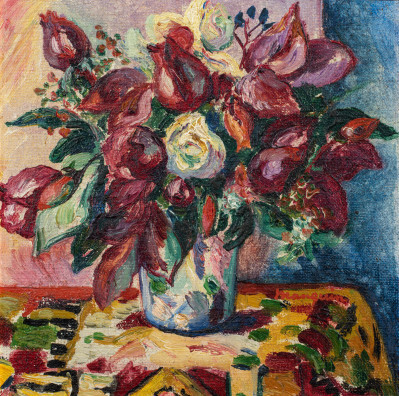
Henri Manguin
Roses, 1916
He had also by this time developed a close friendship with the dealer Ambroise Vollard, one of the most perceptive commercial eyes of the era. Vollard purchased works from Manguin and helped secure his place in the collecting networks that sustained serious modern painters in Paris. That Vollard believed in him is not a minor credential; it places Manguin unambiguously within the first rank of his generation. Manguin's artistic development followed a clear and deeply personal logic.
After the concentrated intensity of his Fauvist years, he did not abandon color but instead refined it, learning to balance his instinct for chromatic boldness with a growing compositional serenity. He discovered the South of France early and returned to it repeatedly, settling eventually in Saint Tropez, where he and his wife Jeanne made their home at a property called the Oustalet. The Oustalet became both a domestic sanctuary and a studio in the broadest sense: the garden, the terrace, the quality of afternoon light falling across fruit and flowers and the figures of those he loved all became subjects. His paintings from this period are not escapist in any shallow sense.
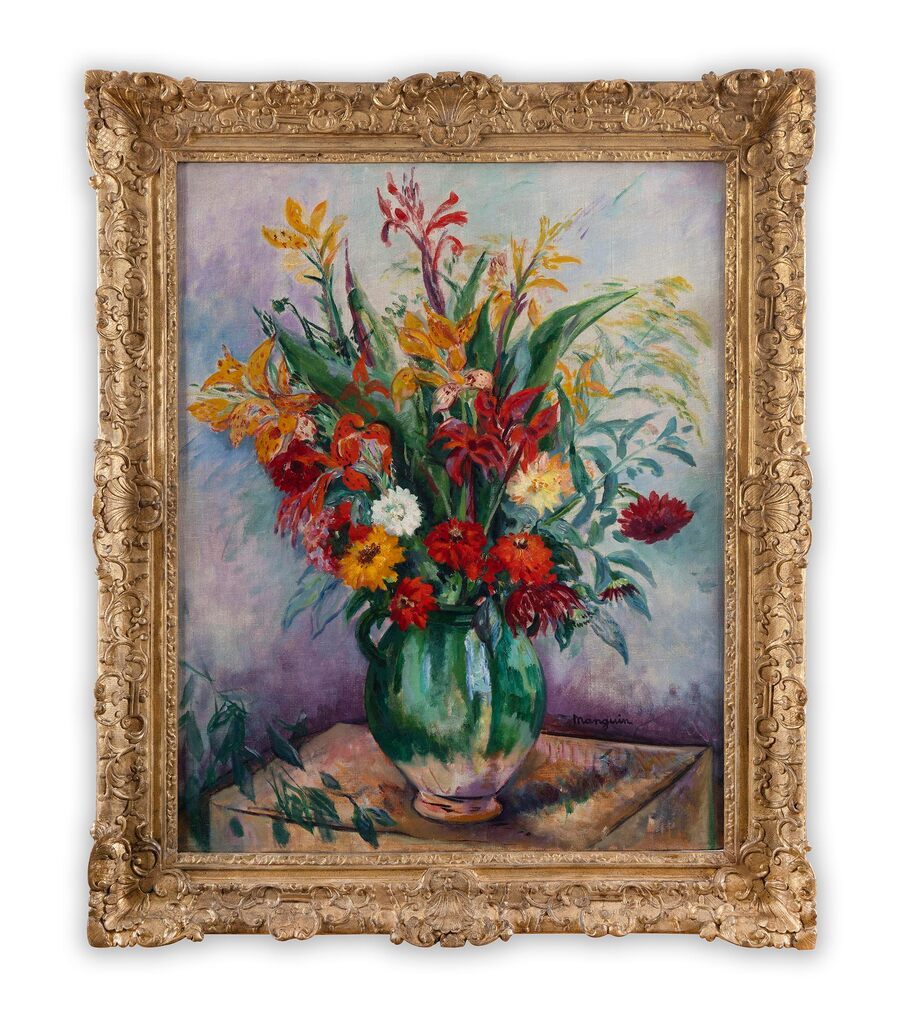
Henri Manguin
Vase vert et fleurs, 1928
They are records of a genuinely examined happiness, observed with precision and rendered with craft. Among the works available on The Collection, several offer a compelling entry point into Manguin's full range. "Poissons et coquillages" from 1925 demonstrates his mastery of the still life as a vehicle for pure painterly investigation, the silvery iridescence of fish and shell becoming an occasion for the kind of tonal sensitivity that separates a great colorist from a merely competent one. "Odette dans le jardin de l'Oustalet" from 1933 is a luminous example of his figure in landscape work, where the human presence and the surrounding garden exist in a state of genuine visual harmony rather than hierarchy.
"Le déjeuner" from 1928 captures the civilized pleasures of the table with an ease that owes something to Bonnard but remains entirely Manguin's own. The watercolor "Femme allongée sur un divan" from 1936 reveals that his facility extended beyond oil painting into a medium that rewards spontaneity and tonal subtlety in equal measure. Taken together, these works trace an artist fully in possession of his gifts and growing more assured with each decade. From a collecting perspective, Manguin occupies an enviable position.
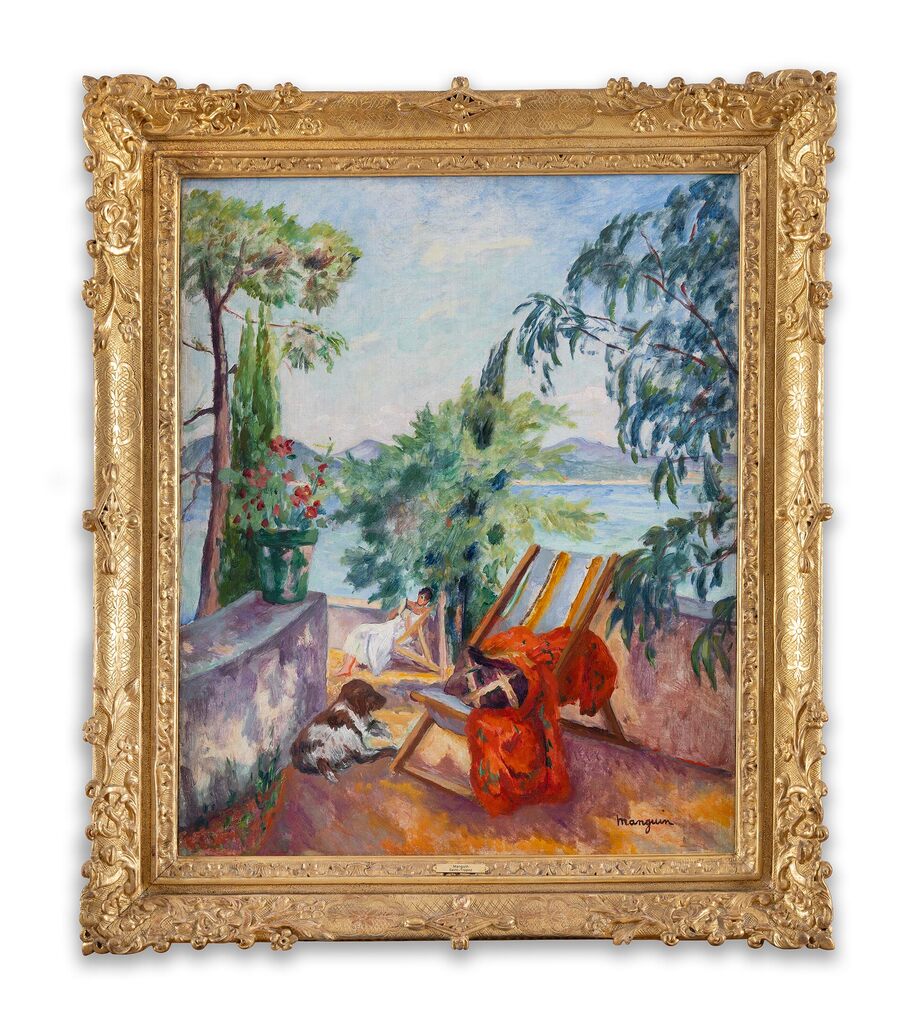
Henri Manguin
Odette et le chien "Barbu" à L'Oustalet, Saint-Tropez, 1934
He is historically significant, documented as a firsthand participant in one of the defining movements of Western modernism, and yet his market has not yet reached the heights commanded by Matisse or Derain, meaning that serious works remain acquirable at prices that will almost certainly appear modest in retrospect. His still lifes and interior scenes tend to be particularly sought after for their compositional clarity and their ability to inhabit a domestic space with genuine grace. Works on paper, including gouaches and watercolors, represent an especially interesting area for collectors who wish to study his process and his thinking at close range. Auction appearances in Paris and at the major international houses have demonstrated steady and growing interest, particularly for works from his mature Saint Tropez period, roughly the late 1920s through the late 1930s.
To understand Manguin fully it helps to place him in relation to his closest peers. Matisse is the inevitable reference, and the two men remained friends throughout their lives, corresponding warmly and visiting one another well into old age. But where Matisse pushed toward radical formal simplification, Manguin retained an attachment to observed reality, to the specific curve of a particular fruit, the precise weight of a reclining figure, that gives his work a different kind of intimacy. Albert Marquet, another Moreau alumnus and lifelong friend, shared Manguin's preference for direct observation, though Marquet inclined toward a cooler, more atmospheric palette.
Pierre Bonnard is perhaps the artist whose sensibility most closely rhymes with Manguin's own: both were painters of domestic joy, of color as emotional climate, of the ordinary moment made luminous by sustained attention. Manguin died in Saint Tropez in 1949, having spent more than half a century making paintings that affirmed the value of pleasure, beauty, and carefully observed life. His nickname, "the painter of happiness," might sound like faint praise in an art world that has long rewarded difficulty and irony, but it is in fact a precise description of a serious artistic ambition. Happiness, as Manguin understood it, was not passive or accidental.
It required looking, choosing, composing, and committing to the canvas with both skill and feeling. The paintings he left behind are the evidence of that commitment, and they are entirely worth your time.
Featured Works
Explore books about Henri Manguin
Henri Manguin
Lucile Manguin
Henri Manguin: Catalogue Raisonné de l'Œuvre Peint
Lucile Manguin, Claudine Grammont
Manguin: Un coloriste français entre Fauves et Méditerranée
Pierre Cabannes
Henri Manguin 1874-1949
Musée de Saint-Tropez