Join The Collection to save, track, and explore works like this.

Henri Manguin — Nature morte aux cyclamens
Henri Manguin

Nature morte aux cyclamens

1912

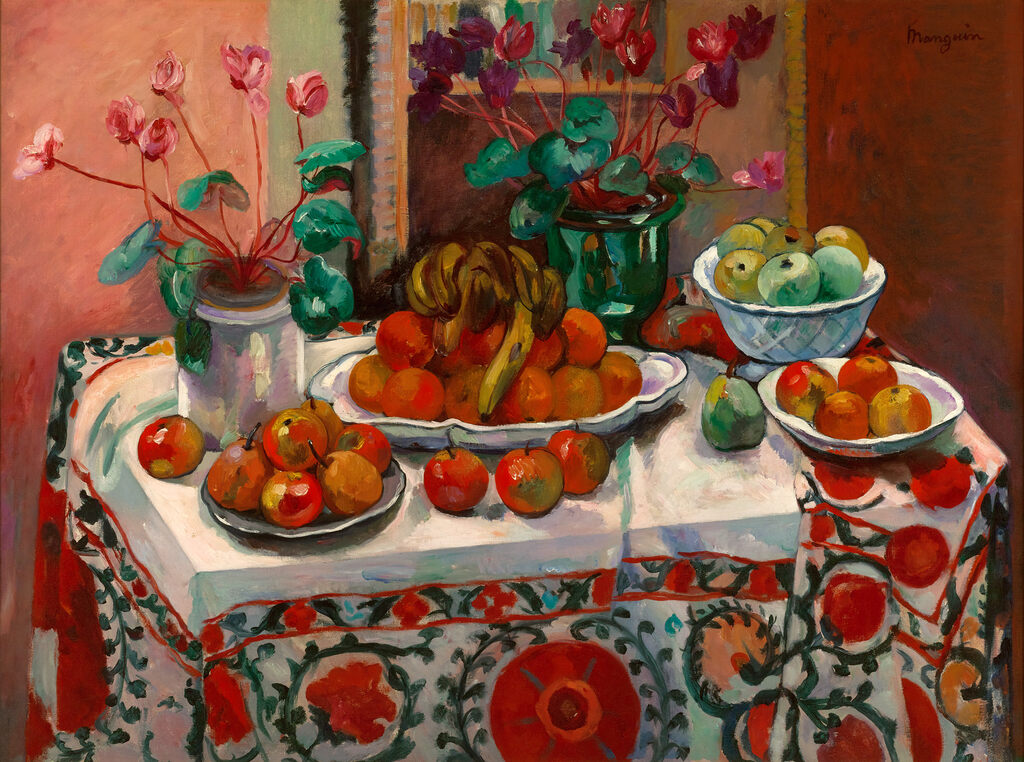
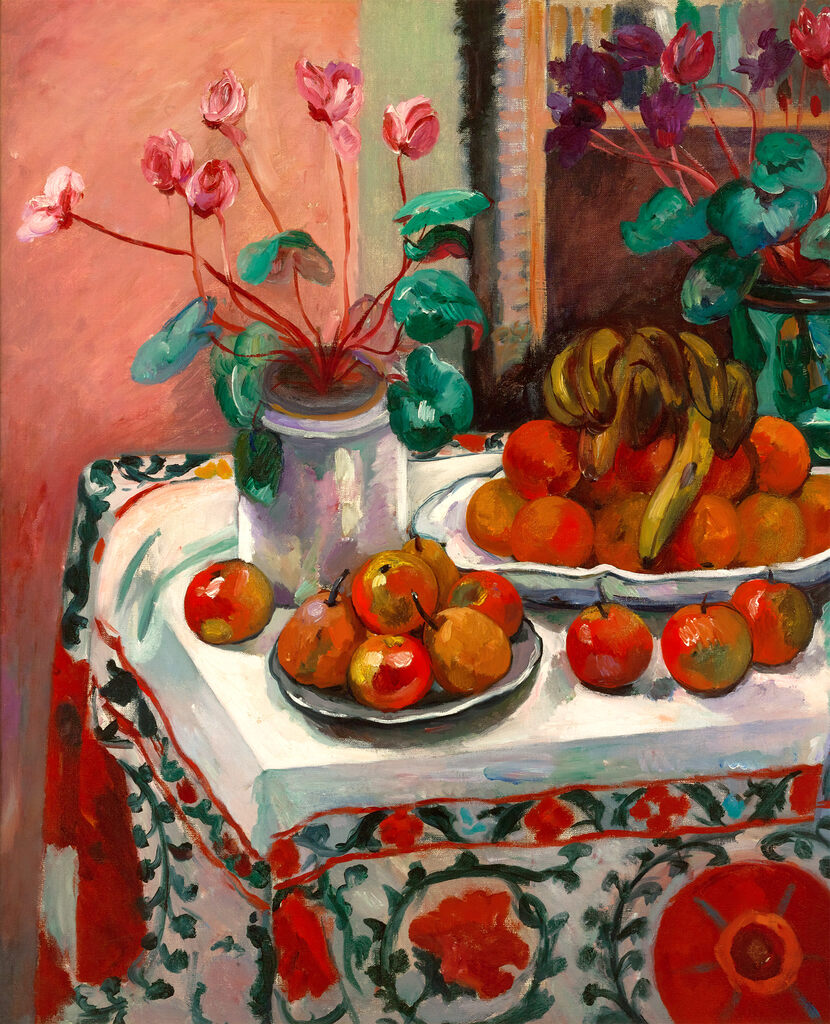
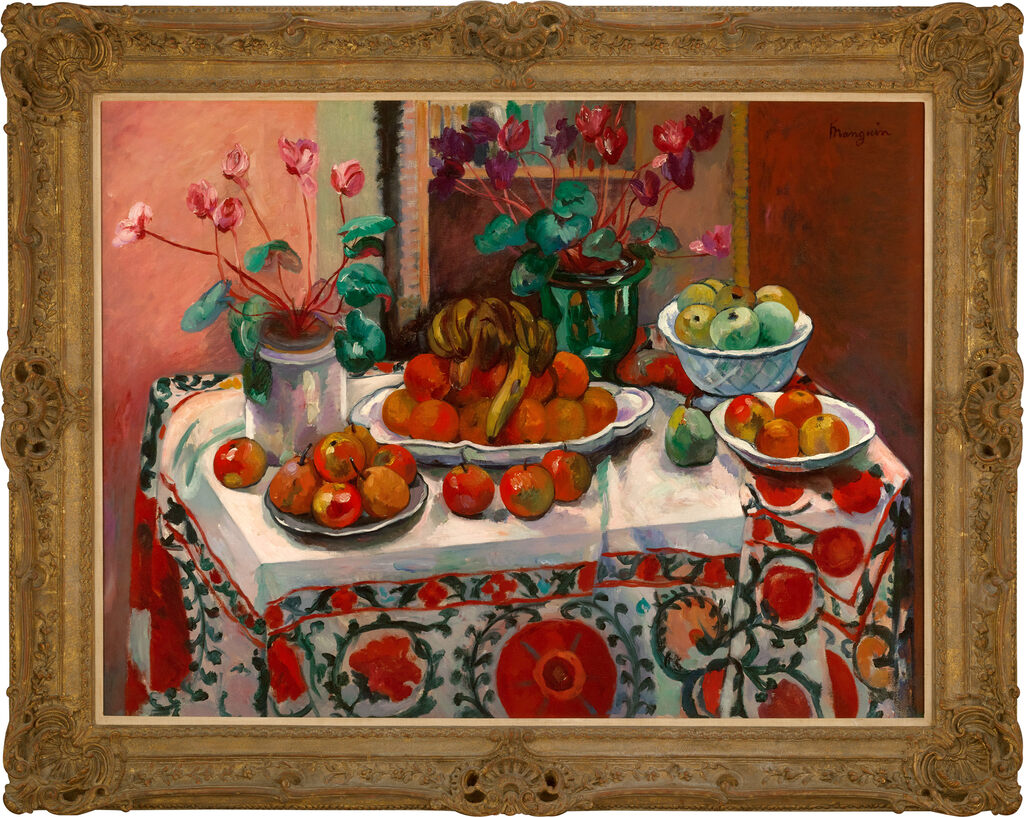
Nature morte aux cyclamens announces itself through sheer chromatic force, the canvas nearly vibrating with the collision of deep crimsons, warm ochres, and layered greens that spill across a patterned tablecloth laden with fruit and flowering cyclamen. Measuring an imposing 97.5 by 130.5 centimeters, the composition rewards close attention, revealing Henri Manguin's characteristic painterly fervor in every passage, from the loosely rendered petals to the boldly stated shadows pooling beneath bowls of gathered produce. Painted in 1912, the work arrives at a moment of confident maturity, after Manguin had already established himself as one of the defining voices of the Fauvist circle and earned the admiring nickname "the voluptuous painter" for his unrestrained command of color and sensory richness. The influence of Cézanne is felt in the structural density of the arrangement, while the luminous, unapologetic palette speaks to the spirit of Manguin's close friend and fellow Fauvist Henri Matisse. Manguin's place within the movement was hard-won and historically significant. His friendships with Matisse and Albert Marquet formed during studies at the École des Beaux-Arts in 1894, and his garden studio became a gathering point for the artists who would collectively reshape European painting. He exhibited alongside the Fauves at both the Salon des Indépendants and the landmark Salon d'Automne of 1905, the exhibition that cemented Fauvism as the most urgent avant-garde tendency of the early twentieth century. That same decade, the celebrated dealer Ambroise Vollard purchased over one hundred of Manguin's works, an endorsement that speaks to the esteem in which the artist was held by the most discerning eyes of the period. Still lifes of this scale and ambition are now genuinely rare on the market, and Manguin's presence in permanent collections including the Art Institute of Chicago, the Hermitage, and the Musée d'Orsay confirms the lasting institutional regard for his contribution to modern painting.

Medium
Oil on canvas
Overall
Framed
Signed
Yes
Location
M.S. Rau, New Orleans, LA

For Sale — $448500

Start the Discussion

Request access to join the discussion

Collectors with works by Henri Manguin

About this work

Henri Manguin, Nature morte aux cyclamens, 1912

Nature morte aux cyclamens announces itself through sheer chromatic force, the canvas nearly vibrating with the collision of deep crimsons, warm ochres, and layered greens that spill across a patterned tablecloth laden with fruit and flowering cyclamen. Measuring an imposing 97.5 by 130.5 centimeters, the composition rewards close attention, revealing Henri Manguin's characteristic painterly fervor in every passage, from the loosely rendered petals to the boldly stated shadows pooling beneath bowls of gathered produce. Painted in 1912, the work arrives at a moment of confident maturity, after Manguin had already established himself as one of the defining voices of the Fauvist circle and earned the admiring nickname "the voluptuous painter" for his unrestrained command of color and sensory richness. The influence of Cézanne is felt in the structural density of the arrangement, while the luminous, unapologetic palette speaks to the spirit of Manguin's close friend and fellow Fauvist Henri Matisse. Manguin's place within the movement was hard-won and historically significant. His friendships with Matisse and Albert Marquet formed during studies at the École des Beaux-Arts in 1894, and his garden studio became a gathering point for the artists who would collectively reshape European painting. He exhibited alongside the Fauves at both the Salon des Indépendants and the landmark Salon d'Automne of 1905, the exhibition that cemented Fauvism as the most urgent avant-garde tendency of the early twentieth century. That same decade, the celebrated dealer Ambroise Vollard purchased over one hundred of Manguin's works, an endorsement that speaks to the esteem in which the artist was held by the most discerning eyes of the period. Still lifes of this scale and ambition are now genuinely rare on the market, and Manguin's presence in permanent collections including the Art Institute of Chicago, the Hermitage, and the Musée d'Orsay confirms the lasting institutional regard for his contribution to modern painting.

Medium
Oil on canvas
Dimensions
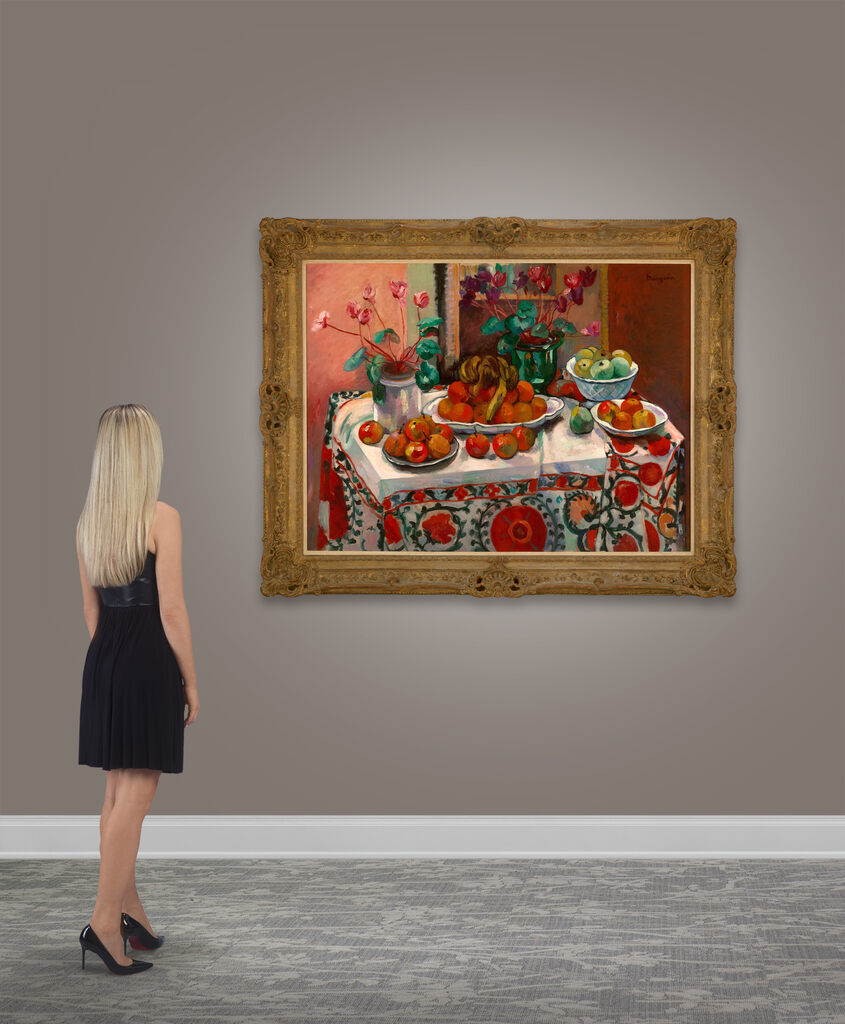
overall: 97.5 x 130.5 cm • framed: 127 x 157.5 x 9.5 cm
Year
1912
Signed
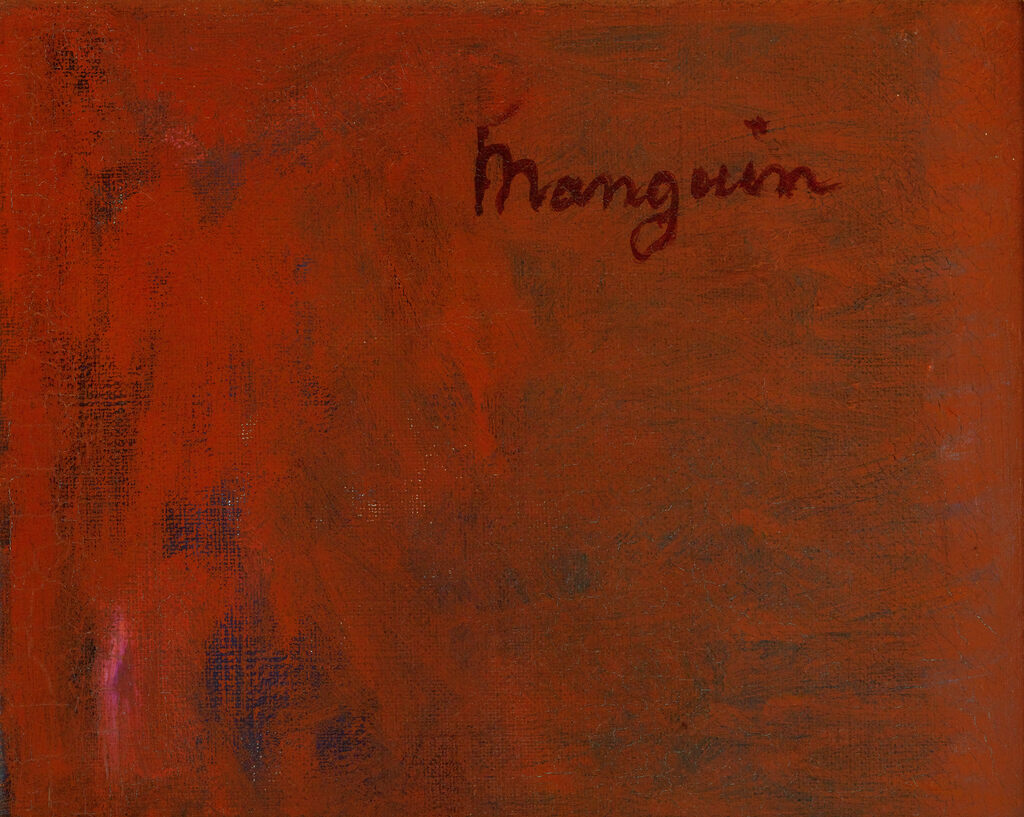
Hand-signed by the artist
Seen at
M.S. Rau, New Orleans, LA

More works by Henri Manguin

Collected by

Musée d'Art Moderne de Paris